The Creator of the Piano Revealed | Discover Who Invented the Piano
The piano is a key instrument in Western music. By the late 19th century, many homes in Europe and the U.S. had one. Owning a piano showed you were well-off, and learning to play could lead to careers.
Historians say the piano came from earlier keyboards. It became popular as its design improved. This piece will tell you who made the piano and its journey to becoming a staple in homes.
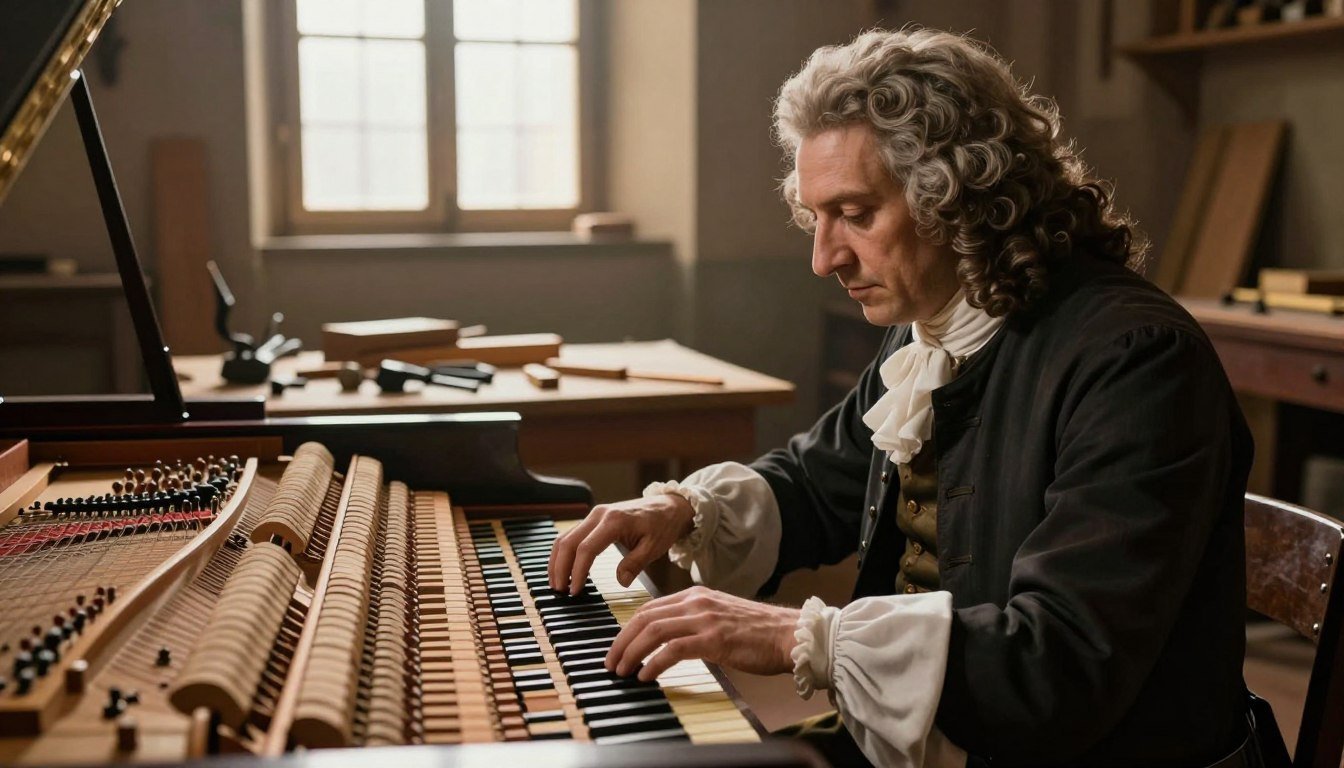
Bartolomeo Cristofori, born in 1655 in Padua, is known as the piano’s creator. He worked for Prince Ferdinando de’ Medici from 1688. Cristofori’s innovation was the hammer action and escapement, which let players control the sound’s volume.
There’s solid proof Cristofori made the piano. We have his instruments and a Medici inventory from around 1700. The next parts will explore Cristofori’s design, other claims, preserved pieces, and how the piano changed music and home life.
Who invented the piano
Bartolomeo Cristofori is the key figure in the piano’s creation. He started working on hammer-action mechanisms in 1698. His work introduced dynamic contrast, a big change from earlier plucked keyboards.
Why Cristofori is credited
Cristofori created a hammer action with a special escapement and a lever called the linguetta mobile. This design lets the hammer release before the string vibrates, allowing for clear sound. Early hammers were made of paper and leather, yet they offered soft-to-loud control. Cristofori’s innovations made him a major piano inventor of his time.
| Item Name | Description | Calories | Price |
|---|---|---|---|
| Cristofori 1720 | Early hammer-action piano showing escapement and una corda mechanism | 0 | $0 (museum piece) |
| Cristofori 1722 | Simpler action with refined hammers and clear dynamic range | 0 | $0 (museum piece) |
| Cristofori 1726 | Further material improvements and sturdier frame for tension | 0 | $0 (museum piece) |
| Silbermann copy | Early 18th-century builds influenced by Cristofori’s action | 0 | Varies |
| Clavichord (for contrast) | Touch-sensitive but low volume, not suited for large rooms | 0 | Varies |
| Harpsichord (for contrast) | Plucked action with steady volume, limited dynamics | 0 | Varies |
| Modern grand | Standardized action built on centuries of refinement | 0 | Starts around $5,000 |
| Upright (historical style) | Compact action adapted for domestic use | 0 | Starts around $1,000 |
| Replica Cristofori | Contemporary reconstructions for study and performance | 0 | Varies |
| Museum exhibit | Displays with documentation such as the 1700 Medici inventory | 0 | Admission fees apply |
Primary evidence
The 1700 Medici inventory is key proof that Cristofori invented the piano. It describes an instrument that can play soft and loud. Three Cristofori pianos from 1720, 1722, and 1726 are in major museums. These items, along with the inventory, prove Cristofori’s role in creating the piano.
Later, Gottfried Silbermann built on Cristofori’s work. Cristofori is widely credited, with others also trying similar ideas. The evidence shows Cristofori as the true creator of the piano.
Origins of the piano: pre-piano instruments and influences
The story of the piano starts with earlier keyboards. These instruments were key in solving the musical problem of combining control with volume. They used plucking, striking, and frame techniques over centuries.
The harpsichord makes sound by plucking strings. It was loud enough for courts and chamber music. But, touch couldn’t change volume, limiting dynamics.
Clavichord
The clavichord strikes strings with small metal tangents. It offers subtle dynamic shading and allows aftertouch. This made it very expressive under a skilled hand. But, its quiet tone made it stay mostly in homes.
Virginal and spinet
Compact forms like the virginal and spinet were for home use. Their small soundboards and cases limited resonance and dynamic range. The spinet’s diagonal string layout produced a thinner tone, good for small spaces but not for large halls.
Clavicytherium and early experiments
The clavicytherium, a vertical keyboard attached to a harp-like frame, appeared in the late medieval period. It showed how builders could rearrange string orientation and case design. Later, the introduction of tuning pins and stronger string-bearing frames in the 15th and 16th centuries helped pave the way for new actions and hammer-based mechanisms.
| Item Name | Description | Calories | Price |
|---|---|---|---|
| Harpsichord | Plucked-string keyboard; clear tone; limited dynamic control | 0 | $12,000–$50,000 |
| Clavichord | String struck by tangent; expressive touch; intimate volume | 0 | $2,000–$15,000 |
| Virginal | Small rectangular plucked instrument for homes; compact sound | 0 | $4,000–$20,000 |
| Spinet | Compact triangular or diagonal layout; thin tone due to size | 0 | $3,000–$18,000 |
| Clavicytherium | Vertical, harp-like frame with keyboard; early layout experiments | 0 | $10,000–$40,000 |
| Tuning pins & frames | Technological advances enabling higher string tension and stability | 0 | $500–$3,000 |
| Domestic keyboard | Smaller instruments designed for private use and practice | 0 | $1,000–$25,000 |
| Court instrument | Larger, resonant keyboards for ensembles and ceremonial use | 0 | $20,000–$60,000 |
| Experimental action | Early attempts combining striking and stopping mechanisms | 0 | $800–$6,000 |
| Soundboard variations | Different materials and sizes affecting tone and projection | 0 | $300–$8,000 |
These instruments and tools were the foundation of piano history. They showed the need for a solution to control loudness by touch while keeping enough volume. This challenge was central to the origins of the piano and why Cristofori’s inventions were so important.
Bartolomeo Cristofori: life, role with the Medici, and workshop innovations
Bartolomeo Cristofori was born in Padua in 1655. He trained as an instrument maker. His early years are not well-documented. But, his move to Florence changed keyboard instrument history.
Early training and craft
Cristofori learned woodworking, stringing, and tuning in northern Italy. This training helped him solve complex mechanical problems. His skills were a foundation for his innovative designs.
Medici appointment and resources
In 1688, Prince Ferdinando de’ Medici hired Cristofori. He became responsible for the court’s musical instruments. This job gave him a steady income, a workshop, materials, and apprentices.
Workshop role and titles
Cristofori later became curator of the Florentine Royal Collection of Musical Instruments. This position formalized his duties. It also protected his experiments.
Design experiments toward dynamic control
Early on, Cristofori created the spinettone and an oval spinet. These designs tested string length, tension, and soundboard response. He learned how touch affects volume and tone.
Move to hammer action
His findings led him to a non-plucking mechanism. By the late 1690s, he developed a hammer action. This innovation allowed for varied dynamics, answering who invented the piano.
| Item Name | Description | Calories | Price |
|---|---|---|---|
| Spinettone | Large spinet with reconfigured string layout to enrich bass and balance tone | 0 | $1,200 |
| Oval Spinet | Compact oval case that tested soundboard resonance and string placement | 0 | $950 |
| Early Cristofori Piano | Hammer-action keyboard allowing soft and loud touch variation | 0 | $7,500 |
| Clavichord | Expressive tangent action for intimate dynamic shading, low volume | 0 | $650 |
| Harpsichord | Plucked strings with bright timbre but limited dynamic control | 0 | $1,100 |
| String Set (Workshop) | Assorted gut and metal strings for experimentation with tension and tone | 0 | $120 |
| Soundboard Sample | Treated spruce pieces used to compare resonance and projection | 0 | $45 |
| Action Prototype Kit | Components for hammer and escapement trials | 0 | $220 |
| Apprentice Labor | Skilled workshop help for building and testing instruments | 0 | $60/month |
| Finish Materials | Varnishes and glues that affect tone and durability | 0 | $35 |
How Cristofori’s piano worked: hammer action, escapement, and mechanisms
Bartolomeo Cristofori created a breakthrough that turned stringed keyboards into expressive instruments. He linked each key to a lever that pushed a felt-covered hammer to hit strings. This design is the heart of Cristofori’s piano mechanism, marking the start of piano history.
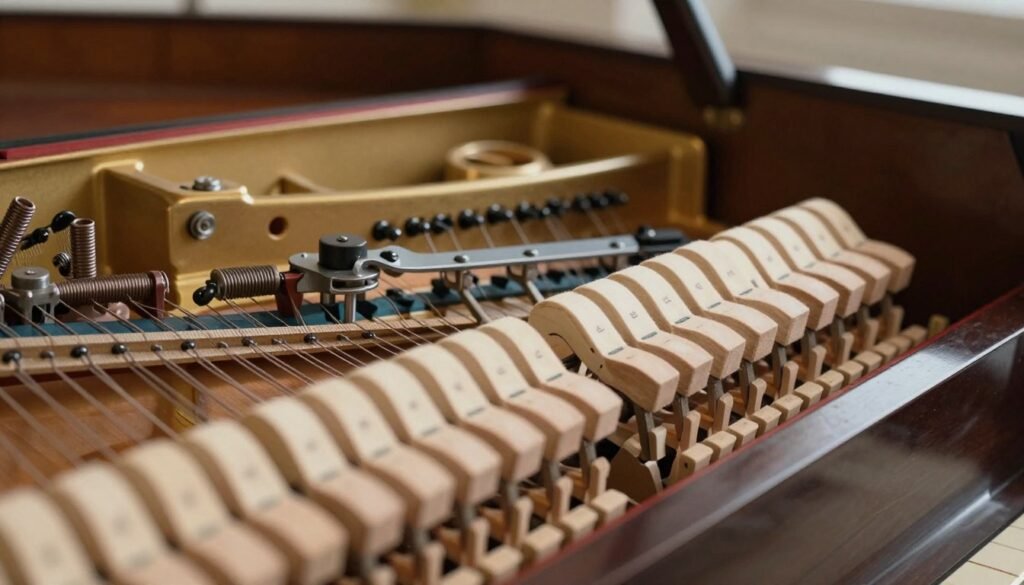
The main parts are easy to understand. Each key moves a jack and lever, sending a hammer to hit a set of strings. Dampers rest on the strings and lift when a key is pressed, letting the soundboard vibrate freely.
Cristofori made the soundboard separate from the tension frame. This allowed the soundboard to amplify vibrations without holding the string tension.
| Item Name | Description | Calories | Price |
|---|---|---|---|
| Hammer assembly | Wooden hammer head covered with leather and paper in Cristofori’s models | 0 | $N/A |
| Damper | Felt pad that stops string vibration when key is released | 0 | $N/A |
| Soundboard | Resonant board detached from the tension frame to boost tone | 0 | $N/A |
| String course | Grouped strings tuned in unison for fuller tone | 0 | $N/A |
| Escapement | Release that lets the hammer fall back before impact | 0 | $N/A |
| Una corda shift | Keyboard shift moving hammers to strike fewer strings | 0 | $N/A |
| Action spring | Small spring returning the hammer and jack to rest | 0 | $N/A |
| Keybed | Row of levers forming the player interface | 0 | $N/A |
| Frame support | Wooden framing holding strings and bridge positions | 0 | $N/A |
| Bridge | Transmits string vibration to the soundboard | 0 | $N/A |
The escapement is key in Cristofori’s design. A notch in the action lets the hammer spring free before hitting the strings. This small gap allows for clean strikes and quick falls, ensuring clear tones.
Cristofori also introduced an early una corda feature. By shifting the keybed, hammers hit fewer strings, creating a softer sound. Later makers added damper systems and sustain pedals, building on Cristofori’s idea. Yet, the core mechanism he created remains at the heart of every modern piano.
Understanding this early piano invention shows why composers could express themselves more. The hammer action and escapement let you control volume by touch while keeping string resonance. This allowed for quick repetition and nuanced phrasing.
First pianofortes and early examples: 1700–1730
The first mention of pianofortes in history is in a 1700 Medici inventory. It describes an instrument by Bartolomeo Cristofori as “che fa’ il piano, e il forte.” This shows Cristofori’s role in creating the first pianofortes, marking a key moment in piano history.
By the 1720s, Cristofori kept improving his designs. Instruments from that time show better escapement and una corda functions. Makers tested different hammers and string gauges to improve the touch.
Cristofori’s instruments had wing-shaped bodies, similar to harpsichords. Their layout, action, and materials were unique. Early pianos had thinner strings and denser hammer coverings, making the sound brighter and more brittle.
Small changes in Cristofori’s work by the mid-1720s were significant. His actions were close to those in later fortepianos. The una corda was present in some models, but sustain pedals were not yet common. These changes allowed for a wider range of dynamics for performers.
| Item Name | Description | Calories | Price |
|---|---|---|---|
| 1700 Medici Arpicembalo | Early Cristofori instrument noted for dynamic control described as “piano” and “forte” | 0 | $0 (historical) |
| Circa 1720 Grand | Refined escapement, improved hammer materials, early una corda mechanism | 0 | $0 (museum piece) |
| Circa 1726 Action Prototype | Action geometry close to later fortepiano design with enhanced repetition | 0 | $0 (conserved) |
| Early Harpsichord for Comparison | Plucked mechanism, limited dynamics, influenced Cristofori’s aims | 0 | $0 (reference) |
| Clavichord for Comparison | Tangent-driven, expressive touch but weak volume; contrast to first pianofortes | 0 | $0 (reference) |
| 1722 Rome Instrument | Shows intermediate materials and action tweaks reflecting ongoing experiments | 0 | $0 (museum piece) |
| 1726 Leipzig Example | Action approaching mature form; clearer dynamic possibilities for performers | 0 | $0 (conserved) |
| Modern Fortepiano Replica | Recreation based on Cristofori plans to illustrate early tone and response | 0 | $8,500 |
| Contemporary Grand (for contrast) | Steel-frame, heavier hammers, long sustain; highlights tonal evolution | 0 | $45,000 |
| Repair and Conservation | Specialized work to preserve action parts and original surfaces | 0 | $3,200 |
Early instruments and modern pianos sound very different. The older sound is clearer and more immediate. This difference shows the choices Cristofori made in his workshop.
Understanding these early examples helps us see the first pianofortes in piano history. Each surviving instrument is a step in the piano’s evolution. They show the craft’s growth in the early 18th century.
Competing inventors and claims: Silbermann, Marius, Schröter and others
In the early 18th century, many makers showed off their ideas for a hammer-action keyboard. This led to a big debate over who came up with it first. The debate spread from Paris to Dresden and then to Leipzig. Today, historians and musicians keep the debate alive with their research and studies.
Jean Marius sent in his hammer-action designs to the Royal Academy of Sciences in 1716. But the Paris guild craftsmen questioned his originality. Marius’s proposals showed he knew about Cristofori’s problems, but there were gaps in his designs.
Gottfried Silbermann started making working pianos around 1732 after studying Cristofori’s work. His pianos helped spread the new mechanism in German workshops. Some of Silbermann’s pianos were hard to play, but Bach later praised the improved ones.
Christoph Gottlieb Schröter claimed to have invented a hammer mechanism in 1717. But his claim is mostly based on reports, not on actual working prototypes. Unlike builders who made real instruments, Schröter’s claim is weaker.
| Item Name | Description | Calories | Price |
|---|---|---|---|
| Jean Marius Proposal | 1716 hammer-action design submitted to the Royal Academy; disputed originality | 0 | $0 |
| Silbermann Piano | Working instruments from c.1732; improved damper systems and wider adoption in Germany | 0 | $0 |
| Schröter Claim | 1717 assertion of a hammer action with limited evidence of a finished prototype | 0 | $0 |
| Cristofori Surviving Instruments | Early, documented pianos with clear hammer action and escapement; physical proof of working design | 0 | $0 |
When looking at competing inventors, researchers check old documents, guild records, and surviving instruments. This helps figure out which claims are based on real prototypes and which are just descriptions.
When talking about piano inventor claims, technical details like escapement, hammer shape, and dampers are important. These details show if a design is just an idea or something you can actually play and study.
Exploring these debates shows that many makers made important improvements. But only a few left behind the physical evidence that proves their contribution. This evidence is what gives them credit in history.
Piano invention timeline and spread across Europe
The piano’s story began in a Florentine workshop and soon filled concert halls and middle-class homes. A detailed piano invention timeline shows how Bartolomeo Cristofori’s idea became a global craft. It highlights key dates, manufacturing centers, and the social spread of the instrument.
1698–1700: Cristofori in Florence created early models with dynamic contrast. The first record of these instruments appears in a 1700 Medici inventory. This marks a significant moment in piano history, showing who designed the first practical piano.
1720s: Cristofori continued to improve his design. Instruments from this time show better escapement and touch. These improvements are key to the next stage in piano history.
| Item Name | Description | Calories | Price |
|---|---|---|---|
| Early Cristofori model (c.1700) | Compact harpsichord-like case with hammer action and escapement | 0 | $0 (museum piece) |
| 1720 Cristofori instrument | Refined escapement and improved string layout for clearer dynamics | 0 | $0 (museum piece) |
| Silbermann fortepiano (1730s) | German interpretation of Cristofori’s action, heavier touch | 0 | $0 (historical replica) |
| Viennese fortepiano (late 18th c.) | Lighter action favored by Haydn and Mozart for clarity and speed | 0 | $0 (replica) |
| Broadwood uprights (early 19th c.) | Stronger frames and extended range for domestic music-making | 0 | $0 (historical replica) |
| Steinway concert grand (late 19th c.) | Industrialized production, standardized scale and cast-iron frame | 0 | $0 (museum or modern instrument) |
| Parlor uprights (mid-19th c.) | Scaled manufacturing made pianos common in middle-class homes | 0 | $0 (historical) |
| Modern grand (20th c.) | Refinements in action, strings, and materials for concert use | 0 | $0 (retail models) |
| Digital pianos (late 20th–21st c.) | Electronic reproduction of piano touch and sound for home use | 0 | $0–$5,000+ |
| Contemporary builders | Specialty makers blend historical and modern design for niches | 0 | $0–$100,000+ |
1730s–mid 18th century: German workshops, led by Gottfried Silbermann and his pupils, adapted Cristofori’s ideas. They produced instruments with unique tonal qualities. This period marks the German chapter in piano history.
Late 18th–19th century: The piano moved from royal courts to homes. Makers like John Broadwood in England and Heinrich Steinway in Germany and the U.S. scaled up production. This made the piano a staple in homes and shaped its public image.
Following this timeline, you see both technical advancements and social changes. The piano’s journey from workshop experiments to mass production shows how innovations spread across Europe and into homes.
Surviving Cristofori pianos and where to see them today
Bartolomeo Cristofori’s instruments are found in three museums. Each one offers a unique look into piano history and early keyboard design. You can see or hear these instruments in New York, Rome, and Leipzig.
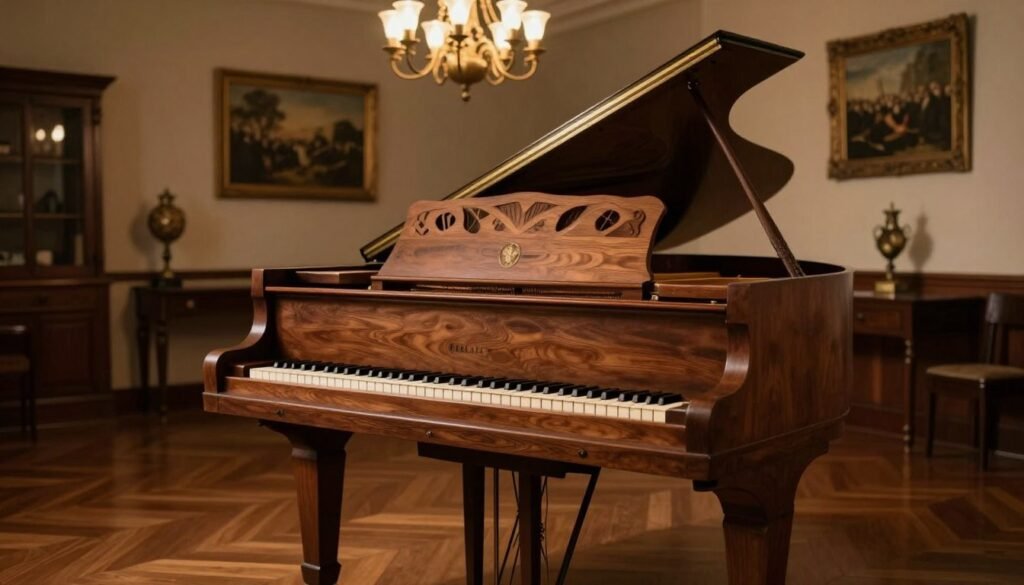
The 1720 Cristofori at the Metropolitan Museum of Art, New York, is playable. It got a new soundboard in 1938 to help with study and occasional playing. Listening to it shows Cristofori’s sound: softer than today’s pianos with a clear attack.
The 1722 piano in Rome’s Museo degli Strumenti Musicali has worm damage and isn’t playable. It has original fittings and an early una corda mechanism. Seeing this piece helps understand piano design choices.
The 1726 instrument at Leipzig University’s Musikinstrumenten-Museum has been restored and recorded. It works well, letting you compare its sound with the Met’s and later pianos. The Leipzig piano sounds thinner and more brittle, with a quicker decay.
| Item Name | Description | Condition | Visiting Tip |
|---|---|---|---|
| 1720 Cristofori, Metropolitan Museum of Art | Single-keyboard, wing-shaped instrument; playable after 1938 soundboard replacement | Playable for study and select performances | Contact the Met’s department of musical instruments for demonstrations |
| 1722 Cristofori, Museo degli Strumenti Musicali, Rome | Original fittings with una corda mechanism; visual example of early design | Not playable due to worm damage | View in person to inspect unique construction and ornamentation |
| 1726 Cristofori, Musikinstrumenten-Museum, Leipzig | Restored and recorded; includes working una corda and original action layout | Playable and available for sound study | Check museum schedules for recordings or live demonstrations |
All three instruments look like large harpsichords but sound like early fortepianos. Cristofori used harder hammers and thinner strings, making a sound that’s intimate and clear. If you want to see Cristofori pianos in person, visit these museums to explore piano history.
For those interested in Cristofori pianos, comparing the Met, Rome, and Leipzig instruments shows how small changes affect sound. Each museum shows different states of preservation, giving a full view of early restoration and performance practices in piano history.
How the piano changed music and why it became dominant
The piano’s arrival changed music forever. Its touch-sensitive action allowed for a wide range of sounds. This range helped composers like Mozart and Beethoven create music with deeper contrasts and subtler phrasing.
New expressive tools led to new forms. Sonatas, nocturnes, and character pieces grew from the instrument’s ability to sustain and shade tones. Performers could shape lines with pedal and touch, creating a vocabulary of nuance that defined Romantic-era repertoire and reshaped piano history.
| Item Name | Description | Calories | Price |
|---|---|---|---|
| Salon Recital | Short public performances in private homes that showcased new piano works | 0 | $10–$30 |
| Concert Grand | Large instrument for halls, powerful projection and rich bass | 0 | $10,000–$200,000 |
| Upright Piano | Space-saving design for domestic education and middle-class living rooms | 0 | $1,500–$20,000 |
| Studio Practice | Affordable pianos used by students and teachers for daily study | 0 | $800–$8,000 |
| Digital Piano | Electronic instruments that mimic acoustic touch and allow silent practice | 0 | $300–$6,000 |
| Pedal Effects | Sustain and una corda functions that expand tonal color | 0 | Included |
| Teaching Method | Standardized graded materials for technique and repertoire | 0 | $5–$60 |
| Composer Output | Works written to exploit dynamic and expressive range | 0 | Priceless |
| Public Performance | Shift from intimate rooms to concert halls as instruments grew louder | 0 | $5–$100 |
| Maker Competition | Industrial builders who standardized design and expanded distribution | 0 | Varies |
Social habits changed with the piano. It became the heart of salon culture and domestic music-making. Middle-class families used it for education, entertainment, and social status. This household presence fueled demand and a broader musical literacy.
Industrial advances sped adoption. Factories refined action design, standardized keyboard range, and raised production quality. Makers like Steinway & Sons pushed for stronger frames and larger sound, allowing performances in bigger venues and cementing piano dominance in concert life.
The competition among manufacturers set modern norms. Standardized dimensions and improved materials made results predictable for builders and musicians. These standards anchored performance practice and teaching, shaping the arc of piano history into the 19th and 20th centuries.
The piano’s mix of expressive power, social reach, and industrial backing explains its staying influence. From intimate teaching rooms to grand concert halls, the instrument rewrote how people compose, perform, and learn music.
Conclusion
Bartolomeo Cristofori of Padua worked in Florence for Prince Ferdinando de’ Medici. He is the key figure in the piano’s invention. His innovation, combining hammers with an escapement, solved earlier keyboard problems.
Documents like the 1700 Medici inventory and surviving instruments support this claim. They show Cristofori’s role in piano history and its origins.
Cristofori’s design was the start for later makers like Gottfried Silbermann. Over time, craftsmen and firms like Steinway improved the piano. They changed its sound, power, and consistency.
This evolution made the piano a favorite in concerts and homes. If you want to hear an early sound, check out the Metropolitan Museum of Art or Museo degli Strumenti Musicali in Rome. You can also find modern replicas from specialist builders.
Knowing about these sources helps when learning, teaching, or choosing an instrument. It connects the present to the piano’s rich history.