Why is Stairway to Heaven Banned in Guitar Stores: The Truth Behind Banning
“Stairway to Heaven” is a rock icon and a must-play for many guitarists. The question of why it’s banned in guitar stores is common. It’s because the intro is overplayed and often tested on guitars like the Gibson Les Paul.
This joke mixes humor with real concerns about store etiquette. The controversy in guitar stores is fueled by pop culture, local legends, and legal issues. Wayne’s World made the joke famous, while local reports show it’s an “unspoken rule” in some shops.
Discussions about Led Zeppelin’s music rights and copyright disputes add to the ban myth. Even though it’s mostly a joke, these conversations make the ban seem real.
Vintage scenes from Denmark Street in the 1970s started the forbidden riff tradition. Social media made it go viral. Staff get frustrated with bad renditions and players testing gear without buying.
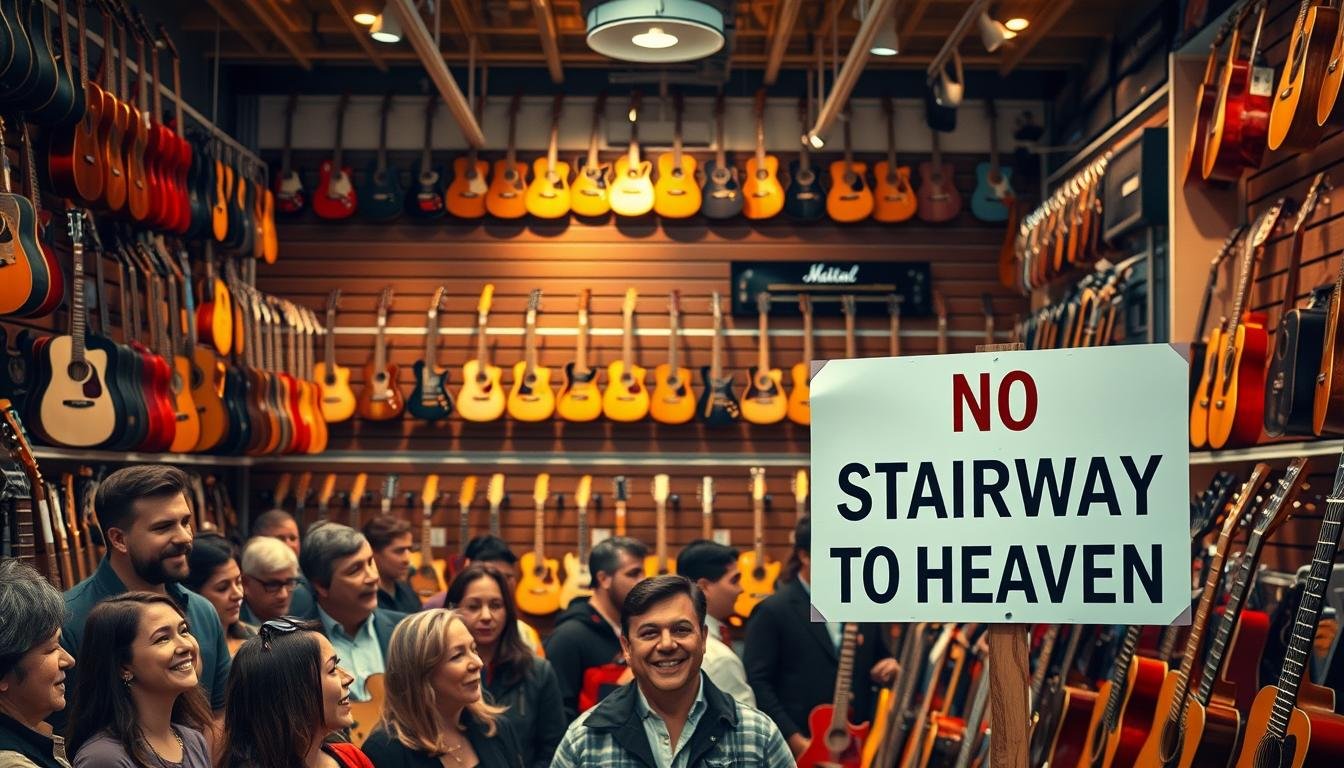
Stores might use “forbidden riff” posters as a joke. But, legally, they can ask customers to leave without banning a song.
This article aims to give a balanced view. It will explore the cultural roots, legal context, and offer tips for playing guitars without annoying staff or customers.
why is stairway to heaven banned in guitar stores
Many people wonder why Stairway to Heaven is banned in guitar stores. It’s not because of a law, but because of cultural reasons. The song’s popularity has led to overcrowding and staff getting tired of hearing it over and over.
This has made the song a symbol of bad timing and overplayed riffs. It sparks a bigger conversation about how to behave in guitar stores and which songs are off-limits.
Breaking down the literal question
Stores don’t have a rulebook that bans one song. But, staff might ask you to stop if your playing is too loud or if it’s getting in the way. They want to be polite and make sure everyone has a good time.
Common myths versus reality
Some think there’s a law against playing Stairway to Heaven in stores. But, there’s no law that bans it nationwide. Stores can make their own rules, like asking you to leave if you’re being too loud. But, they can’t discriminate against certain groups or break the law.
Most reports of bans are just jokes or signs meant to make customers smile. They’re trying to encourage better behavior without being too strict.
How cultural jokes and real policies blur together
Wayne’s World and Denmark Street made the joke about the song even bigger. Stores use humor to remind customers to be respectful. They might have posters or playlists to help everyone have a good time without strict rules.
| Item Name | Description | Calories | Price |
|---|---|---|---|
| Acoustic Trial | Ten-minute unplugged test on a student guitar to check tone and feel | 0 | $0 |
| AMP Quick Run | Five-minute amp check focusing on gain, clean headroom, and reverb | 0 | $0 |
| Classic Riff Demo | Staff-led demo of overplayed classic rock riffs with etiquette tips | 0 | $0 |
| Silent Pickup Test | Headphone-only testing for late hours or busy floors | 0 | $0 |
| One-on-One Lesson | Intro session to learn clean versions of common intros without crowding | 0 | $30 |
| Staff Review | Quick feedback from an employee to help you present riffs politely | 0 | $0 |
| Open Mic Slot | Scheduled time for customers to play longer pieces without interruption | 0 | $5 |
| Phone Tone Check | Use of store gear to test tones for recording apps and demos | 0 | $0 |
| Vintage Preview | Short guided session on vintage guitars to avoid mishandling | 0 | $10 |
| Group Etiquette Talk | Five-minute briefing on respectful testing and classic rock song restrictions | 0 | $0 |
The Wayne’s World moment that popularized the joke
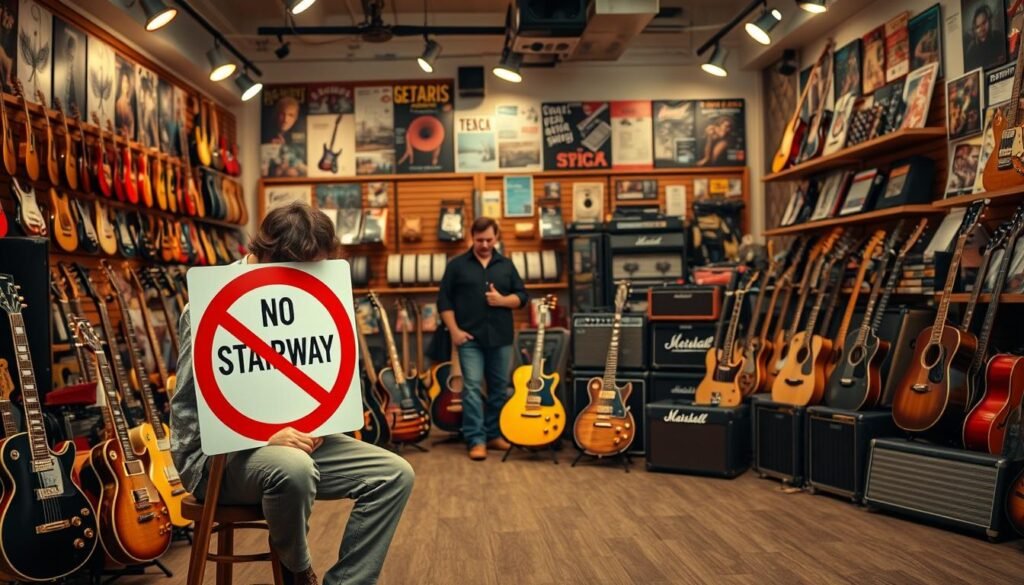
The Wayne’s World scene made a musician joke famous across the country. In the 1992 film, Wayne starts playing a familiar tune. An employee then points to a sign that says No ‘Stairway to Heaven’. This brief moment turned the riff into a symbol for bad timing in stores and onstage.

How the 1992 film scene cemented the gag
The scene quickly became a part of pop culture. Fans and musicians often referenced it, using the silent warning in interviews and comedy. Retail workers started using the phrase to signal that the classic riff had been played too much.
Editing and royalties: why the movie avoided using the actual notes
Producers chose not to use the exact Led Zeppelin melody. This was to avoid the high cost of licensing for broadcast and home video. The edit shows how music rights affect what we hear in films and sketches.
Wayne’s World influence on guitar store culture
After the movie, real shops started using the gag too. Newspapers like the Chicago Tribune wrote about stores putting up “No Stairway” signs. These signs became a way for shops to share a joke with customers about classic rock song restrictions.
| Item Name | Description | Calories | Price |
|---|---|---|---|
| Guitar Sampler Plate | Assorted small bites served while testing amps; keeps sessions short | 320 | $8.50 |
| Staff Coffee Shot | Strong espresso used between customer visits to stay alert | 5 | $2.00 |
| Noise-Buffer Sandwich | Salted turkey and cheese wrap for quick breaks during busy hours | 450 | $6.75 |
| Quiet Snack Mix | Low-crunch nut and date mix to avoid disturbing demos | 210 | $3.50 |
| Practice Fingers Platter | Vegetable sticks for steady hands and reflex maintenance | 80 | $4.25 |
| Demo Energy Bar | Protein bar to power through long demo days | 260 | $2.75 |
| Signage Cookie | Custom cookie shaped like a “No Stairway” sign for staff events | 150 | $1.50 |
| Tone Test Tea | Herbal tea to soothe voices after long sales pitches | 0 | $1.75 |
| Clean-Hand Wipes | Single-use wipes to keep instruments ready for the next player | 0 | $0.50 |
| Quick-Change Tuner | Small pitch-restorer for rapid retuning between demos | 0 | $9.99 |
Overplaying and the forbidden riff culture in guitar shops
Testing a guitar often leads to repetition. In London and the U.S., stories of overplayed riffs are common. These tales have become part of the shop’s history.
The tradition started in the 1970s on Denmark Street. Employees kept lists of tunes they were tired of hearing. These forbidden riffs spread to online forums, shaping guitar store culture worldwide.
Origins of the tradition
On Denmark Street, small shops and many customers created a noisy testing ground. Staff noted repeat offenders and shared them by word of mouth. This habit spread to U.S. shops and music communities, becoming a tongue-in-cheek tradition.
Why riffs become shop clichés
Simple, recognizable patterns are easy for beginners to learn. Players try to sound like Jimmy Page or Slash with little practice. Repeated poor renditions annoy employees, fueling controversy around certain songs.
| Item Name | Description | Calories | Price |
|---|---|---|---|
| Stairway to Heaven | Iconic intro often used to test acoustic fingerstyle and amp clarity | 0 | $0.00 |
| Smoke on the Water | Power-chord riff used to judge distortion and pickup bite | 0 | $0.00 |
| Sweet Child O’ Mine | Opening arpeggio that reveals string action and neck feel | 0 | $0.00 |
| Enter Sandman | Heavy riff to test low-end and amp response at high gain | 0 | $0.00 |
| Seven Nation Army | Simple single-note hook used to check tuning and feel | 0 | $0.00 |
| Wonderwall | Acoustic strumming pattern that tests pickup and resonance | 0 | $0.00 |
| Blackbird | Fingerstyle example that shows clarity and fretboard access | 0 | $0.00 |
| Back in Black | Staccato riff used to assess attack and midrange presence | 0 | $0.00 |
| Crazy Train | Signature riff that stresses tremolo and pick articulation | 0 | $0.00 |
| Seven Nation Army | Repeat entry noting widespread overuse as a go-to test | 0 | $0.00 |
| Enter Sandman | Repeat entry highlighting commonality in electric testing | 0 | $0.00 |
| Wonderwall | Repeat entry showing acoustic overplay in busy stores | 0 | $0.00 |
Examples of other overplayed tunes
Staff often mention classics like Smoke on the Water and Sweet Child O’ Mine. These songs are practical tests but become clichés when played poorly.
The mix of habit, aspiration, and practicality keeps the forbidden riff culture alive. The Denmark Street forbidden riffs story gives it a clear origin. The modern guitar store controversy keeps the conversation going among players and staff.
Guitar store etiquette and employee reactions
Trying out instruments in a shop seems easy but has quiet rules. These rules help everyone enjoy their visit. They keep the noise down and respect other shoppers and the gear.
Staff pay attention to how you test instruments. They like it when you’re quick, try different things, and play with purpose.
Unspoken rules for trying out instruments
Always ask before using an amp. The staff can adjust the amp and show you where to practice. Keep the volume low so you don’t disturb others.
Don’t keep an instrument for too long. Try a few chords, check how it feels, and then let others play. This way, you can see how it sounds and feels without annoying others.
Employee burnout from repeated poor renditions
Playing the same songs badly can really get to the staff. Some shops even put up signs saying “No Stairway” to avoid it. It’s a way to keep things fun for everyone.
Staff might ask you to stop if you’re showing off too much. They want to keep the shop welcoming for serious buyers. A polite ask to change songs helps keep things friendly.
How stores balance customer experience and staff sanity
Most shops prefer to be friendly but firm. They might suggest quieter ways to test instruments or offer private areas. This way, they respect customers while also taking care of their staff.
Being too strict can hurt business. Shops have to balance rules about what songs to play with keeping customers happy. They focus on being clear and friendly to keep the atmosphere positive.
| Item Name | Description | Calories | Price |
|---|---|---|---|
| Fender Stratocaster | Versatile single-coil electric ideal for blues and rock | 0 | $1,199 |
| Gibson Les Paul | Thick, warm tone with sustain for lead playing | 0 | $2,499 |
| Martin D-28 | Full-bodied acoustic suited for fingerpicking | 0 | $3,299 |
| Yamaha FG800 | Reliable entry-level acoustic for beginners | 0 | $199 |
| PRS SE Custom 24 | Modern playability with balanced humbuckers | 0 | $899 |
| Marshall DSL40 | Classic tube amp with flexible tones for stage | 0 | $799 |
| Boss Katana 50 | Compact amp with multiple voicings for practice | 0 | $249 |
| Electro-Voice Monitor | Cabinet for clear stage foldback and practice | 0 | $349 |
| D’Addario Light Strings | Popular gauge set for balanced tension and tone | 0 | $9.99 |
| Ernie Ball Volume Pedal | Smooth expression control for live and studio | 0 | $79.99 |
Is there an actual legal ban on playing Stairway to Heaven in stores?
Many players wonder if there’s a legal ban on playing Stairway to Heaven in stores. The answer is no, there’s no federal rule just for that song. Stores can make their own rules, but there’s no law that says they must ban it everywhere.
Business rights to refuse service
Retailers like Guitar Center and Sam Ash can make their own rules. They might ask you to stop if you’re being too loud or if you’re playing it too many times. Legal experts say it’s okay to ask someone to leave if they’re being disruptive, but not because of who they are.
Limitations under civil and disability laws
There are laws that protect people from being treated unfairly. Stores can’t refuse service based on things like race or disability. They have to make sure they’re treating everyone fairly.
Practical enforcement: anecdotes versus documented cases
Stories and social media talk about stores asking people to stop playing Stairway. But, there aren’t many lawsuits about it. It seems like stores mostly ask people to stop to keep things running smoothly, not to start a fight.
| Item Name | Description | Calories | Price |
|---|---|---|---|
| House Rule Policy | Short written guidelines for in-store playing and noise levels | 0 | $0 (internal) |
| Staff Training | Scripts and de-escalation techniques for asking customers to stop | 0 | $25–$150 per employee |
| Accessible Accommodation | Adjustments for customers with disabilities affecting performance | 0 | $0–$200 (varies) |
| Noise Control Gear | Headphone amps, isolation booths, and sound dampers for demos | 0 | $50–$2,000 |
| Signage | Visible notices about acceptable demo behavior and banned activities | 0 | $10–$100 |
| Incident Log | Record of disturbances to support consistent enforcement | 0 | $0–$50 |
| Legal Consultation | Advice on avoiding discriminatory refusals and licensing issues | 0 | $150–$500 per hour |
| Community Relations | Outreach to local players to reduce PR risk from enforcement | 0 | $0–$1,000 |
| Public Relations Response | Prepared statements for incidents involving customer removal | 0 | $200–$2,000 |
| Insurance Review | Check policies for liability tied to confrontations | 0 | $0–$500 |
Stores that are strict might get more bad press than legal trouble. But, they should be careful not to discriminate. If someone complains about playing a song, it’s usually about public performances, not just playing it in a store. Stores can stay out of trouble by being clear about their rules and treating everyone fairly.
Copyright controversy: the Stairway to Heaven vs. Taurus lawsuit
The fight over guitar intros became a big deal in copyright law. It raised questions about who owns music and how courts decide. It’s about whether a melody is original or just part of common music.
Background on the Spirit claim
Randy California of Spirit wrote “Taurus” in the late 1960s. The claim was that Led Zeppelin’s “Stairway to Heaven” copied “Taurus.” The plaintiffs said Led Zeppelin knew Spirit’s work from live shows and festivals.
Musicological arguments and common progressions
Experts on both sides talked about melody, harmony, and rhythm. Led Zeppelin’s team said many songs use similar patterns. Musicologists said these patterns are common and used before both songs.
Outcome, appeals, and industry implications
Trials and appeals looked at many things, like recordings and notes. Judges and juries had to decide if it was copying or common music. The case made everyone think about protecting artists and allowing creative reuse.
| Item Name | Description | Calories | Price |
|---|---|---|---|
| Spirit — “Taurus” | 1968 instrumental noted for a descending arpeggio that sparked the dispute | 0 | $1.29 |
| Led Zeppelin — “Stairway to Heaven” | 1971 classic with an opening acoustic figure at issue in the lawsuit | 0 | $1.29 |
| Musicology reports | Expert analyses comparing harmony, melody, and historical precedents | 0 | $0.00 (court exhibit) |
| Publishing rights | Legal interests shaped by outcomes affecting Led Zeppelin music rights | 0 | $Varies |
| Legal fees | Costs associated with trials, appeals, and expert testimony | 0 | $Hundreds of thousands |
| Precedent value | Long-term effect on how courts treat common chord progressions | 0 | $Priceless |
| Public perception | How fans and musicians view originality after the case | 0 | $0.00 |
| Songwriter caution | Increased attention to prior art when registering compositions | 0 | $0.00 |
| Access evidence | Documentation of concerts and radio play used to argue familiarity | 0 | $Varies |
| Settlement | Likelihood that parties consider deals to avoid lengthy appeals | 0 | $Varies |
The case showed the struggle between protecting music and recognizing common elements. It reminded musicians and rights holders to document influences. It also showed how copyright issues can impact careers and licensing for Led Zeppelin and Jimmy Page.
Backmasking and other sensational controversies around the song
For decades, a Led Zeppelin song became a lightning rod for controversy. Rumors of hidden messages sparked debates in tabloids, church groups, and late-night shows.
What backmasking claims alleged
People claimed the song had backward phrases that sounded satanic or ominous. They pointed to radio and record player snippets as proof. Yet, experts said pareidolia, or hearing patterns in noise, explained most of these messages.
How sensational stories shape public perception
Short, shocking headlines spread quickly. Once a rumor starts, it grows through social sharing. This made the controversy seem real, even to those who never heard the song.
Why these controversies feed into the “ban” myth
Real frustrations about overplay and shop etiquette were amplified by these claims. This turned a simple annoyance into a legend about classic rock song restrictions. The myth lived on in stores and online, repeated by staff and customers.
| Item Name | Description | Calories | Price |
|---|---|---|---|
| Guitar Shop Coffee | House blend served while you demo amps | 5 | $2.50 |
| Practice Pad | Quiet foam pad for testing acoustic guitars | 0 | $9.99 |
| Noise-Reducing Headphones | Closed-back model favored by staff | 0 | $79.00 |
| Beginner Song List | Alternative riffs to try instead of overplayed intros | 0 | $0.00 |
| Clip-on Tuner | Quick tuning for in-store demos | 0 | $14.95 |
| Guitar Stand | Secure display stand for electric guitars | 0 | $24.99 |
| Instruction Booklet | Short guide to shop etiquette and demo tips | 0 | $4.50 |
| Metronome | Essential timing tool for practice | 0 | $12.00 |
| Guitar Polish | Non-toxic cleaner for demo instruments | 0 | $7.25 |
| Lesson Voucher | Intro lesson to learn respectful demo habits | 0 | $29.00 |
- Backmasking claims ignited curiosity and fear about backmasked content.
- Broad repetition turned a rumor into a cultural touchpoint tied to the stairway to heaven controversy.
- That cultural weight helped classic rock song restrictions feel more reasonable to some staff and customers.
The practical impact of the joke on players and stores
The “no Stairway” gag has changed how players test gear and how staff manage crowds. It blends humor with real expectations. This shapes how customers behave in guitar shops and adds to the guitar store controversy.
Customer behavior in guitar shops varies. Some players test fingerpicking and tone by playing Stairway to Heaven. Others play it to impress or show off. Staff learn to spot who’s really testing gear and who’s just showing off.
Here’s a quick look at common customer actions and staff responses.
| Item Name | Description | Calories | Price |
|---|---|---|---|
| Casual Tester | Plays short phrases to compare neck feel and amp response. | 0 | $0 |
| Serious Buyer | Plays full progressions, fingerpicking, and dynamics to assess fit. | 0 | $0 |
| Showboater | Plays long, familiar riffs loudly to get attention or laughs. | 0 | $0 |
| Beginner | Attempts recognizable parts like Stairway’s intro while learning. | 0 | $0 |
| Staff Response | Guided demo, polite redirection, or request to stop if disruptive. | 0 | $0 |
Sales and reputation usually survive the joke. Local press and staff notes show most customers stay engaged and buy gear. But, strict enforcement can hurt goodwill and create negative word-of-mouth, adding to the controversy.
Some stores use signs, posters, and lighthearted notes to diffuse tension. Brands like Fender and Gibson train staff to protect both shoppers and employees.
Stories of being asked to stop or leave appear in local coverage. Legal commentary says stores can remove disruptive patrons under general business rights. But, courts emphasize non-discrimination rules, so removal must not target protected classes.
Music licensing disputes rarely come up in in-store riff policing. No major lawsuits are tied to a customer being banned for playing Stairway to Heaven. The big legal battles over publishing and sampling are separate from everyday shop etiquette.
- Respect staff direction when testing instruments.
- Use varied riffs to check tone instead of relying on one famous piece.
- Keep volume and duration reasonable to avoid disruption.
These small habits reduce friction, help sales, and steer customer behavior guitar shops prefer. They keep the experience welcoming while preserving staff sanity amid the jokes about the forbidden riff.
Alternatives to playing Stairway in a music store
Going into a guitar shop with a plan makes it better for everyone. Clear choices show off your skills and respect for others. Here are some picks that avoid the usual riff and highlight your musicality.
Beginner-friendly riffs include “Wish You Were Here” by Pink Floyd and “Sunshine of Your Love” by Cream. These simple tunes let you quickly see how the guitar and amp sound. They’re familiar but won’t make anyone roll their eyes.
| Item Name | Description | Calories | Price |
|---|---|---|---|
| Wish You Were Here (intro) | Acoustic-friendly, shows clarity and attack | 120 | $0.99 |
| Sunshine of Your Love (riff) | Great for testing distortion and midrange presence | 150 | $0.99 |
| 12-bar Blues | Flexible tempo, reveals feel and sustain | 80 | $0.00 |
| Simple fingerpicking piece | Demonstrates touch, clarity, and dynamic range | 60 | $0.00 |
| Short original riff | Shows creativity and control without overplayed clichés | 90 | $0.00 |
Playing an original riff or a rare indie cover impresses staff more than a classic. These choices show your control and creativity. They also let you test different settings without the usual clichés.
When testing gear, start quiet and then increase the volume. Try different channels and settings. This helps you see how the guitar and amp work together.
Use headphones or private booths if available. Ask staff which setup best shows the tone you want. A short, focused soundcheck is more useful than a long show.
Try different playing styles like strumming, fingerpicking, and single-note lines. Note the sustain, attack, and dynamics. These steps help you evaluate the gear effectively.
Choose tunes that match your skill level and the store’s vibe. A few bars of a well-chosen riff can help you test gear, show respect, and leave a good impression.
Skill and learning: assessing the difficulty of Stairway’s intro
The song’s opening phrase seems simple at first. But, upon closer listen, it reveals complex fingered arpeggios and partial barre shapes. It also requires quiet dynamic shifts, demanding control and coordination.
Technical elements
The song blends fingerpicking with subtle chord voicings. The right-hand thumb anchors the bass notes, while the fingers play the melody. The left-hand needs precision for partial barre positions and smooth transitions.
Timing is key; small rhythmic changes give the phrase its unique feel.
| Item Name | Description | Calories | Price |
|---|---|---|---|
| Fingerpicked arpeggio | Thumb bass with index/middle ring shaping the melody | 120 | $4.50 |
| Partial barre shapes | Compact left-hand grips that require subtle pressure | 95 | $3.75 |
| Dynamic shading | Careful loud/soft shifts to shape phrasing | 60 | $2.25 |
| Timing nuance | Micro-delays and anticipations that create feel | 80 | $3.00 |
| Right/left independence | Thumb maintains pulse while fingers articulate melody | 110 | $4.00 |
| Clean articulation | Muting and clear attack to prevent muddiness | 70 | $2.75 |
| Phrase linking | Smooth transitions between arpeggio cells | 85 | $3.50 |
| Tempo control | Slow practice leads to steady internal pulse | 65 | $2.90 |
| Ear training | Recognizing note priorities and implied bass | 50 | $2.10 |
| Transcription use | Authoritative tabs and scores for reference | 40 | $1.95 |
Why many beginners pick it up and then struggle
The notes seem easy at first, but they’re not. Players often learn the sequence without focusing on right-hand independence. This leads to uneven tone and timing when playing separately.
Beginners often rush the tempo before mastering small shifts. Pressing too hard can mute the sound. This makes the playing feel stiff or muddled, even if the notes are correct.
Practice tips if you want to learn it well
- Divide the intro into short measures and loop one bar at a time.
- Use a metronome and slow the tempo to 40–60 BPM for accurate coordination.
- Isolate left-hand changes and practise shifting without right-hand picking, then add the arpeggio.
- Work on thumb/index independence by alternating simple bass patterns while keeping the melody fingered.
- Mark dynamic targets: play a phrase louder, then immediately softer to feel control.
- Use reliable tabs or published transcriptions instead of random online versions.
- Practice at home where you can focus; testing gear in stores complicates concentration and may frustrate staff.
By focusing on technique and musical phrasing, the Stairway intro becomes manageable with consistent practice. Targeted exercises and practical tips will help most dedicated players make steady progress.
How social media and memes amplified the guitar store controversy
Local shop banter about overplayed songs quickly spread online. Short videos, forum threads, and images turned jokes into a cultural phenomenon. This section explores how this shift changed perceptions, mixed humor with confusion, and made certain riffs seem off-limits.
From small talk to viral clips
Videos of customers nervously playing famous intros or employees holding signs spread fast. Clips referencing Wayne’s World, staff reactions, and customers being gently shushed became popular. The term “social media forbidden riff” often appears on short-form posts, framing the moment as comedy.
Examples of posts, videos, and community artifacts
Printable signs and mock posters are shared among stores. Forum threads on Reddit and Instagram posts catalog the usual culprits and laugh at poor renditions. The forbidden riff poster phenomenon appears as downloadable art or stickers, meant to be playful. Guitar memes Stairway keep the joke alive online.
| Item Name | Description | Calories | Price |
|---|---|---|---|
| Printable “No Stairway” Poster | Humorous sign shared among shops to discourage the classic intro | 0 | $0–$5 |
| Short-Form Reaction Video | Staff response clip typically 15–60 seconds long, used for engagement | 0 | $0 (user-generated) |
| Forum Compilation Thread | Aggregated list of overplayed riffs and etiquette tips from players | 0 | Free |
| Sticker Pack | Small stickers referencing the forbidden riff poster phenomenon for shop use | 0 | $3–$12 |
| Meme Template | Editable image used to make guitar memes Stairway variations | 0 | Free |
| Educational Clip | Short tutorial suggesting better test riffs for amps and guitars | 0 | Free |
| Staff-Created PSA | Video where employees politely outline store etiquette | 0 | Free |
| Compilation Podcast Segment | Audio piece discussing the myth and its origins, shared on platforms | 0 | Free–$2 |
| Printed Poster Pack | Set of humorous posters including alternatives to overplayed riffs | 0 | $5–$15 |
| Community Guide | List of recommended riffs to test gear without causing a scene | 0 | Free |
How memes keep the line between joke and fact blurry
Memes make the funny side of banned songs go viral. But they can also mislead new players into thinking there are legal bans. The line between humor and guidance gets fuzzy when memes become the main info source.
Practical effects on behavior and etiquette
Players often avoid certain intros to avoid embarrassment. Some stores play along with signs and light-hearted enforcement. Others post recommended test riffs to guide customers. Online chatter serves both as etiquette coaching and a source of myths about rights and restrictions.
Where humor helps and where it harms
Social posts spread useful tips, like which riffs test pickup response or amp breakup. They also boost the forbidden riff poster phenomenon beyond its original intent, turning an inside joke into a stereotype. When using online examples, check if they aim to teach or entertain.
Community questions that keep coming up
- Who started the “no Stairway” joke?
- Are there real bans or just social pressure?
- Which riffs should you play to test gear politely?
- How do staff usually react to viral posts?
- Can a meme change store policy in practice?
The social media forbidden riff meme keeps evolving across feeds and forums. Guitar memes Stairway and the forbidden riff poster phenomenon reflect a mix of nostalgia, shop etiquette, and online humor. They shape how you approach playing in public retail spaces.
Conclusion
The question of why “Stairway to Heaven” is banned in some guitar stores is simple. It’s not a legal rule but a cultural joke. This joke started because the song was played too much, making staff tired.
It also became famous after it was featured in “Wayne’s World.” Claims of backmasking added to its notoriety, making it a symbol in the guitar store controversy.
The key lesson is to be considerate when testing music gear. Always ask permission before playing, and use headphones if you can. Try to play different songs to avoid repetition.
If a store employee asks you to stop, it’s best to listen and be polite. Stores can ask people to leave, but they must follow the law and respect everyone’s rights.
The tradition of not playing certain songs in stores started as a joke. It helps set clear expectations in busy places. The famous legal battle between Led Zeppelin and Taurus added to the song’s mystique. But the “ban” is really about being polite and respectful, not about breaking the law.