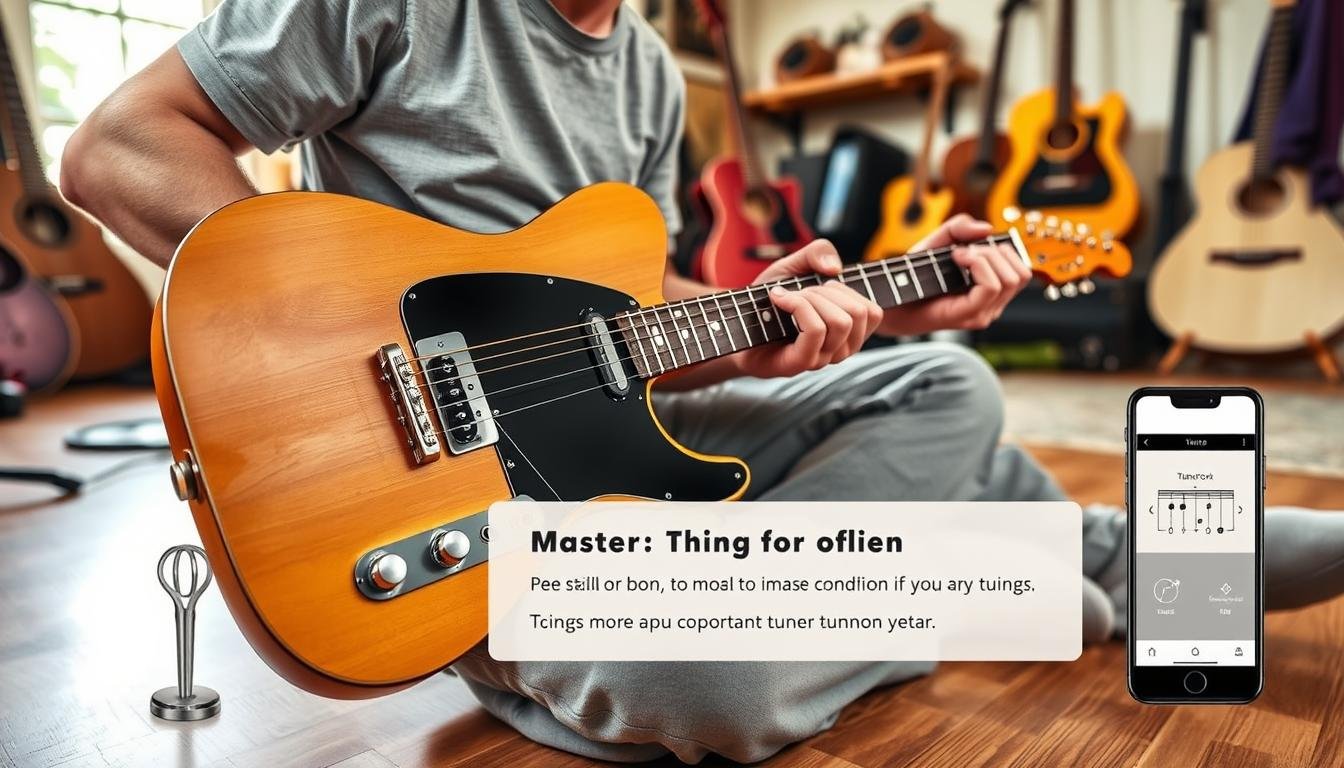
How to Tune a Guitar Without a Tuner: Master Guitar Tuning Without a Tuner Easily
Every time you pick up a guitar, start by checking the tuning. Learning to tune without a tuner saves time and keeps your practice focused. Tuning a guitar manually can take just 30–60 seconds once you know the basics.
Tuning means adjusting each string to the right pitch by turning its tuning peg. To tighten and raise the pitch, turn the peg away from you. To loosen and lower it, turn it toward you. Make sure you’re turning the right peg for the string you’re adjusting to avoid wasting time or breaking a string.
Many professional musicians, including those who play Fender and Gibson, use a reference pitch when playing with others. For beginners, the best approach is clear: tune directly to a reliable reference and improve your ear skills. This guide will teach you how to tune a guitar without equipment and develop your ear to tune by yourself.
Why Learning how to tune a guitar without a tuner is essential for beginners
Beginners often struggle because their playing sounds bad on an untuned guitar. Checking the tuning before you start helps avoid frustration. Learning to tune by ear helps build good habits and boosts your confidence when playing with others.

Why tuning matters for practice and performance
Tuned strings help you hear the right intervals and clear chords. Tuning by ear trains your ears to notice small pitch changes. This skill helps you learn scales, chords, and songs faster. In groups, being in tune is key to avoid awkward moments.
Common problems caused by playing out of tune
Playing out of tune leads to wrong intervals, muddy chords, and bad melodies. It’s hard to learn songs because what you hear doesn’t match the correct pitch. This can lower your confidence, but tuning first can prevent these issues.
Benefits of ear training and musical awareness
Ear training helps you tune without tools and communicate pitch with others. It lets you spot flats and sharps, sense beat rates, and recognize intervals fast. These skills make tuning by ear quicker and more precise over time.
| Item Name | Description | Calories | Price |
|---|---|---|---|
| Tuning habit | Check pitch before each practice to reinforce accurate technique | 0 | $0 |
| Reference pitch | Use a tuning fork, piano, or phone app at first to set a baseline | 0 | $10 |
| Relative tuning | Match strings using intervals to maintain consistent tuning without devices | 0 | $0 |
| Harmonic practice | Use natural harmonics to check octaves and fine-tune pitch | 0 | $0 |
| Daily ear drills | Short listening exercises to identify intervals and beat rates | 0 | $0 |
| Ensemble check | Learn to adjust tuning slightly for group playing when needed | 0 | $0 |
| String maintenance | Replace and stretch new strings to reduce tuning instability | 0 | $6 |
| Practice routine | Start each session with tuning, then play scales and songs | 0 | $0 |
| Pitch memory | Build internal reference by repeating a reliable note daily | 0 | $0 |
| Performance readiness | Consistent tuning reduces nerves and improves overall sound | 0 | $0 |
Guitar tuning basics and standard tuning notes
Tuning a guitar means setting each string to a specific pitch. This makes the instrument sound right when played. You adjust the pitch with the tuning pegs on the headstock.
Turning a peg away from you tightens the string and raises the pitch. Turning it towards you loosens the string and lowers the pitch. If you’re not sure which peg controls a string, trace the string from the bridge to the headstock before turning.

The standard tuning is E A D G B E, from lowest to highest string. Use a mnemonic like “Eddie Ate Dynamite, Good Bye Eddie” to remember it. Bass players use the same notes as the guitar’s lowest four: E A D G. Soprano ukulele has different pitches, but tuning by ear works the same way.
Here’s a quick guide for common string gauges and tuning a guitar manually.
| Item Name | Description | Calories | Price |
|---|---|---|---|
| Low E (6th) | Thick wound string; produces the lowest pitch, stable but needs larger peg turns for pitch change | 0 | $1.50 |
| A (5th) | Thick string; pairs well with low E for bass lines and rhythm | 0 | $1.40 |
| D (4th) | Mid-low tension; responsive to both fingerpicking and strumming | 0 | $1.35 |
| G (3rd) | Midrange string; critical for melody and chord voicings | 0 | $1.25 |
| B (2nd) | Thinner plain or light-wound string; behaves differently in intervals with G | 0 | $1.20 |
| High E (1st) | Thinnest string; highest pitch, sensitive to small turns and easy to break | 0 | $1.10 |
| Replacement Set (light) | Balanced tension set good for most beginners and acoustic guitars | 0 | $6.00 |
| Replacement Set (medium) | Higher tension for fuller tone and louder projection | 0 | $7.50 |
| Replacement Set (hybrid) | Mix of gauges for bright trebles and full lows | 0 | $8.00 |
| String Winder | Tool to speed manual winding and reduce peg slip | 0 | $5.00 |
| Bridge Pin Puller | Removes bridge pins safely when changing acoustic strings | 0 | $3.00 |
| Headstock Grip | Helps steady the headstock while tuning a guitar without a tuner | 0 | $4.00 |
| Fretboard Cleaner | Keeps strings and frets free of grime for stable tuning | 0 | $6.50 |
| Capo | Raises pitch uniformly across all strings for alternate tuning needs | 0 | $9.00 |
| Polishing Cloth | Simple care item that helps extend string life and tuning stability | 0 | $2.50 |
String thickness affects vibration speed: thicker strings vibrate slower and sound lower. Thinner strings vibrate faster and sound higher. Peg turns have the same effect across strings, but the amount needed for a pitch change varies by gauge and winding style.
Practice gentle turns and small checks when tuning without a tuner. Fine, steady adjustments reduce snapped string risk. Use your ear to compare pitches, then lock each string by stretching and checking stability.
Preparing your guitar and environment for tuning without equipment
Before you start tuning your guitar without equipment, take a few steps to prepare. A quick check and a calm room make tuning easier. This helps you tune manually and keep the pitch steady.
Check strings, stretching, and avoiding snapped strings
Examine each string for rust, fraying, or wear. Old strings don’t hold pitch well and break easily. If you see wear, replace the strings before tuning.
With new strings, pull each string away from the fretboard after tuning. This stretching helps keep the pitch stable. When tuning, make small, steady turns on the pegs to avoid sudden tension that can snap a string.
Choosing a quiet space and good listening conditions
Find a quiet room with little background noise. Sit near a reflective surface or in a room with good acoustics. This helps you hear beats and pitch clearly.
Avoid windy or very cold spots and outdoor areas. These conditions make tuning harder and make it tough to notice fine pitch differences.
Visual checks: bridge, nut, and trace string to correct peg
Make sure the bridge saddle and nut are in place and strings are in their slots. Misplaced strings can buzz or jump pitch when tuning.
Trace each string from the bridge to its tuning post to avoid turning the wrong peg. Check peg tightness and watch for slipped posts. Loose pegs cause tuning instability and make it harder to keep the instrument in tune.
| Item Name | Description | Calories | Price |
|---|---|---|---|
| String Set (Light) | Phosphor bronze acoustic set for balanced tone and easy stretching | 0 | $12.99 |
| Replacement Pegs | Sealed-gear tuners to improve tuning stability | 0 | $19.50 |
| Bridge Saddle | Pre-slotted saddle for correct string height and seating | 0 | $8.75 |
| Nylon String Cleaner | Removes grime and extends string life | 0 | $7.20 |
| Folding Music Stand | Helps place reference notes or a tuning fork at ear level | 0 | $14.99 |
| Soft Cloth | Microfiber cloth for wiping fretboard and strings | 0 | $4.00 |
| Electronic Dampener | Reduces sympathetic vibrations while tuning | 0 | $6.50 |
| Tuning Fork A440 | Stable reference pitch for starting manual tuning | 0 | $9.99 |
| Clip-on Humidity Meter | Monitors environment to prevent pitch drift | 0 | $11.25 |
| Capo | Useful for fretted reference notes during relative tuning | 0 | $8.00 |
How to tune a guitar without a tuner
Learning to tune a guitar without a tuner starts with a steady reference and a quiet space. A clear pitch helps you tune the low E string and then the others. Follow each step carefully and be careful not to snap any strings.
When you don’t have a tuner, use a tuning fork set to A=440 Hz, a piano, or a friend’s well-tuned guitar. You can also use your memory of a concert A if you have good ears. Apps and clip-on tuners can help you get better at tuning by ear.
The table below compares common reference sources so you can pick the best one for your situation.
| Item Name | Description | Calories | Price |
|---|---|---|---|
| Sturmey-Archer Tuning Fork | Durable A=440 Hz fork for a clear reference pitch. Strikes easily on knee or rubber pad. | 0 | $12 |
| Yamaha Upright Piano | Stable acoustic reference when well tuned; ideal in studios or homes with maintained pianos. | 0 | $3,500 |
| Fender Acoustic Guitar | Another instrument tuned with a reliable method offers practical, real-world matching. | 0 | $300 |
| Smartphone Tuning App | Accessible and visual reference; great for beginners learning tuning a guitar by ear. | 0 | Free–$5 |
| Memory/Trained Ear | Mental reference of concert A or low E from practice sessions. Best after ear training. | 0 | $0 |
| Keyboard (Casio, Roland) | Electronic keyboards provide stable, repeatable pitches for quick matching. | 0 | $100 |
| Clip-on Reference Tuner | Not required for manual tuning, useful as a backup while you train your ears. | 0 | $15 |
| Metronome with Pitch | Some metronomes include a tone generator for basic reference pitches in practice. | 0 | $25 |
| Studio Reference Tone | High-accuracy tones used in recording setups; ideal for precise work. | 0 | $0–varies |
| Live Ensemble Note | Use a reliable musician’s pitch in rehearsals for real-world tuning needs. | 0 | $0 |
Here’s how to tune a guitar by ear. Start with the 6th string (low E). Play your reference pitch, then pluck the open low E and turn the peg in small, steady increments until the pitches match.
After the low E is set, move upward through A, D, G, B, and high E. Use relative tuning checks as you go. Tune each string, then re-check earlier strings because tension changes can shift pitch. Keep plucking while turning to hear small changes clearly.
Safety tips reduce the chance of breakage. Make small turns of the tuning peg and avoid rapid winding. If a string is far flat or sharp, bring it closer slowly and pause to feel tension. Stop if a string suddenly tightens or feels like it might pop. Trace the string from nut to peg to confirm you are adjusting the correct tuner before making changes.
When using new strings, stretch them gently after the first tune and retune several times until they settle. Practicing tuning a guitar by ear for a few minutes each day speeds up skill gains and reduces dependence on electronic tuners.
Tuning a guitar by ear using relative tuning methods
Relative tuning lets you align each string to a single correct reference. Start with one reliable pitch, then match neighboring strings by ear. This approach makes tuning a guitar without a device practical for practice, gigs, and travel.
Using octave and fifth relationships
Play the 5th fret on the low E and compare it to the open A. Tune the A until both sound the same. Repeat the same 5th-fret rule to move from A to D, D to G, and B to high E. These intervals are easy to hear and form the backbone of relative tuning methods.
The B string exception and interval adjustments
The interval pattern shifts between G and B. Instead of the 5th fret, press the 4th fret on the G string and match it to the open B. After that, use the 5th fret on the B to match the high E. Recognizing this quirk prevents common pitch errors when tuning a guitar by ear.
Fretted reference notes and harmonics for accuracy
Natural harmonics at the 5th and 7th frets give clear octave and partial matches. Compare a 5th-fret harmonic on low E with a 7th-fret harmonic on A to check octave alignment. Use the 12th-fret fretted note to confirm intonation and octave placement.
| Item Name | Description | Calories | Price |
|---|---|---|---|
| Low E → A | 5th-fret on E tuned to open A for a stable fifth interval | 0 | $0.00 |
| A → D | 5th-fret on A matched to open D to continue the chain | 0 | $0.00 |
| D → G | 5th-fret on D matched to open G for consistent tuning steps | 0 | $0.00 |
| G → B | 4th-fret on G matched to open B due to the interval change | 0 | $0.00 |
| B → High E | 5th-fret on B tuned to open high E to finish the set | 0 | $0.00 |
| Harmonic checks | 5th and 7th-fret harmonics used to verify octave alignment | 0 | $0.00 |
| 12th-fret octave | Fretted 12th-fret note confirms intonation and octave accuracy | 0 | $0.00 |
| Reference pitch | Single correct reference note required before using relative tuning methods | 0 | $0.00 |
| Practical use | Apply these steps to tune a guitar without a device in quiet spaces | 0 | $0.00 |
| Trouble checks | Re-check harmonics and fretted notes after playing to ensure stability | 0 | $0.00 |
Start by practicing matching intervals slowly. Listen for beats when two pitches are almost the same; the beats slow as you reach perfect match. This skill refines your ability to tune a guitar by ear and strengthens your overall musicianship.
Advanced ear-based techniques and harmonic tuning
Sharpen your pitch sense by using harmonics and careful listening when tuning a guitar without equipment. Natural harmonics produce clear, sustained tones. These tones help you compare strings more accurately than fretted notes alone.
How to use natural harmonics (5th and 7th fret) to match pitch
Play the 12th-fret harmonic to check octave alignment. Then, use the 7th- and 5th-fret harmonics to compare adjacent strings. The 7th-fret harmonic is slightly flatter than the 5th, making them good reference points across the neck. Match sustain and timbre instead of pressing hard, which reduces finger-induced pitch shift.
Detecting beats and small pitch differences by ear
When two notes are nearly the same pitch, you’ll hear pulsations called beats. Faster pulsations mean a larger pitch gap. Count beats per second to estimate cents difference: about one beat per second equals roughly one cent at guitar pitches. So, a few quick beats show a noticeable detune.
When to temper tuning and practical compromises for ensemble playing
Solo practice calls for accurate tuning a guitar manually to a clear reference pitch. In group settings, bands sometimes adopt slight detunings for character or to match non-fixed-pitch instruments like pedal steel. Most learners should avoid tempering until they can reliably detect beats and tune a guitar without equipment to standard pitches.
| Item Name | Description | Calories | Price |
|---|---|---|---|
| 12th-fret harmonic | Clear octave reference, useful for confirming overall tuning | 0 | $0 |
| 7th-fret harmonic | Slightly flatter tone, good for matching lower strings | 0 | $0 |
| 5th-fret harmonic | Brighter harmonic, helps compare higher strings and octaves | 0 | $0 |
| Beat counting drill | Use paired notes to count pulsations and estimate cents | 0 | $0 |
| Manual tuning routine | Start from low E, use harmonics and fretted references to finish | 0 | $0 |
| Ensemble compromise | Gentle detuning up to ~15 cents for musical effect when needed | 0 | $0 |
| Ear training session | Short daily practice focused on intervals and beats | 0 | $0 |
| Reference pitch check | Confirm A440 or chosen reference before manual adjustments | 0 | $0 |
| Harmonic-to-fretted match | Use harmonic on one string and fretted note on another to fine-tune | 0 | $0 |
| Quick tuning without gear | Rely on harmonics and beat detection when tuning a guitar without equipment | 0 | $0 |
Practice these steps regularly to make harmonic tuning feel natural. Focus on detecting beats as your primary feedback. Over time, tuning a guitar manually will become faster and more reliable, even without a tuner or other equipment.
Troubleshooting and staying in tune without a device
Keeping your guitar in tune is all about paying attention to simple things. This guide will help you figure out why strings go out of tune. It also gives tips for tuning your guitar by ear and staying in tune during practice and shows.
Changes in temperature and humidity can affect your guitar’s strings and neck. New strings need tuning a few times until they settle. Old strings lose their tightness and don’t hold the pitch well.
Playing too hard, bending strings too much, and not winding strings right can also cause tuning issues.
Quick fixes for slipping pegs and tuning instability
To stop slipping pegs, tighten the ferrules or pins on your guitar. Use a bit of peg compound or a graphite pencil in the nut slots to prevent binding. Wind your strings neatly around the post with two to three coils for a secure fit.
If the bridge or nut is causing friction, apply some lubricant where the string meets it.
| Item Name | Description | Calories | Price |
|---|---|---|---|
| String winding | Neat coils around the post to prevent slippage | 0 | $0 (technique) |
| Peg compound | Small amount applied to tuning machine to steady pegs | 0 | $6–$12 |
| Graphite lubricant | Reduce nut binding for smoother tuning action | 0 | $3–$8 |
| New strings | Replace old sets to restore pitch stability | 0 | $6–$20 |
| Clip-on tuner | Temporary stabilizer and training aid when needed | 0 | $10–$25 |
| Proper peg tightening | Adjust machine head tension without over-tightening | 0 | $0 (maintenance) |
| Bridge/nut adjustment | Minor tweaks to remove string binding points | 0 | $0–$30 (parts/tool) |
| Humidifier | Stabilize wood in dry climates to help tuning | 0 | $10–$30 |
| Stretching routine | Repeated gentle pulls to accelerate string settling | 0 | $0 |
| Professional setup | Full adjustment of intonation, nut, and neck relief | 0 | $50–$120 |
When a tuner or pro setup is the best choice
Use a tuner for perfect pitch, like when recording or playing with others. A clip-on tuner, like a Snark, is helpful while you learn. If your guitar’s notes sound off, even with correct tuning, get a professional setup. They can adjust your guitar for lasting stability.
Practical routine to aid staying in tune
Start every practice by stretching new strings and checking the winding. Tune by ear, then use harmonics to confirm. Play chords to catch any tuning issues. Repeat these checks during long performances to stay in tune.
Practice drills to improve tuning a guitar manually and by ear
Make tuning a part of your warm-up routine. Start by checking the tuning, then play scales and songs. Short sessions of 30–60 seconds help build muscle memory for tuning.
Daily listening exercises
Start with single-note identification. Play an open string and sing the note back. Then, match that pitch on another string. This trains your pitch memory.
Practice finding if a note is flat or sharp. Play two close pitches and listen for beats. Count the pulsations to measure how far the pitch is off.
Routine for steady improvement
Always check tuning first, then run a short scale or arpeggio. Repeat fretted reference notes and harmonics across strings. Doing this daily sharpens your ear.
Keep sessions brief and consistent. Use a checklist: reference pitch, relative tuning, quick run-through of songs. This habit reduces time spent fixing pitch during practice.
Using training tools as temporary support
Treat apps or clip-on tuners as training wheels. Apps like GuitarTuna or a Snark clip-on give quick feedback. Use them to confirm your work, then rely less on the device.
For recording or performance, verify final pitch with a reliable tuner or Korg device. This balances practical accuracy with long-term ear development.
| Item Name | Description | Calories | Price |
|---|---|---|---|
| 30–60s Tuning Loop | Short routine: reference pitch, relative tuning, quick scale | 0 | $0 |
| Beat Counting Drill | Play two close pitches and count beats to gauge cents off | 0 | $0 |
| Harmonic Match | Use 5th and 7th fret harmonics to compare strings | 0 | $0 |
| Singing Reference | Sing open string notes to build pitch memory | 0 | $0 |
| App Confirmation | Use GuitarTuna or similar to check ear-based tuning | 0 | $0–$5 |
| Clip-on Tuner | Fast visual feedback for practice and gigs | 0 | $10–$20 |
| Reference Instrument | Use piano or keyboard to provide a stable pitch | 0 | Varies |
| Recording Check | Record a short phrase to confirm tuning in context | 0 | $0 |
| Weekly Progress Log | Note tuning accuracy and beats per minute when mismatched | 0 | $0 |
| Teacher Feedback | Short lessons focused on ear training and manual tuning | 0 | $20–$50 |
Keep progress measurable. Track how many beats you hear at first, then note improvement. Gradually reduce reliance on apps while boosting confidence in tuning.
Conclusion
Tuning a guitar without a tuner is easy with practice. Start by tuning every time you play. This way, tuning can take just 30–60 seconds, making practice more enjoyable.
For beginners, focus on a clear reference pitch. Use a tuning fork, piano, or digital reference to improve your ear. This makes tuning easier and less stressful.
Practice tuning with reference pitches, relative tuning, and harmonics. Use electronic tuners for teaching or when you need exact pitches. If tuning is hard, get professional help. These steps will help you tune confidently and naturally.