
Guitar Maintenance: How to String a Guitar Effectively
This guide shows you how to string a guitar and the importance of maintenance. It gives a simple, step-by-step guide to restringing with confidence. This will improve your guitar’s tone and playability.
The article talks about the tools you need, preparing, and safely removing old strings. It also covers cleaning the fretboard, using the bridge and tuner, stretching, and tuning. Experts like Taylor Guitar and Tony Polecastro share their methods for the best results.
New strings make your guitar sound brighter and reduce tuning problems. Most players should replace their strings every 40–60 hours of play. For those who play less, every 2–3 months is good.
Keep reading for easy, practical steps for both acoustic and electric guitars. You’ll learn when to change strings, simple care tips, and how to restring safely. This keeps your guitar in tune.
Essential tools and supplies for restringing guitar
Before you start restringing your guitar, get your tools ready. This saves time and protects your instrument. Here’s a quick guide to the must-haves for any guitar stringing job.

| Item Name | Description | Calories | Price |
|---|---|---|---|
| Pack of quality strings (D’Addario / Elixir) | Choose gauge for your guitar and style; coated options last longer | 0 | $6–$20 |
| String cutters / wire cutters | Snip excess near tuner posts cleanly and safely | 0 | $8–$25 |
| String winder with bridge-pin notch | Speeds winding and removes bridge pins without strain | 0 | $3–$12 |
| Tuner (clip-on or phone app) | Essential for accurate tuning after restringing | 0 | $0–$25 |
| Soft cloth | Protects finish and wipes the fretboard and body | 0 | $2–$10 |
| Towel or blanket | Protects work surface and prevents scratches | 0 | $0–$15 |
| Small set of pliers | Useful for stubborn bridge pins; use gently to avoid dents | 0 | $5–$20 |
Optional supplies for care and comfort
- 0000-grade steel wool for rosewood/ebony fretboards; follow manufacturer advice and cover the sound hole.
- Fretboard oil or conditioner such as Taylor Fretboard Oil; apply a small amount on a rag for dry boards.
- Pencil (carpenter’s pencil) to add graphite lubricant to nut slots and reduce friction.
- Masking tape or a small towel to cover the soundhole during cleaning.
- Spare bridge pins and an extra set of strings in case a pin or string breaks.
- Beverage and music for comfort while you work.
For anyone following a guitar stringing tutorial, these tools are key. The right strings, a secure workspace, and reliable tools are essential. Keep your gear organized for a smooth restringing process.
Practical notes: string winders are cheap and usually have a bridge-pin notch. Use pliers and winders carefully to avoid chipping pins or denting the bridge. These simple precautions cut mistakes and make the guitar restringing experience more pleasant.
Preparing your guitar before you change strings
Before you start, set up a clean, well-lit workspace. Gather your tools. A tidy area saves time and prevents damage to the finish. Choose the right string set for the best sound.
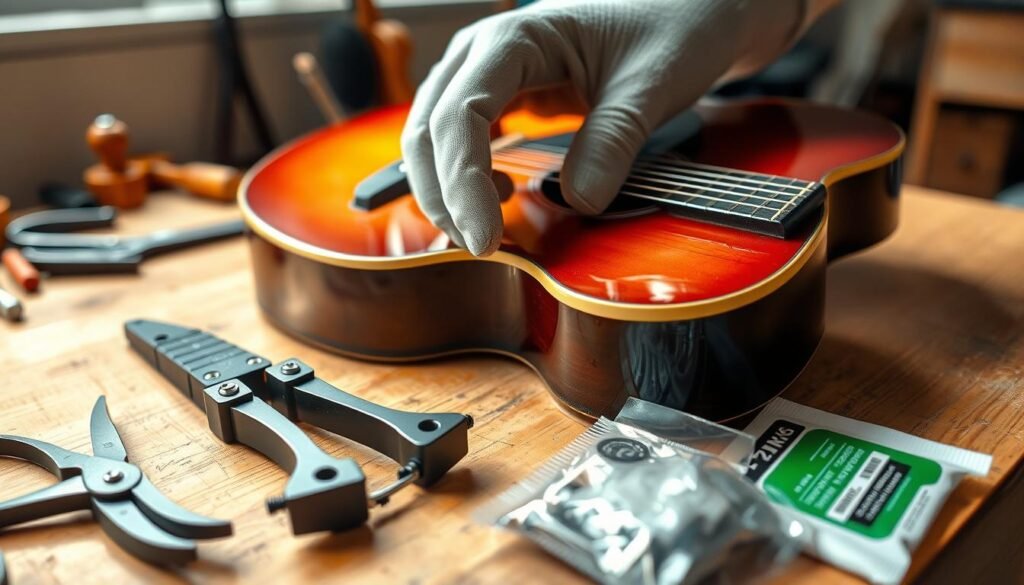
Work surface and protection
Clear a flat table and lay a soft towel or blanket to cushion the body. Place a small tray nearby for bridge pins, loose tuners, and the old strings. This prevents sharp ends from rolling off.
Cover the soundhole with a cloth when using steel wool on the fretboard. This stops dust from falling into the guitar. Sit in a comfortable chair at a height that lets you reach the headstock and bridge without strain.
| Item Name | Description | Calories | Price |
|---|---|---|---|
| Towel or blanket | Soft padding for the guitar body to prevent scratches | 0 | $0 (use household) |
| Small tray | Holds pins and cut strings for safe disposal | 0 | $5–$10 |
| Good lamp | Bright, angled light to see tuners and bridge clearly | 0 | $15–$40 |
| Cloth for soundhole | Prevents dust from entering when cleaning with steel wool | 0 | $0–$5 |
| Comfortable chair | Height that aligns you with headstock and bridge | 0 | $0–$150 |
| String winder | Speeds up tuning post turns and string removal | 0 | $8–$20 |
| Wire cutters | Neat trimming of excess string after winding | 0 | $10–$25 |
| Fretboard cleaner | Safe cleaning while strings are off | 0 | $6–$20 |
| New string set | Correct gauge and type for the instrument | 0 | $6–$20 |
| Masking tape | Optional: protect headstock finish when clamping | 0 | $2–$6 |
Choosing the right strings
Check the packaging for string gauge. Numbers like .012–.053 show thickness. If there are no markings, lay strings out largest to smallest to identify gauge. For beginners, a light gauge reduces breakage while learning.
Match string type to the instrument. Acoustic steel-string sets suit dreadnoughts and parlor guitars. Electric sets use nickel-plated steel for pickups. Consider brands like Elixir for coated longevity and D’Addario for consistent tone and value.
Keep a spare set on hand so a sudden break does not delay practice. Picking the right set before changing guitar strings makes restringing faster and helps you find the best way to string a guitar for stable tuning and tone.
Loosening and removing old strings safely
Before you start, clear a stable surface and gather your tools. You’ll need a string winder, cutters, and eye protection. A calm, stepwise approach keeps you safe and protects the instrument. This guide will help you loosen and remove bridge pins and old strings safely.
Start with the high E string and move down to the low E. Use a string winder to turn each tuner slowly until the string is slack. Pluck the string while turning; if pitch rises, reverse the tuner direction. Continue until each string produces no tension when plucked.
| Item Name | Description | Calories | Price |
|---|---|---|---|
| String winder | Speeds tuner winding and often includes a bridge-pin notch | 0 | $8 |
| String cutters | Flush cutters trim strings cleanly near the soundhole | 0 | $12 |
| Protective mat | Soft surface to shield finish during restringing | 0 | $10 |
| Needle-nose pliers | Helpful when a winder lacks a bridge-pin notch | 0 | $9 |
| Eye protection | Safety glasses to guard against snapped string ends | 0 | $6 |
| Coil bag | Small pouch for used strings before recycling | 0 | $4 |
| Bridge-pin puller | Designed to lift pins straight up without damage | 0 | $7 |
| Fretboard cleaner | Use between removing and installing strings | 0 | $11 |
| Tuner lubricant | Smooths post rotation for easier loosening | 0 | $5 |
| Masking tape | Protects finish near bridge when levering pins | 0 | $3 |
Removing bridge pins and old strings
Cut strings above the soundhole with flush cutters. This avoids scratching the guitar and makes lengths manageable. Use the notch on a string winder to lift bridge pins straight up. If no notch exists, place masking tape on the bridge to protect the finish. Then, use needle-nose pliers or cutters as a gentle lever, pushing upward near the saddle to avoid pin denting.
Remove ball ends and coil old strings together. Place used strings in a pouch for recycling or disposal. On acoustic guitars, set pins back into their holes after removal to keep them with the instrument. Wear eye protection when tension may be present and keep cut ends away from face and hands to prevent injury.
Following these steps makes removing guitar strings predictable and safe. Clear, slow movements reduce the chance of snapped strings or bridge damage when you’re restringing an acoustic guitar and preparing for the next set.
Cleaning and caring for the fretboard while strings are off
Removing strings is a rare chance to check and treat the fretboard. Proper cleaning and conditioning keep the wood healthy. This is important between string replacements and supports long-term care.
Follow a simple, safe order to avoid damage. Cover the soundhole with a towel to stop grit from falling into the body. Use a soft cloth to dust around the headstock, bridge, and fret ends before tackling stubborn grime.
Cleaning steps and tools
Start with a dry microfiber cloth to lift loose dirt. For unfinished rosewood or ebony, use 0000-grade steel wool gently along the grain to remove built-up grime. Taylor Guitar guidance supports this gauge when used carefully and kept off finished surfaces.
Keep steel wool away from metal hardware to prevent filings from embedding in tuners or pickups. Vacuum or brush the board after steel wool, and wipe again with a clean cloth so no residue remains before conditioning.
| Item Name | Description | Calories | Price |
|---|---|---|---|
| Microfiber Cloth | Soft lint-free cloth for dusting and final wipe | 0 | $5 |
| 0000 Steel Wool | Ultra-fine steel wool for removing grime on unfinished boards | 0 | $6 |
| Soft Brush | Small brush to clear filings from frets and hardware | 0 | $8 |
| Fretboard Oil | Taylor Fretboard Oil or boiled linseed oil for conditioning | 0 | $10 |
| Towel | Used to cover soundhole and protect the guitar body | 0 | $4 |
| Vacuum (small) | Removes steel wool residue and dust from the body cavity | 0 | $25 |
| Cotton Rag | Apply and remove oil without leaving lint | 0 | $3 |
| Cleaner for Maple | Light spray or damp cloth safe for lacquered maple fretboards | 0 | $9 |
| String Winder | Speeds removal and replacement during restring guitar tasks | 0 | $7 |
| Needle-nose Pliers | Helps with bridge pins and stubborn string ends | 0 | $12 |
Conditioning the fretboard
Choose a small amount of fretboard oil and rub it in with a rag, working a little area at a time. Wipe off excess to prevent sticky buildup. Condition only when the wood looks dry or every few rounds of guitar string replacement.
Avoid oil on lacquered maple. Use a slightly damp cloth or a cleaner made for finished maple boards. Regular, measured care helps keep frets smooth and tone stable during routine guitar maintenance.
how to string a guitar
Restringing an acoustic or electric guitar is easier with a calm, steady pace. This guide will show you how to string a guitar from the bridge to the tuners. It covers preparing new strings, seating ball ends, and the common order and method to keep strings neat and stable.
Preparing new strings at the bridge
Open the string packet carefully and uncoil each string away from your face. Identify the gauges by the package markings or arrange them largest-to-smallest if labels are unclear.
For acoustic guitars with bridge pins, seat the ball end into the hole. Make sure the bridge pin’s groove faces the headstock. Press while pulling the string up to seat the ball against the bridge plate. If pins feel tight, remove and retry instead of forcing them.
For electric designs with through-body or tailpiece systems, thread the ball end through the bridge, tailpiece, or tremolo block following the guitar’s layout. Pull the string until the ball end seats firmly against the bridge plate or block.
Order and method
Many technicians recommend working from the thickest string (6th, low E) to the thinnest (1st, high e). This low-to-high order helps keep new strings organized while you restring acoustic guitar or an electric model.
Seat the bridge end first for acoustics, insert the pin, then run the string to the corresponding tuner. Leave enough tail length for secure wraps: aim for 2–3 wraps on bass strings and 5–6 on treble strings. Exact counts vary with headstock layout.
Keep the first wrap closest to the tuner hole and wind subsequent wraps downward toward the headstock center. For treble strings, place the lower wraps below the edge of the tuner hole to avoid kinks and breakage.
| Item Name | Description | Calories | Price |
|---|---|---|---|
| D’Addario EJ16 | Phosphor bronze light acoustic set, clear tone and long life | 0 | $9.99 |
| Elixir Nanoweb | Coated acoustic strings for extended life and reduced finger noise | 0 | $19.99 |
| Ernie Ball Regular Slinky | Nickel-plated electric set with balanced tension | 0 | $6.99 |
| Martin Retro | Vintage-style acoustic bronze for warm, open sound | 0 | $12.50 |
| Fender 60/40 | Bright electric tone, good for bright, cutting leads | 0 | $8.99 |
| Cleartone Polished | Hand-polished acoustic strings for clarity and sustain | 0 | $14.99 |
| GHS Boomers | Durable electric strings with strong midrange | 0 | $7.49 |
| DR Sunbeam | Bright acoustic set that breaks in quickly | 0 | $11.00 |
| La Bella Deep Talkin’ Bass | Wound sets for low-string warmth on acoustic bass | 0 | $21.00 |
| John Pearse | High-quality acoustic bronze with balanced projection | 0 | $13.75 |
Hold each string taut while seating pins. Check that the ball end sits firmly against the bridge plate before tightening at the tuner. This practical approach reduces slippage and speeds tuning stability as you follow this guitar stringing tutorial.
- Work low-to-high to stay organized.
- Keep tails long enough for secure wraps.
- Replace stiff pins gently to avoid damage.
Stringing technique at the tuning machines
The way you string your guitar affects how well it sounds and feels. Use small, steady motions and keep the coils neat. This guide will help you string your electric guitar like a pro.
Begin by threading the string through the tuner post hole. Pull it tight so it fits well in the nut slot. Hold the string near the nut to make it easier to wrap.
For a secure wrap, start the first wrap over the tail end. Then, wrap each coil under the tail end. This creates a neat stack. Rubbing a pencil’s graphite into the nut slots helps with tuning.
Threading and winding best practices
Feed the string through the post and pull it tight until you have about two to three tuners’ worth of slack. This slack helps you wrap the string stably. Keep the coils tight and cut the tail close to the post to avoid getting caught.
Using a string winder can speed up the process. But, check the coil alignment often. Tune slowly and avoid over-tightening. These steps will make stringing your guitar faster and easier.
Recommended wrap counts and directions
Bass strings need 2–3 wraps around the post, with the coils heading toward the headstock. Treble strings require 5–6 wraps for stability, also pointing toward the headstock.
Make sure the first wrap goes over the free end and the next wraps go under it. This locks the string in place. Keep the wraps neat and cut the tails close to the post for safety and a clean look. These steps ensure your guitar stays in tune quickly.
| Item Name | Description | Calories | Price |
|---|---|---|---|
| Ernie Ball Regular Slinky | Light gauge electric set favored for balance and tone | 0 | $6.99 |
| D’Addario NYXL | High-tension steel core for extra tuning stability | 0 | $11.99 |
| DR Strings Pure Blues | Roundwound with warm mids and comfortable feel | 0 | $9.50 |
| Planet Waves Pro-Winder | Handy combo with cutter and bridge pin puller | 0 | $12.00 |
| Fender 2mm Graphite Stick | Easy nut lubrication to reduce binding | 0 | $3.99 |
| Music Nomad String Cleaner | Extends string life by removing oils and grime | 0 | $8.49 |
| Gibraltar String Winder | Durable winder for faster turning | 0 | $7.25 |
| Kyser Quick-Change Capo | Helps with tuning and quick capo changes | 0 | $14.99 |
| Planet Waves Propeg | String winder with integrated cutter and peg puller | 0 | $13.50 |
| Dunlop Posi-Lok Cutter | Flush-cut cutters for clean tail trimming | 0 | $16.95 |
- Keep wraps neat and direct coils toward headstock center to lower slippage.
- Use light graphite in nut slots to reduce friction when you stretch strings.
- Follow recommended wrap counts for each string to match tuning stability needs.
Stretching, tuning, and trimming for stable tuning
After changing guitar strings, small actions can make a big difference. A calm and careful approach helps avoid frustration. The goal is to make each string stable, so it keeps its pitch during playing and performances.
Start by tuning each string with a reliable tuner. Gently pull the string away from the fretboard at the 12th fret. Use your finger to bend the string a bit, not to pull it hard.
Keep stretching and tuning until the string’s pitch is steady. New strings often need several gentle stretches in the first 10–20 minutes. This practice helps strings settle faster after a restring.
| Item Name | Description | Calories | Price |
|---|---|---|---|
| Light Stretch | Short, gentle pull at 12th fret to reduce initial slippage | 0 | $0 |
| Cyclic Tuning | Tune low-to-high then repeat to balance tension across the neck | 0 | $0 |
| Clip Trim | Cut excess string close to tuner post to prevent snags | 0 | $5 |
| Final Check | Re-check tuning after trimming and a short break | 0 | $0 |
| Patience Time | Allow strings to settle for several hours before important sessions | 0 | $0 |
| Repeat Cycle | Perform stretch-and-tune iterations until pitch holds | 0 | $0 |
| Use Quality Tuner | Clip-on or pedal tuner gives precise readings during setup | 0 | $15–$80 |
| String Cutters | Flush cutters trim tails close to posts to reduce snag risk | 0 | $8–$25 |
| Gentle Technique | Avoid aggressive pulls to lower chance of breakage | 0 | $0 |
| Check Intonation | After strings settle, verify intonation and make final tweaks | 0 | $0 |
Tuning sequence and trimming
Follow a clear sequence: tune from the lowest string to the highest or the reverse, then cycle through again. Strings often get sharper after the first stretches, so repeat tuning until each string stays put.
When strings hold pitch after several cycles, trim the excess tail near the tuner post with flush cutters. Leave a small bit to avoid slippage, then re-check each string. A careful trim reduces snags and supports long-term tuning stability.
Expect new strings to need attention for a few hours. Before any important session, check tuning once more. These steps make guitar string replacement feel routine and keep your instrument sounding its best.
Common problems and troubleshooting guitar restringing
Changing strings can make your guitar sound better and feel easier to play. But, it can also reveal small problems. This guide will help you fix common issues when you restring your acoustic guitar. Follow these steps and checks to solve tuning problems and keep your guitar in top shape.
When changing strings, pull pins straight up to avoid cracking. Use a string winder or a light plier to keep the force vertical. Heavy tools can dent pins and let the ball end slip. Always have spare bridge pins from Martin or Fender ready to replace any that are damaged.
If a pin is tight, don’t force it. Remove it, clean the hole with a soft cloth, and re-seat the string. A clean seat helps prevent slippage and makes it easier to remove pins later.
Tuning instability and string breakage
Poor winding and friction at the nut can cause tuning problems. Start each string with a locking overlap and wind towards the headstock center. Keep the bottommost treble wraps below the tuner hole edge to avoid kinks.
Use graphite from a pencil or a nut lubricant to lower friction. Stretch new strings gently by pulling them to pitch and retuning several times. Use light gauge strings while learning to restring to lower breakage risk.
String breaks often happen at sharp bends, damaged ball ends, or when tuning too high too fast. Check the string ends for corrosion or nicks. Proper winding technique and pre-stretching can prevent most failures.
Action and buzzing after restringing
New tension can change neck relief and reveal fret buzz or higher action. Check fret relief by capoing the first fret and measuring the gap at the 7th or 8th fret. Small tweaks to the saddle can adjust action slightly. Sand the saddle in tiny steps and test often.
If buzzing appears, inspect low frets and adjust the truss rod in small turns. Let the neck settle for 24 hours after a string change before declaring a problem. Persistent issues are best handled by a luthier or tech at a local shop like Sweetwater or Guitar Center for a professional setup.
| Item Name | Description | Calories | Price |
|---|---|---|---|
| Bridge Pins | Replacement pins in ebony or plastic to avoid pin damage | 0 | $6–$15 |
| String Winder | Winder with notch to remove bridge pins and speed winding | 0 | $5–$20 |
| Graphite Pencil | Lubricant for nut slots to reduce tuning instability | 0 | $1–$3 |
| Light Gauge Strings | Easy-to-stretch sets for beginners and fewer breaks | 0 | $6–$12 |
| Spare Saddles/Shims | Thin shims for raising saddle height without heavy modification | 0 | $3–$10 |
| Pliers (soft-jaw) | Removing tight bridge pins without chipping edges | 0 | $10–$25 |
| Cloth & Cleaner | Clean pin holes and fretboard when strings are off | 0 | $5–$15 |
| Truss Rod Wrench | Adjust neck relief in small, safe increments | 0 | $8–$20 |
| Quality Strings | Durable, well-made sets to reduce corrosion and breakage | 0 | $8–$20 |
| Electronic Tuner | Accurate tuning to avoid over-tightening and initial instability | 0 | $10–$40 |
- Use the string winder notch as a lever when possible.
- Lock the first wrap and wind in the correct direction to limit tuning instability.
- Stretch strings and retune repeatedly after installation.
These practical guitar restringing tips keep repair time short and tone steady. When small fixes don’t help, seek a professional setup to protect the instrument and maintain playability.
Conclusion
Learning to string a guitar is simple. First, prepare your tools and a safe area. Then, loosen and remove the old strings. Clean the fretboard and prepare the new strings at the bridge.
Wind the strings neatly at the tuners. Stretch and tune them several times. Trim the ends and check the tuning. This method keeps your guitar in tune and extends string life.
For regular care, change strings every 40–60 hours or 2–3 months if you play less. Do it sooner if strings appear dirty, rusted, or sound bad. Use a string winder, cutters, and a good tuner to make the process faster.
Choose brands like D’Addario or Elixir. Start with light gauges for easier winding and tuning. This helps beginners.
After restringing, play and listen for better sound and feel. If tuning issues persist, check the nut, winding, and bridge pin seating. If problems continue, get a professional setup for action or buzzing issues.
Follow these tips and techniques to keep your guitar sounding great.