
How Many Strings Does a Guitar Have? Unveiling Facts
The modern standard guitar usually has six strings. This number is common in both acoustic and electric guitars used in popular music. Knowing how many strings a guitar has helps you choose the right one and learn fast.
Six-string guitars have strings of different thicknesses. They are numbered from thinnest (1st) to thickest (6th). The standard tuning is E (high E), B, G, D, A, low E. This tuning is key in much of today’s guitar music.
From ancient plucked instruments to the six-string design today, there’s a rich history. Luthiers like Antonio Torres Jurado and Christian Frederick Martin helped shape modern guitars. Electric guitars, after innovations and models like the Gibson ES-150, also adopted six strings.
Later, guitars with seven and eight strings were made for heavier music. Today, makers keep innovating with new materials and designs. While six strings are standard, guitars can have more or fewer strings depending on the style and need.
how many strings does a guitar have

Most modern guitars have six strings. This setup is great for playing chords, melodies, and common tunes in rock, folk, blues, and pop.
But, not all guitars have the same number of strings. Bass guitars have four strings, classical guitars use six nylon strings, and twelve-string acoustics have paired courses for a shimmering sound.
| Item Name | Description | Calories | Price |
|---|---|---|---|
| Six-string acoustic | Standard six single strings for chords and fingerstyle | 0 | $199 |
| Four-string bass | Low-pitched four-string setup for bass lines | 0 | $249 |
| Twelve-string acoustic | Paired courses creating bright, ringing tones | 0 | $349 |
| Seven-string electric | Extended range with an extra low string for heavy riffs | 0 | $399 |
Knowing how many strings a guitar has is important. It affects the range of notes you can play, the chords you can make, and the songs you can play. Musicians pick their instruments based on their style and skill level.
Playing a guitar is similar, no matter how many strings it has. You use one hand to press the strings and the other to strum or pick. But, the feel of the guitar can change based on its scale length, string spacing, and setup.
Standard six-string guitar explained and tuning details
The six-string guitar is the most popular choice for beginners. It fits many musical styles well. This section explains the string numbers, tuning notes, and materials. You’ll learn how these affect the guitar’s sound and feel.
String numbering and order
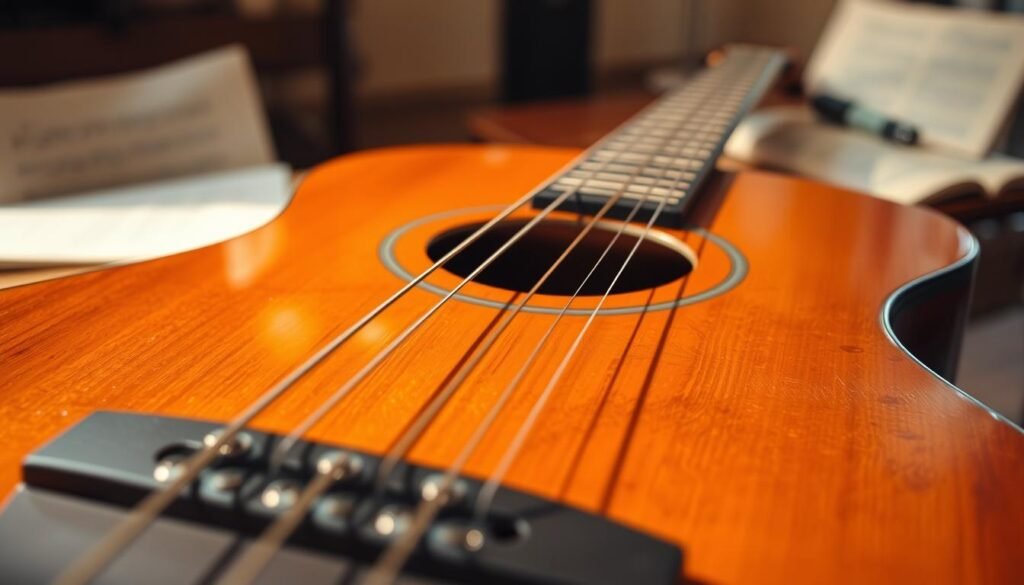
Strings on a six-string guitar are numbered from 1 to 6. The thinnest string is 1, and the thickest is 6. When playing, the 6th string is closest to the headstock, and the 1st is closest to the floor.
The standard order is: 1 = high E, 2 = B, 3 = G, 4 = D, 5 = A, 6 = low E. Knowing this helps you read tablature, tune your guitar, and talk with others about music.
Standard tuning and standard notes
Standard tuning for a six-string is E2, A2, D3, G3, B3, E4. This tuning is great for many types of music. It helps you learn songs and play chords and scales easily.
Using standard tuning makes learning songs and following music easier. It shows how each string adds to the music’s melody and harmony.
String construction and materials
How a string is made depends on the guitar type. Classical guitars use nylon strings, while steel-string acoustics use phosphor-bronze or bronze. Electric guitars often have nickel-plated steel or stainless steel strings.
Strings can be wound in different ways. Roundwound strings are bright and noisy, while flatwound strings are smooth and dark. Coated strings, like Elixir and D’Addario XT, resist sweat and last longer.
Choosing the right materials and winding affects how the string feels and sounds. Changing strings might need adjustments to keep the guitar playing well.
| Item Name | Description | Calories | Price |
|---|---|---|---|
| D’Addario EJ16 | Light phosphor-bronze acoustic set, balanced tone and tension for general play | 0 | $8.99 |
| Elixir Nanoweb | Coated acoustic set with long life and bright tone retention | 0 | $19.99 |
| Ernie Ball Regular Slinky | Nickel-plated steel electric set, popular for rock and blues | 0 | $6.99 |
| D’Addario Nylon Classical | Clear nylon trebles with silver-plated wound basses for classical guitars | 0 | $7.50 |
| DR Strings Tite-Fit | Roundwound electric set with durable wrap and crisp attack | 0 | $12.99 |
| GHS Boomers | Bright, sustaining electric strings favored by live players | 0 | $9.50 |
| Martin SP Lifespan | Coated acoustic set designed for extended tone life and warm response | 0 | $17.99 |
| D’Addario XS | Electric coated strings with consistent feel and corrosion resistance | 0 | $16.99 |
| Thomastik-Infeld Jazz | Flatwound set for smooth feel and dark jazz tones | 0 | $34.00 |
| Cleartone Acoustic | Coated acoustic strings with bright tone and long life | 0 | $14.00 |
Guitar string variations and extended-range instruments
Guitarists pick instruments with different string counts for their music and sound goals. This section shows common and rare options. It helps you decide on range, feel, and setup needs before changing your instrument or technique.
Seven- and eight-string models
Seven-string guitars add a low B below the standard low E. This extends the bass range. Metal and modern jazz players use it for heavier riffs and wider voicings.
Eight-string guitars go further, often adding a low F# or lower. Some designs have a high A instead for extended soloing. These instruments need wider necks and heavier string gauges for proper tension and intonation.
| Item Name | Description | Calories | Price |
|---|---|---|---|
| 7-string (standard) | Low B added; suited for heavy riffs and jazz voicings | 0 | $700–$2,500 |
| 8-string (extended) | Low F# or lower; wider range for progressive and djent styles | 0 | $900–$3,500 |
| 12-string | Six courses of two strings produce a chiming chorus effect | 0 | $400–$2,000 |
| 4-string instruments | Bass and tenor guitars; simpler tuning and spacing | 0 | $200–$2,200 |
| 10-/harp guitars | Additional open bass or sympathetic strings for resonance | 0 | $1,200–$6,000 |
Twelve-string guitars and course pairs
The 12-string pairs each of the six notes into courses. The top two courses (high E and B) are in unison. The lower four are tuned in octaves for rich harmonics.
This setup creates a natural chorus effect used in folk, rock, and jangle pop. Players will notice different tactile feedback and wider headstocks for the paired tuners.
Other uncommon counts and specialty designs
Four-string setups are standard for bass guitar (E-A-D-G) and common on tenor guitars for folk and traditional styles. Five-course instruments were frequent in Renaissance and regional traditions.
Ten-string and harp guitars add open or sympathetic strings to expand resonance and low-end reach. Classical ten-string models and harp hybrids are great for studio and solo repertoire that demands extra sustain and color.
Practical choices
Choosing a guitar string total depends on music, comfort, and gear. Extended-range instruments change hand spacing and require amp and pickup considerations.
Think about the number of strings on a guitar before committing. Pick a count that fits your technique, genre, and long-term goals. This way, you’ll get the most from your playing.
History of guitar string counts and evolution to six strings
The story of guitar strings goes back thousands of years. Early harps and lutes in Egypt, Mesopotamia, and Persia were the first to use strings. These instruments had just two to three strings to play simple tunes.
In the medieval times, pictures from Hittite and Babylonian sites showed lute-like instruments. People started to use more strings, trying different ways to sound good. This was the start of the journey to the guitar we know today.
During the Renaissance and Baroque, makers made instruments with more strings. In Spain and Italy, guitars and vihuelas had four or five courses of strings. These were paired to sound good together, not like today’s single strings.
Music of that time used tablature to write down parts. This showed how strings were grouped, not single strings. The names like chitarra and chartar connect old traditions to the modern guitar.
In the 17th century, Italian makers started to use more single strings. This made music clearer for soloists and groups. It also changed how people thought about the best number of strings.
By the 19th century, Antonio Torres Jurado made the modern classical guitar. He used larger bodies and special bracing. At the same time, American makers like Christian Frederick Martin made guitars with steel strings. This changed how guitars sounded and felt to play.
In the early 20th century, electric guitars came along. Gibson’s ES-150 and players like Charlie Christian made six-string electric guitars popular. The use of new materials like nylon and steel strings finished the journey to today’s six-string standard.
| Item Name | Description | Calories | Price |
|---|---|---|---|
| Egyptian lute ancestor | Small, simple plucked instrument with 2–3 strings; early melodic use | 0 | $0 |
| Renaissance four-course guitar | Paired courses tuned in unison or octaves; popular for dance and song | 0 | $0 |
| Baroque five-course vihuela | Spanish influence with rich polyphony, used tablature notation | 0 | $0 |
| Early single-string Italian guitar | Transition toward separate strings, clearer melody lines | 0 | $0 |
| Torres classical design | Standardized dimensions and fan bracing for six-string nylon guitars | 0 | $0 |
| Martin X-braced steel acoustic | Stronger top for steel strings; expanded projection and tone | 0 | $0 |
| Gibson ES-150 electric | Early amplified guitar that helped normalize six-string electrics | 0 | $0 |
| Modern six-string guitar | Contemporary standard across genres, nylon and steel variants | 0 | $0 |
| Extended-range instruments | Seven-, eight-, and twelve-string designs for broader range | 0 | $0 |
| Harp and bass hybrids | Specialist instruments adding sympathetic or extra bass strings | 0 | $0 |
The journey to six strings was shaped by music, materials, and maker skills. The history of guitar strings shows how they evolved to meet player needs.
Knowing how guitar strings changed helps us understand instrument design and musical tastes. Today’s six-string standard is the result of centuries of innovation and craftsmanship.
Types of guitars and typical string counts by instrument
The guitar family includes many instruments with different uses and string setups. The number of strings on a guitar affects its sound, playing style, and the music you can play.
Classical and nylon-string guitars
Classical (Spanish) guitars have six nylon strings. The top three strings are plain nylon for a clear sound. The bottom three have a nylon core with metal for deeper bass.
This setup is great for classical, flamenco, and fingerstyle music. It works well with wide necks, helping with finger independence.
Steel-string acoustics and electrics
Most steel-string acoustic guitars have six strings made of steel or bronze. The bracing supports the higher tension of these strings. Electric guitars also have six strings, made of steel or nickel-plated, for versatility in many genres.
Twelve-string guitars double courses for a shimmering sound, available in both acoustic and electric models.
Bass guitars and other stringed relatives
Standard bass guitars have four strings tuned E-A-D-G. They are key for low-end sounds. Five- and six-string basses add a low B or high C for more range in modern music.
Other relatives like the requinto, guitarrón, tiple, and ukulele family often have four strings. Harp guitars, baritone guitars, and extended-range classical instruments vary in string count, from extra bass strings to alternate course setups.
| Item Name | Description | Calories | Price |
|---|---|---|---|
| Classical Guitar | Six nylon strings; suited for classical and flamenco; wide neck | 0 | $399 |
| Steel-String Acoustic | Six steel/bronze-wound strings; bright tone; X-bracing | 0 | $499 |
| Electric Guitar (Solid Body) | Six nickel-plated strings; versatile for many genres | 0 | $699 |
| Twelve-String Acoustic | Twelve strings in six courses; rich, chorus-like sound | 0 | $899 |
| Standard Bass | Four strings (E-A-D-G); foundational low-end role | 0 | $549 |
| Five-String Bass | Five strings with added low B; extended low range | 0 | $649 |
| Six-String Bass | Six strings with low B and high C; wide range for solos | 0 | $799 |
| Baritone Guitar | Longer scale; tuned lower than standard six-string | 0 | $749 |
| Harp Guitar | Six strings plus additional open bass or treble strings | 0 | $1,299 |
| Ukulele | Four strings; small, bright-toned soprano to tenor sizes | 0 | $89 |
- Consider the musical role when selecting string quantity.
- Match neck shape and scale length to playing style.
- Test different string counts to find the best fit for your repertoire.
How string count affects tone, playability, and musical style
The number of strings on a guitar shapes its voice and how you play it. Choices in guitar string count and guitar string variations change range, harmonic color, and the relationship between your fretting and picking hands.
Adding strings expands the pitch range. A seven- or eight-string model adds low notes for deeper riffs and new voicings. A twelve-string pairs courses to create a natural chorus and richer overtones. These guitar string variations let players explore bass extensions or shimmering upper registers without changing tuning radically.
| Item Name | Description | Calories | Price |
|---|---|---|---|
| Six-string electric | Standard range for most styles; balanced midrange and treble | 0 | $0 |
| Seven-string guitar | Adds a low B for heavier riffs and extended chords | 0 | $0 |
| Twelve-string acoustic | Pairs strings in courses for bright, chiming textures | 0 | $0 |
| Extended bass | Low tunings for modern metal and jazz fusion | 0 | $0 |
Playability and string spacing
More strings often mean a wider neck. Wider necks change fretting hand reach and may require new fingering patterns. At the same time, adding strings reduces spacing between adjacent strings. This tighter spacing affects fingerstyle comfort and picking accuracy.
Classical guitars keep wider spacing to aid fingerstyle technique. Electric models with narrower spacing favor fast alternate picking and sweep patterns. When you try different instruments, check how the neck width and string spacing match your hand size and technique.
Genre-driven choices
Different genres push players toward specific string counts. Folk and jangle pop love the chiming texture of twelve-string acoustics. Metal and progressive players favor seven- or eight-string guitars for low-end power and extended-range riffs. Jazz and studio musicians may prefer four-string basses or modified counts to fit tonal needs.
Pick a string count based on the music you play, ergonomic comfort, and whether you need extended range or traditional voicings. Visit a music store to test guitar string variations and consider lessons or online tutorials when shifting to a different number of strings on a guitar.
String gauge, materials, and their influence on sound and feel
Choosing the right guitar string gauge shapes tone, tension, and playability. Lighter sets bend easily and favor lead work. Heavier sets deliver more volume and sustain on acoustic instruments. Think of gauge as the first decision that guides setup and feel.
Gauge measures thickness in thousandths of an inch. A common light electric set is .009–.046. A common heavy acoustic set is .012–.054. Lower gauge numbers reduce tension, making bends simpler. Higher gauge numbers raise tension, giving fuller low end and longer sustain.
Changing the guitar string amount or moving between light and heavy sets changes neck relief and action. When the string tension rises, the truss rod may need loosening. When tension drops, the truss rod may need tightening. Small adjustments prevent fret buzz and keep intonation stable.
| Item Name | Description | Calories | Price |
|---|---|---|---|
| D’Addario EJ16 | Light phosphor bronze acoustic set, balanced warmth | 0 | $9.99 |
| Elixir Nanoweb | Coated acoustic set for longer life and smooth feel | 0 | $19.99 |
| Ernie Ball Regular Slinky | Nickel-plated steel electric set, bright and versatile | 0 | $6.99 |
| D’Addario NYXL | High-tension electric set with improved tuning stability | 0 | $12.99 |
| Martin MA170 | Light acoustic phosphor bronze, warm resonance | 0 | $11.99 |
| DR Strings Tite-Fit | Stainless electric set for durability and clarity | 0 | $14.99 |
| La Bella 2001 | Nylon classical set, mellow and traditional | 0 | $7.99 |
| Thomastik-Infeld | Premium coated acoustic set with smooth feel | 0 | $24.99 |
| Elixir Electric Nanoweb | Coated electric set for extended life and reduced grime | 0 | $16.99 |
| D’Addario EJ11 | 80/20 bronze acoustic set, brighter sound | 0 | $8.99 |
Materials and coatings
Acoustic strings often use phosphor bronze for warmth. 80/20 bronze gives a sharper, brighter voice. Electric strings commonly use nickel-plated steel for balance. Stainless steel resists corrosion and yields extra brightness.
Nylon strings give a soft, mellow classical tone. Gut remains a historical option for period instruments. Coated strings from Elixir, D’Addario EXP, and Ernie Ball Coated add a thin polymer layer. Coatings extend life and cut finger-grime without muting tone drastically.
Setup considerations when changing gauges or adding strings
Changing the guitar string total or converting to an extra string requires measured setup work. Adding a seventh string typically needs a wider nut or a new nut altogether. Bridge saddles, intonation, and nut slot depth must match the new gauges.
Consult manufacturers’ tension charts before picking gauges for alternate tunings. Extended-range instruments need heavier low strings to avoid floppy feel and to keep stable intonation. A professional setup ensures the neck, nut, and bridge react well to a different guitar string amount.
Try sample sets from trusted brands before committing. Players who experiment find the sweet spot between comfort and tone faster when they match gauge, material, and the instrument’s build. This approach reduces surprises and protects playability over time.
Common tunings for different string counts and practical tips
Choosing a tuning affects your sound, chord shapes, and how easy it is to play. Whether you’re wondering about the number of strings on a guitar or exploring extended-range instruments, the tuning you pick is key. This section will cover practical options and simple habits to keep your instrument in tune on stage and in the studio.
Standard six-string tuning is E-A-D-G-B-E. It fits most method books, backing tracks, and gig setups. Many players stick to common tunings to make melody and rhythm parts easy to switch between.
Drop D (D-A-D-G-B-E) gives a heavier low-end and single-finger power chords. Open G (D-G-D-G-B-D) is great for slide and roots-plus-drone textures. DADGAD (D-A-D-G-A-D) suits Celtic and folk voicings. These tunings let you explore unique chord shapes and drone notes without changing the guitar’s string count.
Tunings for seven- and eight-string guitars add a low B or low F# below the standard six strings. Players often tune the extra bass down further for metal and djent styles. Remember to adjust scale length and gauge to keep the low strings in tune.
Use heavier gauges for the extra low string, and set the truss rod and intonation correctly. If you switch from six to seven or eight strings, expect setup adjustments to optimize action and resonance.
Tuning strategies focus on consistency. Stretch new strings gently, tune in small steps, and re-tune after a short playing period. For alternate tunings, keep spare strings in the gauges you prefer. This keeps tone and tension steady when changing tunings between songs.
| Item Name | Description | Calories | Price |
|---|---|---|---|
| Clip-on tuner | Fast, accurate chromatic tuning for live and practice | 0 | $20 |
| Pedal tuner | Road-ready, mute function, visible on stage | 0 | $90 |
| Smartphone app (Fender Tune) | Convenient, visual reference and practice modes | 0 | Free |
| Heavy gauge set (for 7/8 string) | Maintains tension on extra-low strings and reduces floppiness | 0 | $18 |
| Spare string pack | Matched gauges for alternate tunings and quick changes | 0 | $12 |
| String winder | Saves time during string changes and tuning swaps | 0 | $8 |
| Intonation tool | Helps set accurate saddle positions after gauge or tuning changes | 0 | $25 |
| Reference pitch fork | Useful for ear training and tuning by ear | 0 | $15 |
| Maintenance kit | Cloths, lubricant, and storage case to prolong string life | 0 | $22 |
| Metronome | Supports timing when training to tune by ear and play in tempo | 0 | $10 |
Standard tuning for six-string and common alternatives
Start with E-A-D-G-B-E for most lessons and sessions. Use Drop D for a low power sound. Open tunings like Open G or DADGAD are great for slide, folk, and drone styles. These options show that common guitar tunings are tools, not limits.
Tuning strategies for extended-range guitars
When adding strings, keep the top strings in standard pitches and extend bass below. Match heavier gauges to the extra string and check scale length. Proper setup prevents fret buzz and keeps intonation true.
Tuning tools and techniques
Carry a reliable tuner, whether a Snark clip-on, Peterson pedal, or a smartphone app like Fender Tune. Practice tuning by ear using harmonics and 5th-fret comparisons for better intonation skills. Keep spare strings and the right gauges on hand for quick swaps.
Knowing guitar string number and the tunings that suit it helps you make musical choices with confidence. Adopt simple maintenance habits and you will spend less time fixing tuning problems and more time playing.
Changing and maintaining guitar strings for longevity and performance
Proper string care keeps your instrument sounding clear and playing well. Here are steps for a safe string change and maintenance. These steps help extend life and preserve tone. They also help manage the guitar string amount and understand the total you need for different instruments.
- Tools: use a string winder, wire cutters, a reliable tuner, and a soft cloth.
- Loosen and remove strings one at a time, unless you prefer a full removal. Clean the fretboard and inspect frets while strings are loose.
- Install new strings through the bridge and onto tuning pegs. Wind carefully, trim excess, then bring each string up to pitch.
- Gently stretch new strings, retune repeatedly until stable, and verify intonation and action after a full set change.
String care and storage tips
- Wipe strings after each session with a soft cloth to remove sweat and oils that speed corrosion.
- Consider a string cleaner or lubricant for longer life, specially on steel strings.
- Store spare sets flat in a cool, dry place. Keep the guitar in a hard case or a room kept at 45–55% humidity for wooden instruments.
- Coated brands from Elixir and D’Addario last longer but also benefit from routine wiping and proper storage.
When and why to replace strings
- Replace strings when tone becomes dull, sustain drops, or strings show corrosion, discoloration, or fraying.
- Frequency depends on use: gigging professionals may change weekly; avid hobbyists might swap monthly; casual players can aim for seasonal changes.
- Having spare sets in the right gauges at gigs and practice sessions prevents long downtime and ensures consistent sound.
| Item Name | Description | Calories | Price |
|---|---|---|---|
| D’Addario EXL110 | Nickel wound, balanced tension, popular for electric guitars | 0 | $6.99 |
| Elixir Nanoweb | Coated strings for extended life and reduced finger noise | 0 | $12.99 |
| Martin SP Lifespan | Acoustic phosphor bronze with protective treatment | 0 | $9.99 |
| Ernie Ball Regular Slinky | Bright tone, light gauge choice for electric guitars | 0 | $7.49 |
| Thomastik-Infeld Classic | High-quality nylon sets for classical guitars | 0 | $29.00 |
| DR Strings Lo-Rider | Oil-tempered for a warm, long-lasting tone on acoustics | 0 | $11.50 |
| GHS Boomers | Powerful projection for stage and recording | 0 | $8.99 |
| Elixir Polyweb | Smoother feel, extended coating life for acoustics | 0 | $13.99 |
| D’Addario EJ45 | Phosphor bronze light gauge, classic acoustic tone | 0 | $8.99 |
| Martin M170 | Bronze acoustic set with balanced response | 0 | $9.50 |
Tracking the guitar string total you own simplifies gig prep and maintenance planning. Count your spare packs to match the guitar string amount needed for each instrument you play. Consistent care makes new strings sound better longer and reduces the chance of unexpected failures on stage or in the studio.
Specialized strings and modern innovations in string technology
The market for specialized guitar strings has grown fast. Players now have options that extend lifespan, change feel, or suit alternate tunings. These choices help match tone and playability to style and instrument.
Coated strings from Elixir, D’Addario (EXP/XT), and Ernie Ball resist sweat and grime to last longer. Coatings can soften the initial brightness and change the fingertip feel. Many players accept this trade-off for fewer string changes and more consistent tone over time.
| Item Name | Description | Calories | Price |
|---|---|---|---|
| Elixir Nanoweb | Polymer coating for bright yet long-lasting acoustic tone | 0 | $16–$22 |
| D’Addario EXP/XT | Coated sets with traditional feel and extended life | 0 | $12–$20 |
| Ernie Ball Coated | Durable coating for electric and acoustic use | 0 | $10–$18 |
| La Bella Flatwound | Smooth surface for jazz, reduced finger noise | 0 | $18–$28 |
| DR Strings Tite-Fit | Hybrid winding with balanced tension and warmth | 0 | $12–$20 |
| AeroBand Silicone Set | Silicone-based prototype for comfort and modular electronics | 0 | $35–$60 |
| D’Addario Hybrid Set | Mixed materials to balance brightness and smoothness | 0 | $14–$22 |
| Gauged Baritone Set | Higher tension for longer scale lengths and lower tunings | 0 | $18–$30 |
| Tenor Specialist | Strings tailored to tenor scale and tension demands | 0 | $12–$24 |
| Hybrid Groundwound | Groundwound on lower strings, roundwound trebles | 0 | $16–$26 |
Winding types shape tone and feel. Roundwound strings deliver bright tone and textured feel. Flatwound strings offer a smooth surface, low finger noise, and darker jazz tones. Halfwound, groundwound, and hybrid constructions aim to blend warmth with some sparkle.
Recent guitar string innovations include silicone and polymer experiments. Companies introduced prototype silicone strings that reduce fingertip wear and pair with built-in electronics for tone switching. Hybrid sets mix materials and gauges for stable tension in alternate tunings and extended-range instruments.
Specialty strings exist for tenors, baritones, harp guitars, and extended-range models. These sets keep proper tension across longer scale lengths and nonstandard tunings. Designer sets from established brands help maintain playability without repeated trial and error.
Practical advice: try coated versus uncoated sets and sample flatwound and roundwound types to find what suits your genre and touch. Consult brand tension charts when moving between constructions or changing scale length. Small experiments yield big gains in comfort and tone.
- Test one set type at a time to notice differences in feel and tonal balance.
- Use tension charts from D’Addario, Elixir, or Ernie Ball when changing gauges.
- Consider groundwound or hybrid sets for mixed-genre playing.
- Explore specialty sets for baritone, tenor, or harp guitars to optimize tension.
- Specialized guitar strings help you tailor sound and maintenance.
- Guitar string innovations keep advancing comfort and durability.
- Guitar string variations offer targeted choices for each instrument type.
Note: testing remains the best way to match strings to your guitar and style. Small changes in construction create clear shifts in tone and playability.
Conclusion
Most guitars have six strings. This standard has grown over centuries. It shapes how we play music today.
When you ask about guitar strings, you often get six as the answer. But, there are guitars with four, five, seven, eight, and twelve strings too. Each type is used in different music styles and offers unique sounds.
Things like string material and gauge affect how a guitar sounds and feels. Changing strings might need adjustments to the guitar’s setup. Choose the right number and type of strings for your music and comfort. Always have a tuner and extra strings ready. Regular string maintenance is key for great sound.