Understanding Guitar Fret Numbers: How Many Frets on a Guitar
Imagine holding a guitar in front of you. The strings go towards your face. The fretboard has dots at key points. These dots are at frets 3, 5, 7, 9, and a double dot at 12 to mark the octave.
Most guitars have 19 to 24 frets. The nut is zero for an open string. Each fret is one semitone. Beginners often see 19 frets, but electric and acoustic guitars can have 24.
The 12th fret is special. It makes the same note an octave higher. This means patterns and notes repeat after 12 frets. Standard tuning (E-A-D-G-B-E) helps map notes and read tabs.
This section covers the basics: how many frets a guitar has, what fret numbers mean, and how to use frets and markers. The next parts will dive deeper into fret counts, the importance of extra frets, and tips for memorizing the neck.
Overview of Guitar Frets and Fretboard Anatomy with guitar frets keyword
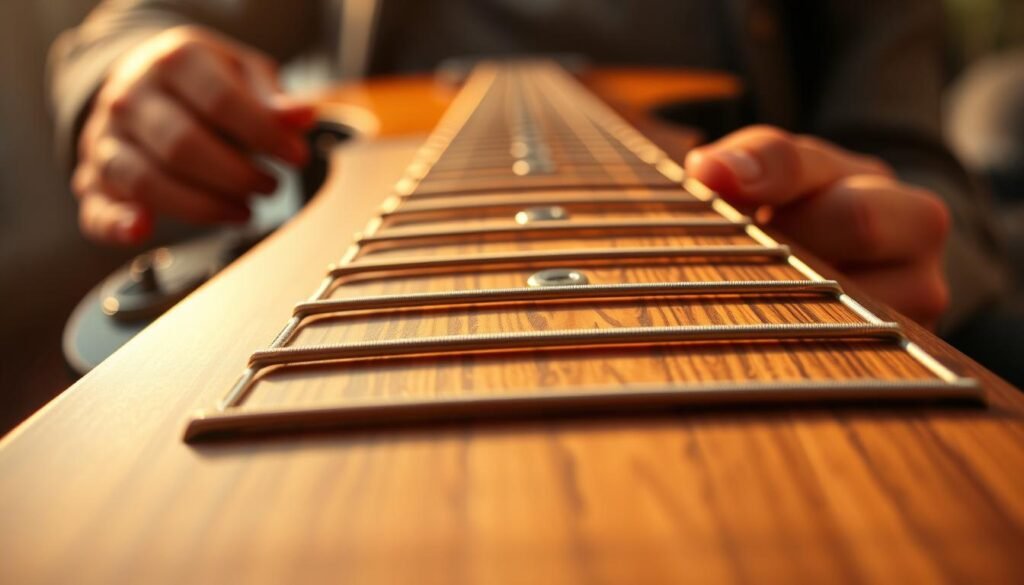
The fret is a thin metal strip on the guitar fingerboard. Each fret marks a semitone step. Pressing a string just behind a fret raises the pitch by one semitone. Knowing where frets sit helps you move up and down the neck with purpose.
The nut is at the end of the fingerboard where open strings start. The neck holds the fretboard and guitar neck frets, giving the instrument its reach and spacing. You’ll see fret markers—dots or inlays—at common spots like 3, 5, 7, 9 and a double mark at 12. These markers help you navigate quickly when you shift positions.
Guitar frets are numbered from the nut outward. The 12th fret is a landmark because it repeats open-string pitch one octave higher. Patterns on the guitar fretboard anatomy repeat after 12 frets, so mapping notes up to that point gives you a full visual map for the whole fingerboard.
Tablature mirrors the fingerboard visually. Six horizontal lines represent strings, with numbers showing which fret to press. Tabs let you find notes quickly without reading standard notation, making fret-based learning accessible for beginners.
| Item Name | Description | Calories | Price |
|---|---|---|---|
| Nut | Slot that anchors open string spacing at headstock end | 0 | $0.00 |
| First Fret | First metal strip after the nut; begins semitone sequence | 0 | $0.00 |
| Third Fret Marker | Single dot used as short-range visual cue | 0 | $0.00 |
| Fifth Fret | Common position for harmonics and open-string relationships | 0 | $0.00 |
| Seventh Fret | Used for interval landmarks and scale patterns | 0 | $0.00 |
| Ninth Fret | Secondary position marker for quick shifts | 0 | $0.00 |
| Twelfth Fret (Double Marker) | Octave point where open-string notes repeat | 0 | $0.00 |
| Fifteenth Fret | Extends upper-range access on many guitars | 0 | $0.00 |
| Soundboard Joint Area | Where body meets neck; can limit fret count on acoustics | 0 | $0.00 |
| Bridge End | Anchors strings on the body; final tonal contact point | 0 | $0.00 |
Start learning with the open strings E-A-D-G-B-E and work fret-by-fret up to the 12th. This approach ties the physical layout to pitch, helping memory and technique. With a clear grasp of guitar fretboard anatomy, you will read tabs with less guesswork and play with more confidence.
how many frets on a guitar

Choosing the right number of frets on a guitar is key. It affects the sound, how easy it is to play, and the style. Acoustic and classical guitars have shorter necks for easier playing. Electric guitars, on the other hand, often have more frets for lead players.
Here’s a quick guide to common guitar setups. It shows typical fret counts and their uses. This helps you pick the right fretboard for your playing style.
| Item Name | Description | Calories | Price |
|---|---|---|---|
| Classical Guitar (19 frets) | Traditional nylon-string design with a shorter neck and easy open-string access | 120 | $350 |
| Steel-String Acoustic (20–21 frets) | Common folk and singer-songwriter layout that blends upper fret access with strong resonance | 210 | $450 |
| Acoustic with Cutaway (21 frets) | Cutaway models give better reach to higher frets for lead lines on an acoustic guitar | 185 | $600 |
| Electric Standard (21–22 frets) | Balanced range suitable for rhythm work and modest soloing; seen on many Fender and Gibson models | 160 | $700 |
| Electric Extended (24 frets) | Two-octave range per string, favored by metal and shred players for upper-register access | 200 | $900 |
| Modern Hybrid (22–24 frets) | Combines acoustic feel with electric reach; works for studio players who need flexibility | 175 | $750 |
| Parlor/Travel Guitars (19–20 frets) | Compact fretboard for portability and comfortable fretting for small hands | 130 | $320 |
| 12-String Acoustic (20–21 frets) | Extra strings add harmonic richness without changing typical acoustic guitar frets | 230 | $800 |
| Baritone Electric (22–24 frets) | Lower tuning with extended range; useful for alternative and metal styles | 210 | $950 |
| Left-Handed Models (varies) | Fret counts mirror right-handed versions; choices align with intended sound and playability | 160 | $700 |
Typical fret counts by instrument type
Most classical guitars have 19 frets. Many steel-string acoustics have 20–21 frets. These frets are good for rhythm and fingerstyle playing, but not for very high notes.
Electric guitars can have 21 to 24 frets. Many modern electrics have 22 or 24 frets for soloists. This lets them play two full octaves above the open string. The number of frets on electrics often depends on the genre and brand.
Impact of extra frets on range and music styles
More frets mean you can play higher notes without moving your left hand too far. This is great for metal, shred, and fusion players who need to play fast lines in the upper register.
For singer-songwriters and classical players, fewer frets are better. They keep the neck comfortable and preserve the sound. Learning the fretboard is easier because patterns repeat after the 12th fret, whether you have 19 or 24 frets.
Standard fret markers and the 12-fret octave rule for guitar fretboard
The guitar fingerboard has visual guides to help you learn and play faster. Most guitars have single inlays at frets 3, 5, 7, and 9. A double marker is at the 12th fret. These markers help you place your hands correctly and navigate the fretboard.
The 12-fret octave rule is key to understanding the neck. Notes on open strings repeat at the 12th fret, an octave higher. This pattern makes learning scales and chords easier.
For beginners, tabs and diagrams show where markers are. Seeing fret dots on a diagram helps match visual cues to the real guitar. Use these cues when moving around the fretboard during practice.
| Item Name | Description | Calories | Price |
|---|---|---|---|
| Dot Inlay Set | Standard single dots at 3, 5, 7, 9 and double at 12 for quick navigation | 0 | $12.99 |
| Side Dot Pack | Small side markers for the neck edge, useful on stage | 0 | $8.50 |
| Pearl Double Dot | Higher-contrast double inlay at the octave for clear position reference | 0 | $19.00 |
| LED Fret Markers | Illuminated markers for low-light performance and learning | 0 | $34.75 |
| Fretboard Decal Set | Removable decals that mimic inlays, ideal for learners | 0 | $6.25 |
| Custom Inlay Service | Professional installation of personalized markers on the fingerboard | 0 | $85.00 |
| Practice Mat | Neck diagram mat showing dots and octave layout for study | 0 | $14.99 |
| Training Stickers | Color-coded stickers to mark intervals and octaves for drills | 0 | $5.49 |
| Marker Removal Kit | Safe tools and cleaners for removing decals or glue residue | 0 | $9.95 |
| Beginner Guidebook | Compact guide explaining marker positions and the 12-fret octave rule | 0 | $7.50 |
How fret markers help navigation
Markers help you find positions without looking down all the time. Side dots are discreet guides for focus. Dot patterns make quick changes easier.
Counting strategies help with landmarks. Count five frets up or down from a known marker. This trick is useful for solos and chord changes.
Practice with markers, then remove them to test your memory. The 12-fret octave rule helps you move patterns up the neck. This makes the fretboard feel smaller and easier to master.
Guitar neck frets versus fingerboard design considerations
Choosing a guitar’s design affects playability and upkeep. Players find differences in feel, tone, and wear. Small changes in scale length and fret spacing change how the guitar feels and sounds.
Scale length and fret spacing
Scale length is key for fret placement. A 24.75″ Gibson-style scale has closer frets near the nut, making playing easier. A 25.5″ Fender-style scale has wider frets and higher string tension, leading to a clearer tone.
Fret spacing follows a formula tied to scale length. This means guitars with different scales have different spacing, even with the same number of frets. Switching guitars, you’ll notice this difference right away.
| Item Name | Description | Calories | Price |
|---|---|---|---|
| Short-scale electric | 24.75″ scale with tighter fret spacing, easier bends | 0 | $899 |
| Long-scale electric | 25.5″ scale, firmer tension, clearer low notes | 0 | $949 |
| Baritone | Longer scale for lower tunings, wider fret spacing | 0 | $1,199 |
| Short-scale acoustic | Comfortable for smaller hands, warmer tone | 0 | $749 |
| Parlour | Compact body and short scale, intimate response | 0 | $679 |
| Travel guitar | Reduced scale and compact fretboard for portability | 0 | $399 |
| Extended-range guitar | More frets, requires careful fret spacing for reach | 0 | $1,299 |
| Classical guitar | Typical 650mm scale with nylon tension characteristics | 0 | $499 |
| Seven-string | Longer neck and spacing to accommodate extra string | 0 | $1,099 |
| Left-handed model | Mirror layout, same scale, identical fret spacing | 0 | $899 |
Fretboard materials and wear
Fretboard materials impact feel and durability. Rosewood is warm and oily, while Maple is snappy and bright. Ebony is slick and dense, resisting dents with hard fretwire.
Guitar frets wear down from use and string type. Steel strings and bending can cause grooves. Harder fretwire and dense materials slow wear. To fix worn frets, you can dress, re-crown, or refret them.
Think about maintenance when picking a guitar. For heavy playing, choose durable materials and high-gauge fretwire. For comfort and easy playing, consider a short scale with closer frets and smooth materials.
Guitar fret number and reading tabs: how fret numbers map to tablature
Learning to read guitar tabs starts with understanding fret numbers. Tabs have six lines, with the top line being high E and the bottom being low E. Numbers on these lines tell you which fret to press. A 0 means play the string open, a 1 means press the first fret, and so on.
This simple rule helps you turn a fret number into a playable note. It’s a key part of reading tabs.
| Item Name | Description | Calories | Price |
|---|---|---|---|
| High E String | Top line on a tab; numbers indicate fret position from 0 upward | 0 | $0.00 |
| Low E String | Bottom line on a tab; used for bass notes and root movement | 0 | $0.00 |
| Fret Range | Tabs commonly cover 0–24 to match most guitars’ fret counts | 0 | $0.00 |
| Technique Symbols | H = hammer-on, P = pull-off, T = tap, PM = palm mute | 0 | $0.00 |
| Chord Stacks | Vertically aligned numbers show multiple frets played at once | 0 | $0.00 |
| Open Note Check | Use open string names E-A-D-G-B-E to confirm tabed pitches | 0 | $0.00 |
| Marker Aid | Fret markers help you find positions quickly on the neck | 0 | $0.00 |
| Tuning Reminder | Always tune before playing tabs to match written fret numbers | 0 | $0.00 |
| Common Range | Most players use the first 12–24 guitar string frets for songs | 0 | $0.00 |
| Visual Layout | Left-to-right reading mirrors the timing and rhythm of music | 0 | $0.00 |
How to read fret numbers on tabs
First, identify the string order and open notes. Match the number to the fret on that string. For example, if a tab shows 7 on the top line, press the seventh fret of the high E string.
Read tabs from left to right to follow the melody. When numbers line up vertically, play them together as a chord.
Tabs usually cover a practical fret range that fits most instruments. This answers questions like how many frets on a guitar a tab might reference. Many tabs list positions up to 24, so players with 22 or 24 fret necks can use the same chart.
Common beginner mistakes with frets and tabs
New players often get string orientation wrong and play the low E instead of the high E. They also confuse tab numbers with suggested finger numbers. Remember, a 0 on a line is an open string, not the letter O.
Ignore fret markers and you’ll lose landmarks on the neck. Trying advanced symbols like taps before mastering basic fret placement can lead to poor timing and wrong notes.
Simple checks can reduce errors. Tune first. Use the string names E-A-D-G-B-E to cross-check the tabed pitch. Count frets from the nut toward the body and use inlay dots to verify positions. These habits help you learn about specific guitar fret number placement and how tabs translate to sound.
Guitar fretboard notes: mapping notes from open strings to the 12th fret
Learning how notes are arranged on the guitar neck boosts your confidence. The open strings are E, A, D, G, B, E, from low to high. Each fret raises the pitch by a semitone. This means the 12th fret is the octave of the open string.
Most guitars mark this important spot with small dots or double dots. This helps you learn faster.
The guitar has 12 unique pitches in each octave. Playing any string from open to the 12th fret covers the full chromatic scale. Charts and tabs show these positions for all six strings. They also highlight sharps and flats, which are key for soloing or playing chords.
Here’s a chart to help you quickly find fret positions. It lists frets 1–12 for each string. It also points out common natural notes, which are important for learning.
| Item Name | Description | Calories | Price |
|---|---|---|---|
| Low E string (E) | F, F#, G, G#, A, A#, B, C, C#, D, D#, E (12) | 0 | $0.00 |
| A string (A) | A#, B, C, C#, D, D#, E, F, F#, G, G#, A (12) | 0 | $0.00 |
| D string (D) | D#, E, F, F#, G, G#, A, A#, B, C, C#, D (12) | 0 | $0.00 |
| G string (G) | G#, A, A#, B, C, C#, D, D#, E, F, F#, G (12) | 0 | $0.00 |
| B string (B) | C, C#, D, D#, E, F, F#, G, G#, A, A#, B (12) | 0 | $0.00 |
| High E string (E) | F, F#, G, G#, A, A#, B, C, C#, D, D#, E (12) | 0 | $0.00 |
| Natural note landmarks | Common natural notes fall at frets 3, 5, 7, 9, 12 across strings for quick visual cues | 0 | $0.00 |
| Chromatic concept | Each fret = one semitone; twelve semitones complete an octave | 0 | $0.00 |
| Tab mapping | Tabs label fret numbers per string so you can translate sheet ideas onto the guitar fingerboard | 0 | $0.00 |
| Learning aid | Use dots at 3, 5, 7, 9 and double dot at 12 to memorize positions | 0 | $0.00 |
| Practical tip | Find octaves by moving to the 12th fret or using the 5th-fret relationship between adjacent strings | 0 | $0.00 |
| Harmonic landmark | Natural harmonics at the 7th and 12th frets reveal octave and fifth relationships | 0 | $0.00 |
Learning a few key relationships can make learning easier. Notes on the 5th fret of a higher string often match pitches on the adjacent lower string. Harmonics at the 7th fret show a clear octave-plus-fifth tone. This helps you verify tuning and locate intervals.
Practice moving through the chromatic layout one string at a time. Start by finding natural notes, then add sharps and flats. As you get better, you’ll be able to quickly find notes on the fretboard. This will help with chord voicings and lead choices.
Acoustic guitar frets: common configurations and playability factors
Most acoustic guitars have a simple fret layout. This balance is key for both sound quality and ease of playing. Guitars usually have 19 to 21 frets. Classical guitars often stop at 19.
Steel-string acoustics usually have 20 or 21 frets. Cutaway designs let you play higher notes without losing sound quality.
How the body joint affects reach
The spot where the neck meets the body is important. A 14th fret joint means fewer frets above the soundhole than a 12th-fret joint. Cutaway guitars let your hand reach higher, which is great for playing songs that need those extra notes.
| Item Name | Description | Calories | Price |
|---|---|---|---|
| Classical, 19 frets | Neck joins at 12th fret; warm, full tone; ideal for fingerstyle | 180 | $399 |
| Steel-string, 20 frets | Balanced reach and resonance; common for acoustic strumming | 210 | $549 |
| Steel-string, 21 frets | Extra upper range; better for lead lines on acoustic | 230 | $699 |
| Cutaway model, 20–21 frets | Enhanced access to higher frets; useful for soloing | 200 | $799 |
| Parlor, 19 frets | Compact body for comfort; focused midrange response | 160 | $459 |
| Jumbo, 20 frets | Large body with powerful bass; may limit upper‑neck reach | 260 | $899 |
| Grand Auditorium, 20 frets | Versatile tone and playability for many styles | 220 | $649 |
| Travel acoustic, 19 frets | Small scale for portability and easy fretting | 140 | $299 |
| Electro‑acoustic, 20–21 frets | Onboard electronics with typical acoustic fret counts | 240 | $749 |
| Cutaway dreadnought, 21 frets | Classic dreadnought power with improved upper access | 275 | $999 |
Choosing an acoustic based on fret count
For rhythm, open chords, or singing while strumming, a 19-fret guitar is good. It offers a rich tone and easy playing. If you need to play high notes, choose a 20 or 21-fret cutaway. Make sure the fret count matches the music you play.
Think about comfort and scale length when picking an acoustic. Shorter scales are easier to stretch and have less string tension. Taller players or fingerstyle players might prefer longer scales for better sound and range. Try guitars from Martin, Taylor, and Yamaha to see how frets and body shape affect playability.
Electric guitar frets: extended ranges, 22 vs 24 fret debate, and styles
Electric guitar frets greatly affect the sound and feel of the instrument. Most guitars have between 21 and 24 frets, with 22 and 24 being the most common. Players choose based on their music style, lead playing needs, and the neck-body join.
Adding more frets changes the guitar’s layout and tone. Moving the bridge and pickups a bit changes how pickups pick up string vibrations. This can make the sound brighter or warmer, depending on the pickup’s position.
22-fret vs 24-fret practical differences
24-fret guitars offer a wider range, making high soloing easier. Many shred and metal players prefer this for their lead work.
22-fret guitars are better for accessing the neck heel and have a unique tone. Classic rock and blues players often choose this for its feel and comfort near the body joint.
| Item Name | Description | Calories | Price |
|---|---|---|---|
| 22-fret electric | Two-octave range to 22nd fret; easier neck heel access | 0 | $799 |
| 24-fret electric | Full two octaves per string; favored for high solos | 0 | $899 |
| Humbucker placement | Bridge humbucker near saddle for bright attack | 0 | $120 |
| Single-coil setup | Neck single-coil for warm, rounded tones | 0 | $90 |
| Extended fretboard | Compound-radius boards for modern playability | 0 | $150 |
| Maple fretboard | Bright top-end and fast feel | 0 | $60 |
| Rosewood fretboard | Warmer tone with natural sustain | 0 | $70 |
| Bridge placement change | Shorter string length behind bridge; subtle timbre shifts | 0 | $0 |
| Setup for shred | Low action and thin strings for speed | 0 | $45 |
| Setup for blues | Higher action for vibrato and bend space | 0 | $45 |
Pickup placement and tone changes with more frets
Adding frets can move hardware toward the bridge. This change affects pickup placement and how harmonics are captured. Pickups near the bridge bring out brightness and attack. Pickups closer to the neck offer warmer, fuller tones.
When comparing guitars, look at the fretboard end and pickup placement. The same pickup can sound different with a longer fretboard. Small changes can affect tone and playing style.
Learning and memorizing the fretboard: tips for mastering guitar fingerboard
Begin with the open strings: E, A, D, G, B, E. Start with a small group on one string, like E–F–G on the low E. Add a new note each day. Many find they memorize the fretboard in a few weeks with regular practice.
Use tablature and diagrams to help your hands and ears remember. Say each note name as you play it. This connects motor skill, hearing, and memory for quicker learning.
Stepwise practice plan for fret memorization
Day 1: Learn the open strings and find one note across all strings. Days 2–7: Add one neighboring fret at a time. Days 8–14: Mix in simple scales and short songs that use those notes. Keep drills short—five to ten minutes daily beats long, infrequent sessions.
Use flashcards or an app to quiz fret positions. Focus on recalling accurately, not fast. Repetition with low pressure moves knowledge from short-term to long-term memory when learning the fretboard.
Using patterns, octaves, and landmarks for faster recall
Learn octave shapes and landmark frets: the 12th-fret octave, the 5th- and 7th-fret relationships, and common interval shapes. These patterns help you guess notes across strings without memorizing every fret.
Create simple mnemonics for string names, like a familiar phrase for E-A-D-G-B-E. Mix those phrases with octave patterns to map guitar fretboard notes quickly during practice and performance.
Practice naming notes aloud while playing scales and chord tones. Use diagrams, tablature, and targeted drills to reinforce visual, auditory, and kinesthetic memory. This blended approach speeds up fret memorization and supports long-term retention.
| Item Name | Description | Calories | Price |
|---|---|---|---|
| Daily Five-Minute Drill | Short session naming one fret across strings, then adding one neighbor | 0 | $0 |
| Tab and Diagram Practice | Use tablature to visualize positions and audibly name notes while playing | 0 | $0 |
| Octave Mapping | Practice octave shapes and move them across the neck for instant reference | 0 | $0 |
| Landmark Focus | Target 5th, 7th, and 12th frets as anchors during improvisation | 0 | $0 |
| Mnemonic Routine | Create and repeat memory phrases for open strings and common notes | 0 | $0 |
| Scale Integration | Apply learned notes to simple scales and songs for context | 0 | $0 |
| Flashcard Review | Quick recall checks with physical or app-based flashcards | 0 | $0 |
| Progress Log | Record daily notes learned to track steady improvement | 0 | $0 |
| Context Drill | Play simple songs that use targeted frets to cement memory | 0 | $0 |
| Slow Naming | Deliberate practice of naming each fret slowly to avoid mistakes | 0 | $0 |
Conclusion
This guitar fretboard summary covers the basics. Most guitars have between 19 and 24 frets. The 12-fret octave repeat makes it easy to find notes. Open strings are E-A-D-G-B-E.
Reading tablature is straightforward. It uses fret numbers directly, with 0 for open strings. This makes navigating the fretboard simple.
When picking a guitar, think about your playing style. Acoustics usually have 19–21 frets. Electrics and extended-range guitars often have 22–24 frets.
Check the scale length and fret spacing for comfort. Make sure to confirm the fret count before buying. This avoids surprises when playing higher notes.
Use fret markers and landmarks to guide you. Start with small steps and practice regularly. Patterns, octaves, and tabs help build muscle memory.
By following these steps, learning how many frets a guitar has becomes easy. It won’t hold you back from playing.