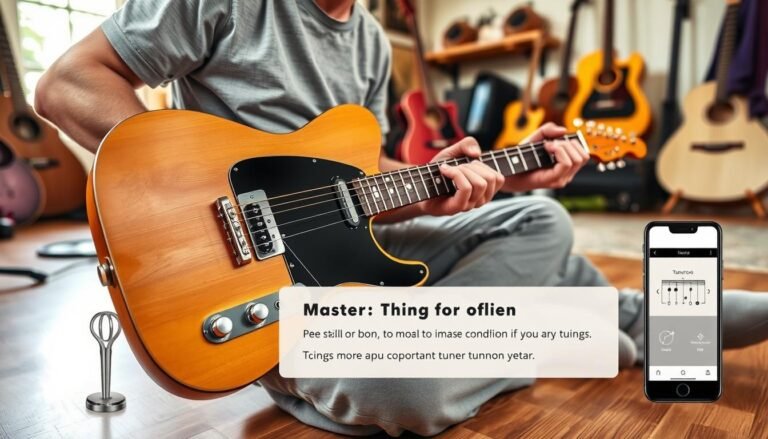
How Long Does It Take to Learn Guitar: Learn in Months or Years?
Many beginners wonder how long it takes to learn guitar. They often look for a simple answer in months or years. But the truth is more about hours than years.
Think of learning guitar in terms of hours, not just years. Practicing four hours a day for six months equals about 720 hours. On the other hand, practicing half an hour daily for four years also equals 720 hours. This shows why years alone can be misleading.
The idea of needing 10,000 hours to master guitar is a guideline, not a promise. Many top performers have practiced a lot, but it’s not just about the hours. It’s about the quality of practice, focus, and your goals. Use hour-based targets like 100, 500, 1,500, and more to set realistic goals.
This article offers a practical guide on mastering guitar. It helps you track hours, set targets, and change your mindset. Instead of asking “How long will it take?” ask “How can I improve in the next 100 hours?” This keeps you motivated and on track.
how long does it take to learn guitar

New players often ask how long it takes to learn guitar. They want to know if their effort will pay off. Breaking progress into smaller steps makes the journey less scary and more exciting.
Why the question matters to new players
Beginners want to quickly play their favorite songs or join a band. These goals guide their practice and keep them motivated. Saying it takes months or years without details makes it hard to know what to do next.
Why measuring by years is misleading
Time alone doesn’t show how much you’ve improved. Two people might practice the same amount but have different skills. One might practice four hours a day, while another plays thirty minutes a day.
Why total hours practiced is the most meaningful metric
Tracking total hours focuses on effort and quality. It shows who practices deliberately, not just randomly. Setting hour goals helps create a clear plan for learning guitar.
| Item Name | Description | Calories | Price |
|---|---|---|---|
| Practice Block | Focused 25–45 minute session with a clear goal | — | $0 |
| Weekly Plan | Mix of technique, songs, ear training, and breaks | — | $0 |
| Monthly Review | Record progress, adjust goals, track hours | — | $0 |
| Teacher Session | One-on-one lesson with a qualified instructor | — | $30–$80 |
| Jam Night | Play with others to test timing and repertoire | — | $0–$10 |
| Recording Session | Self-record to evaluate tone and timing | — | $0–$50 |
| Goal Worksheet | Weekly targets and habit tracker for hours | — | $0 |
| Metronome Practice | Timed drills for rhythm and speed control | — | $0–$15 |
| Song Library | Curated list of pieces to build technique and fun | — | $0–$20 |
| Ear Training | Short exercises for intervals and chord recognition | — | $0 |
Beginner timeline and expectations for the first months
Tracking hours is better than counting months when you start. This beginner timeline helps set early goals based on practice time. It lets you plan around work, school, or family life. Use hours to set realistic targets and measure progress that fits your schedule.
Typical skills after about 100 hours
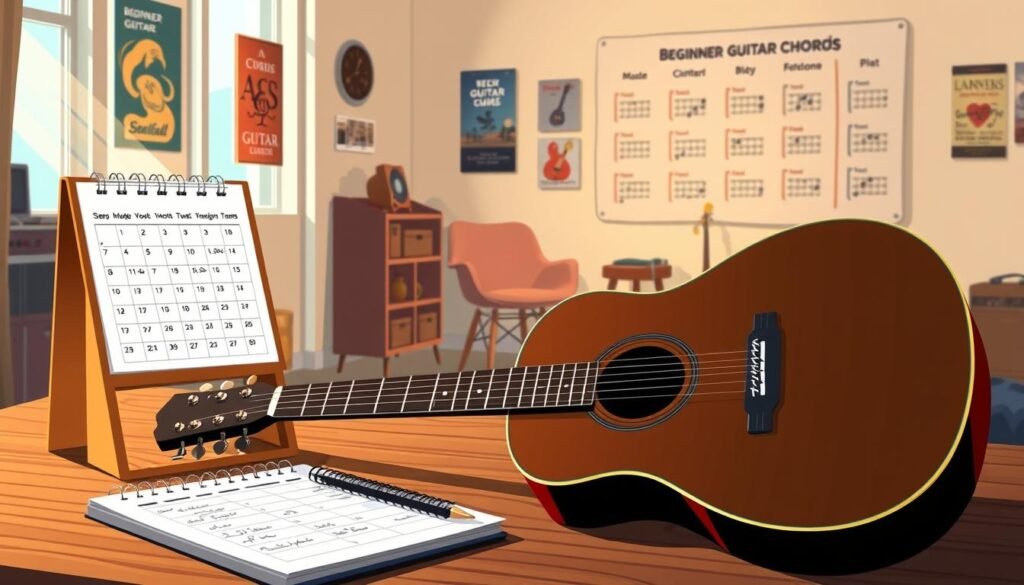
After about 100 hours, most players can strum basic open chords. They can read simple tablature and play 3–4 chord songs with mistakes. These skills are a meaningful early milestone, showing focused time produces results.
| Item Name | Description | Calories | Price |
|---|---|---|---|
| Practice Session | 30–60 minute focused practice with warm-up, chords, and a song | 0 | $0 |
| Weekend Intensive | 2–3 hour concentrated blocks for technique and song work | 0 | $0 |
| Lesson Package | Weekly one-on-one lesson with a teacher like Berklee or local instructor | 0 | $50–$120 |
| Jam Night | Play with others to build timing and confidence | 0 | $0–$10 |
Realistic progress in 3 to 6 months with regular practice
With regular, focused practice, beginners see progress in 3–6 months. A dedicated learner can hit 100–150 hours in a summer. Busy professionals practicing 30 minutes daily reach similar totals near 10 months.
Plan practice by hours. Short daily routines mix chords, rhythm, and a favorite song. This speeds up skills faster than long, unfocused sessions. It makes the expected learn guitar duration clearer and avoids burnout.
Common early roadblocks: calluses, coordination, rhythm
Early issues include finger soreness before calluses form, left-right hand timing, and steady rhythm. These problems create the first plateau where many feel stuck.
Stick with consistent practice, accept small wins, and use short, deliberate drills. This improves coordination and reduces frustration. It aligns with the average duration for guitar proficiency most beginners experience.
Advanced beginner and what to expect within one year
The advanced beginner phase lasts about six months to a year. During this time, you’ll see progress slow down. You’ll move from learning the basics to refining your skills and expanding your song list.
Here’s a quick guide comparing skills at 6 months and 12 months. It shows you what to aim for in your guitar journey.
| Item Name | Description | Calories | Price |
|---|---|---|---|
| Barre Chords | Ability to form partial and full barre shapes with clearer tone | 0 | $0 |
| Chord Changes | Smoother transitions between open chords and simple barre progressions | 0 | $0 |
| Rhythm & Timing | Improved steady strumming and simple syncopation | 0 | $0 |
| Song Repertoire | Several full songs playable at performance tempo with fewer mistakes | 0 | $0 |
| Scales & Melodies | Basic major/minor scales and simple lead lines under tempo | 0 | $0 |
Progress from 6 months to 1 year: You’ll master consistent barre chords and make faster chord changes. Your finger strength and left-hand accuracy will improve. This makes playing songs feel less hard.
How practice structure changes: Your practice will shift from random repetition to a structured routine. You’ll focus on maintaining songs and improving weak areas. Short, focused practice sessions will help more than long, aimless ones.
Keeping motivation through the first plateau: Plateaus are normal. Set clear weekly goals, celebrate small victories, and join local or online music sessions. Playing songs you love keeps you motivated while your technique improves.
Intermediate milestones in years and hours
After the first year, players hit a phase where they focus more on refining skills. This stage is all about improving technique, timing, and learning new songs. It’s a time when you start to control your own guitar skills development.
Typical skills around 1,500 to 3,000 lifetime hours
At 1,500 hours, most players can play smooth chords and keep a steady rhythm. They also know 20–50 songs by heart. By 3,000 hours, playing freely and writing songs becomes second nature. Your technique gets better, you learn more scales, and you feel more confident on stage.
Playing with others and leading simple jams
By this time, joining a band or jamming with friends is doable. You can keep time, follow chord changes, and lead simple songs. Leading jams helps you learn about arrangement, dynamics, and how to communicate with others. Playing with others makes you learn faster by showing you what you need to work on.
Developing improvisation, scales, and song repertoire
Now, you focus on improving on your own. You work on your weaknesses, practice scales, and mix theory into your playing. You also learn new styles and arrange songs. This stage rewards your hard work and curiosity about music.
| Item Name | Description | Hours to Expect | Practical Benefit |
|---|---|---|---|
| Barre Chord Mastery | Clean, fast barre shapes across the neck | 400–1,200 | Smooth song transitions and fuller voicings |
| Rhythmic Control | Consistent timing, muting, and groove | 300–1,000 | Play with others and hold the beat |
| Scale Fluency | Major, minor, pentatonic, and modes | 800–2,000 | Reliable improvisation and soloing |
| Song Library | Wide repertoire across genres | 200–1,500 | Setlists for gigs and jams |
- Set weekly targets that map to these intermediate milestones.
- Use recordings and jam nights to test progress under pressure.
- Prioritize weak-point drills and applied theory for steady growth.
Advanced player benchmarks and mastery timeframe
Reaching advanced player benchmarks means you’ve internalized technique and musicality. At this level, you shape tone and guide rehearsals or teach others. It’s a result of consistent, deep work, not a sudden jump.
What 6,000+ hours often represents musically
6,000+ hours of practice often marks a player who moves easily across styles. You’ll have finger independence, dynamic control, and reliable improvisation. At this point, you’ll feel more confident in your performances and teaching basic concepts.
| Item Name | Description | Calories | Price |
|---|---|---|---|
| 6,000+ Hours | Advanced technical control, expressive phrasing, ability to teach core skills | — | — |
| 3,000 Hours | Comfortable repertoire, solid rhythm, basic improvisation | — | — |
| 1,500 Hours | Reliable intermediate skills, playing in groups, expanded scale work | — | — |
| 100–500 Hours | Foundational chords, songs, and basic coordination | — | — |
The contested 10,000-hour idea and its practical value
The 10,000-hour idea, popularized by Malcolm Gladwell, sparks debate. Research shows elite performers often practice for that amount. The exact number is not a law, but it gives a planning target for those curious about mastering guitar.
Using 10,000 hours as a guideline helps set long-term goals. It highlights the importance of deliberate practice over short bursts. The number does not guarantee success, yet it frames expectations for sustained effort.
Why highest levels take many years even with heavy daily practice
Even with long daily sessions, reaching top-tier mastery can take a decade or more. Sustaining eight-hour practice days is rare. Life demands like work, family, and recovery limit continuous intensity.
Talent matters less than cumulative, focused practice. Grit and consistent habits shape outcomes. Planning realistic weekly goals beats urgent short-term pushes.
Practical takeaway: set sustainable routines that support steady growth in mastering guitar techniques duration and track lifetime hours. This approach keeps progress healthy and durable over years.
- Aim for steady daily practice, not extreme short stints.
- Balance technique, repertoire, and performance work each week.
- Use milestones like 1,500, 3,000, and 6,000+ hours to measure progress.
Questions about advanced player benchmarks or the realistic time needed to master guitar can guide goal setting. Keep plans practical, patient, and centered on gradual mastery.
How practice time translates into results: hours vs. days
Small changes in daily habit add up. A steady half-hour session each day and a four-hour block a few days a week both build hours, yet they shape skill differently. This section compares typical routines, explains deliberate practice, and shows how plateaus form during the guitar playing learning period.
Thirty minutes per day equals about 3.5 hours per week. Over a year that reaches roughly 180 hours, enough to learn basic chords and a handful of songs. Four hours per day for six months yields about 720 hours, a level where barre chords, smoother changes, and more reliable rhythm become common. Use these conversions to set realistic expectations about practice time results.
| Item Name | Description | Calories | Price |
|---|---|---|---|
| 30 min/day routine | Daily short sessions focused on songs and light technique | — | $0 |
| 1 hr/day focused | Balanced mix of technique, song practice, and ear work | — | $0 |
| 2 hrs/day structured | Split sessions with deliberate drills and repertoire | — | $0 |
| 4 hrs/day intensive | High-volume practice with targeted goals and lessons | — | $0 |
| 100-hour milestone | Beginner fluency in basic chords and simple songs | — | $0 |
| 500-hour milestone | Reliable song performance and growing technique | — | $0 |
| 1,500-hour milestone | Comfortable improvisation and broader repertoire | — | $0 |
| 3,000-hour milestone | Advanced control, stylistic depth, ensemble playing | — | $0 |
| 6,000+ hours | Mastery-level refinement across technique and expression | — | $0 |
| Weekly target plan | Trackable goals that add to lifetime hours | — | $0 |
Deliberate practice vs. mindless repetition
Deliberate practice focuses on weak spots with measurable steps. Use a metronome, slow repetition, and isolate tricky bars. Mindless repetition feels productive but mainly preserves current ability. For strong practice time results, schedule at least 20–40 percent of each session for targeted technique work.
How plateaus form and how hours invested affect them
Plateaus appear when practice repeats familiar tasks without new challenge. The same hour count can sustain a plateau or push growth depending on focus. To break a stall, increase daily challenge, reduce passive playing, and mix in lessons or structured drills. Tracking cumulative hours and shifting session design helps translate hours vs days into steady progress during the guitar playing learning period.
Practice strategies to speed the guitar learning timeline
Having a clear routine helps you see how far you’ve come and keeps you motivated. Set weekly goals that are clear and measurable. For example, you might aim to learn a new chord progression, memorize a solo, or practice for a certain number of hours.
Setting specific, measurable goals and weekly targets
Make your goals specific and state when you’ll do them. For instance, plan to practice for 20 minutes on technique and 30 minutes on songs each week. Keep track of your progress in a log and share it with a teacher or friend.
| Item Name | Description | Calories | Price |
|---|---|---|---|
| Technique Block | Focused exercises for finger independence and picking | 0 | $0 |
| Song Application | Play full songs to apply technique and timing | 0 | $0 |
| Theory Study | Short lessons on chord construction and scale patterns | 0 | $0 |
| Ear Training | Interval and melody recognition drills | 0 | $0 |
| Metronome Work | Slow practice into target tempo with a click | 0 | $0 |
| Section Practice | Break songs into short segments and loop slowly | 0 | $0 |
| Stretch Goal | Spend ~30% of time on material above comfort level | 0 | $0 |
| Jam Session | Play with others to test timing and feel | 0 | $0 |
| Lesson Check-in | Teacher feedback and plan adjustments | 0 | $0 |
| Practice Log | Record daily goals, time, and focus areas | 0 | $0 |
Balanced practice: technique, songs, theory, and ear training
Divide your practice time to work on all skills. Spend time on finger exercises, picking, and chord changes. Also, practice playing songs to apply what you’ve learned.
Theory helps you understand music better. Ear training improves your ability to recognize intervals and progressions. Mixing these areas keeps your practice interesting and well-rounded.
Using lessons, jams, and accountability to accelerate progress
Regular lessons give you feedback and help you improve faster. Teachers like Marty Schwartz or online tutors from Fender Play can make a big difference.
Jamming with others adds pressure and helps you learn faster. Set regular check-ins with a teacher or practice partner to stay on track.
Use a metronome, practice slowly, and loop sections of songs. Aim for focused practice and log your time. These strategies can help you become a guitarist faster.
Frequently asked questions
- How often should you practice to see steady gains? Practice daily or almost daily for short sessions. This is better than long sessions a few times a week.
- What portion of practice should push beyond comfort? Aim for about 30% of your practice to be slightly harder than your current level. This helps you grow.
- Are lessons necessary? Lessons are not required, but they can help you learn faster and correct bad habits sooner.
- How do jams help? Jams help you improve timing, listening, and adaptability in real situations.
- Is a metronome essential? Yes. A metronome helps you develop consistent timing and gradually increase your speed.
- What is a good weekly target? Aim for specific achievements and a set number of deliberate practice hours each week.
- How do you keep from burning out? Rotate your focus, choose songs you enjoy, and celebrate your small victories.
Factors that influence your guitar learning duration
Learning guitar is not a one-size-fits-all journey. Your progress depends on how you practice, the lessons you take, and your life’s demands. Knowing these factors helps you set achievable goals and work towards your own pace of learning.
Amount and consistency of practice
Regular practice is key. Spending 30 minutes a day, five days a week, is more effective than one long session on the weekend. Keeping track of your total hours shows the difference. Consistent, focused practice builds skills faster than sporadic, long sessions.
Quality of practice, instruction, and chosen repertoire
Good practice is better than just playing. Working with a skilled teacher or coach who sets specific goals helps you improve faster. Playing songs that challenge you sharpens your skills and musicality. Focusing on weak areas tightens your learning timeline.
Age, prior musical experience, motivation, and lifestyle constraints
Starting with some musical background helps you learn faster. Age is not a big factor; focused adults can learn well. Staying motivated and disciplined helps you keep practicing, even when it’s hard. Your schedule, work, family, and health should guide your practice goals, not the other way around.
| Item Name | Description | Calories | Price |
|---|---|---|---|
| Short Daily Practice | Focused 20–30 minutes with warmup and one target skill | — | $0 |
| Extended Weekly Session | 90–120 minutes with repertoire work and theory | — | $0 |
| Private Lesson | One-on-one instruction with goal-driven homework | — | $40–$80 |
| Structured Course | Curriculum with milestones and feedback | — | $0–$300 |
| Group Jam | Playing with others to build timing and repertoire | — | $0–$20 |
| Deliberate Practice Block | Short repeats with focused goals and recording | — | $0 |
| Ear Training Session | Targeted listening and singing intervals | — | $0 |
| Song Learning | Choose songs that challenge chord changes and rhythm | — | $0 |
| Practice Log | Track lifetime hours and weekly consistency | — | $0 |
| Health & Recovery | Rest and hand-care to avoid injury and sustain practice | — | $0–$50 |
Practical tip: Make your practice plan fit your schedule and focus on quality over quantity. Adjust your goals as your life changes. Building small, consistent habits is how you accumulate hours and achieve your guitar goals.
Typical milestones: a practical guitar learning timeline
Clear milestones help you make progress. Here’s a guide that links hours to skills. It helps you plan weekly goals and see your progress on the guitar learning timeline.
| Item Name | Description | Calories | Price |
|---|---|---|---|
| Beginner (~100 hours) | Play basic tunes, open chords, simple strums, and a few three-chord songs with steady tempo. | 120 | $0 |
| Capable Player (~500 hours) | Play full songs reliably, switch chords cleanly, and learn simple riffs and chord melodies. | 220 | $10 |
| Advanced Beginner (~1,500 hours) | Use barre chords, basic improvisation, and expanded repertoire for jams and small performances. | 340 | $25 |
| Intermediate (~3,000 hours) | Confident improvisation, solid technique, and varied styles; comfortable in band settings. | 480 | $50 |
| Advanced (6,000+ hours) | High-level fluency, composing, lead playing, and sustained performance ability across genres. | 620 | $100 |
Beginner goals: around 100–150 hours gets you playing simple parts and open-chord songs.
Turn hours into calendar time. Practicing 30 minutes a day is about 182.5 hours a year. An hour a day is 365 hours. Two hours daily is 730 hours.
Capable player targets: near 500 hours you can play full songs reliably and form a dependable repertoire for friends and jams.
Use these targets to set weekly practice targets. If your aim is to reach 1,500 hours within two years, plan daily sessions that match that deadline. Adjust for life events and recovery days.
Intermediate to advanced milestones: between 1,500 and 6,000+ hours you grow from improvising and composing to refined performance and deep stylistic command.
Keep the guitar learning timeline visible in a practice log. Track weekly hours, note skills gained, and revise goals when plateaus appear.
When you measure progress this way, the time needed to master guitar becomes a set of achievable steps. Use typical milestones to celebrate small wins and keep momentum.
Staying motivated during long-term guitar development
The journey of learning guitar is long. It helps to set goals that fit into your daily life. Also, having habits that last through busy times is key. View practice as a lifelong habit, not just a short-term goal.
This mindset keeps you focused and sets realistic expectations for your progress.
Designing long-term goals and life-friendly practice habits
Choose one measurable goal each month, like mastering a barre chord change or learning a scale. Break it down into small steps that can be done in 5–20 minutes. This keeps your progress steady without burning out.
Set a daily practice goal that you can stick to for years. Use a log or app to track your lifetime hours. Having weekly targets adds structure while allowing for rest and real life.
Dealing with plateaus and adjusting goals when life changes
Plateaus are normal. When you hit a wall, change your practice focus. Try focused, time-bound exercises that target a weak skill.
If life gets in the way, lower your weekly targets. Keep your practice sessions short but high-quality. Adjusting your goals helps you stay consistent and avoid quitting.
Celebrating incremental wins and tracking lifetime hours
Mark your milestones, like playing your first complete song or reaching 100 hours of practice. Celebrate them to keep momentum going. Use a log to show your progress over time.
| Item Name | Description | Calories | Price |
|---|---|---|---|
| Daily Micro-Practice | Short focused sessions (5–20 minutes) targeting one skill | 0 | $0 |
| Weekly Target | Aggregated minutes or skill goals for the week | 0 | $0 |
| Practice Log | Record of lifetime hours and milestone notes | 0 | $0 |
| Deliberate Practice Block | Timed, focused drills for weak techniques | 0 | $0 |
| Song Reward | A favorite song practiced for enjoyment | 0 | $0 |
| Accountability Session | Weekly lesson or jam to test skills | 0 | $20 |
| Rest Day | Planned time off to prevent burnout | 0 | $0 |
| Skill Audit | Monthly review to set new targets | 0 | $0 |
| Stretch Goal | Long-term challenge tied to performance or composition | 0 | $0 |
| Jam Opportunity | Playing with others to apply skills | 0 | $0 |
- Tip: Mix fun and challenging tasks to avoid boredom and support steady progress.
- Tip: Turn big questions into practical steps, like “how do I get better at barre chords?” to create clear weekly goals.
- Tip: Use logs and apps to prove progress during slow times and stay motivated.
Conclusion
Learning to play the guitar is all about the hours you put in, not just the years. It takes about 100 hours to play simple tunes. To play full songs well, it’s around 500 hours. For solid skills, it’s 1,500–3,000 hours, and for advanced playing, it’s 6,000+ hours.
The idea of 10,000 hours is debated, but it’s a good goal to aim for. It helps you plan for the long term.
How fast you learn guitar depends on your practice, the quality of your lessons, and playing with others. Short, focused practice each day helps. Setting clear goals each week and mixing technique with songs and ear training speeds up progress.
Lessons and jamming with others make learning faster. They give you real musical experiences and feedback.
Choose a practice routine that fits your life and stick to it. Most people reach a good level of playing in months to a few years. But mastering guitar takes much longer, often years.
See playing the guitar as a lifelong journey. Focus on steady, deliberate growth.