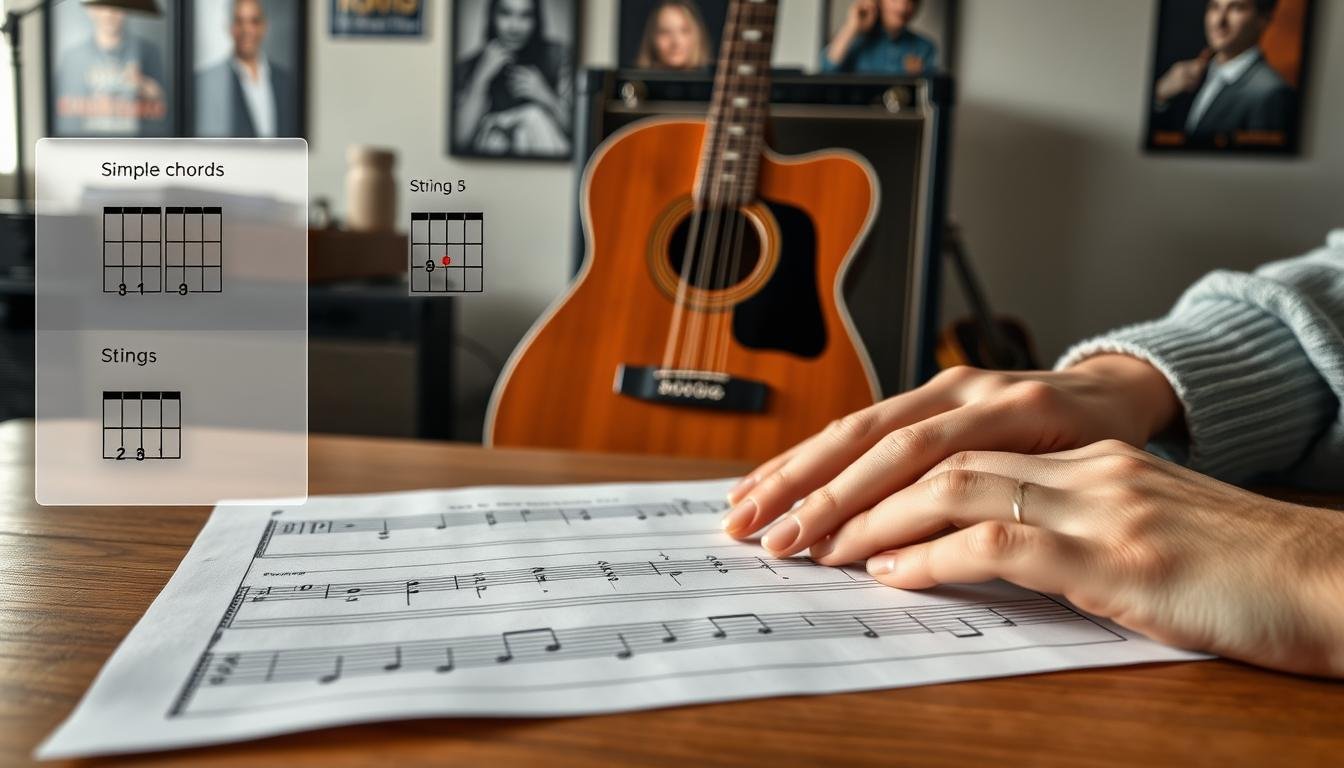
Learn Guitar Fast: How to Read Tabs for Guitar
Guitar tablature guide helps beginners see the fretboard clearly. It has six horizontal lines, each for a guitar string. The top line is high E, followed by B, G, D, A, and low E at the bottom.
Numbers on these lines show which fret to press. A 0 means play an open string.
This beginner guitar tabs tutorial helps you learn quickly. TAB shows exactly where to place your fingers. This way, you can play riffs and chords easily, without needing standard notation.
Vertically aligned numbers mean playing chords or notes together. TAB is practical and handles the guitar’s many fingering options. Programs like School of Rock use it because it directly points to fret and string locations.
Using TAB with tuning checks and simple rhythm cues can speed up your progress.
Why guitar tablature is the fastest way to start playing
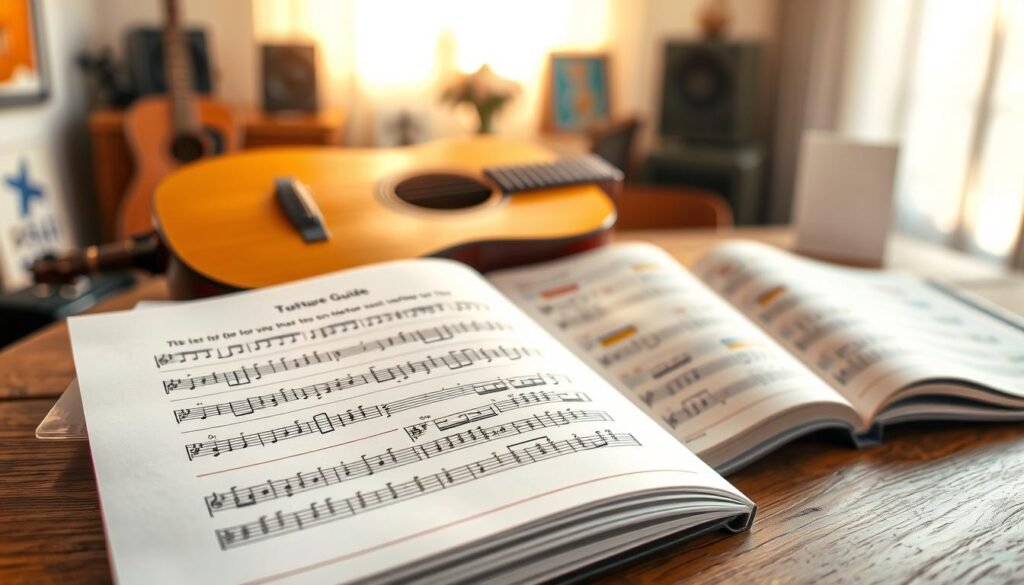
Guitar tablature makes learning easier for beginners. It uses a simple six-line staff that matches the guitar strings. Numbers on the lines show which frets to press.
This direct method lets you start playing melodies quickly. It’s faster than trying to figure out finger positions from standard notation.
What TAB is and why it works for beginners
TAB uses lines for each string and numbers for frets. It shows exactly where to place your fingers. This makes it easy for beginners to start playing real songs right away.
Advantages over standard notation for guitarists
Standard notation gives exact pitch and rhythm. But TAB is better for showing where to place fingers and offers different options for notes. This makes it easier to choose the right frets for your playing style.
How TAB shows fret and string locations as a roadmap
TAB’s vertical alignment helps with chord shapes. Single numbers indicate single-note lines. With fret numbers and string order, it’s like a map for the guitar neck.
Teachers and apps often add extra help like finger suggestions and chord charts. This fills in any gaps and helps you learn faster.
| Item Name | Description | Calories | Price |
|---|---|---|---|
| Basic TAB Cheat Sheet | Six-line diagram with common symbols and a short legend | 0 | $0.00 |
| Beginner Riff Pack | Five short riffs using open strings and simple fretting | 0 | $4.99 |
| Chord Map Companion | Fretboard diagrams linked to tab examples for common chords | 0 | $2.99 |
| Slow-Down Backing Track | Looped backing with tempo control to match tab phrases | 0 | $1.99 |
| Fingering Tips Sheet | Practical hand shapes and finger assignments for tab positions | 0 | $0.99 |
| Rhythm Marking Guide | Simple cues to pair with TAB when rhythm is not shown | 0 | $1.49 |
| Starter Song Pack | Three easy songs with annotated TAB and timing hints | 0 | $3.99 |
| Position Alternatives Chart | Common notes shown in multiple fretboard positions | 0 | $1.29 |
| Technique Cue Cards | Quick references for hammer-ons, slides, and bends in TAB | 0 | $0.79 |
| Teacher Matching Guide | How to combine TAB with lessons to speed learning | 0 | $2.49 |
Start playing songs with this guitar tablature guide. It helps you pick the clearest fret options and use chord charts when needed. This approach speeds up your learning and keeps practice focused on sound and feel.
how to read tabs for guitar
Guitar tablature is a visual way to learn songs quickly. Read TAB from left to right. The six lines match the guitar’s layout, with the top line being the high E string and the bottom the low E string.
This layout makes reading guitar tabs easy for beginners.
Reading direction and string order
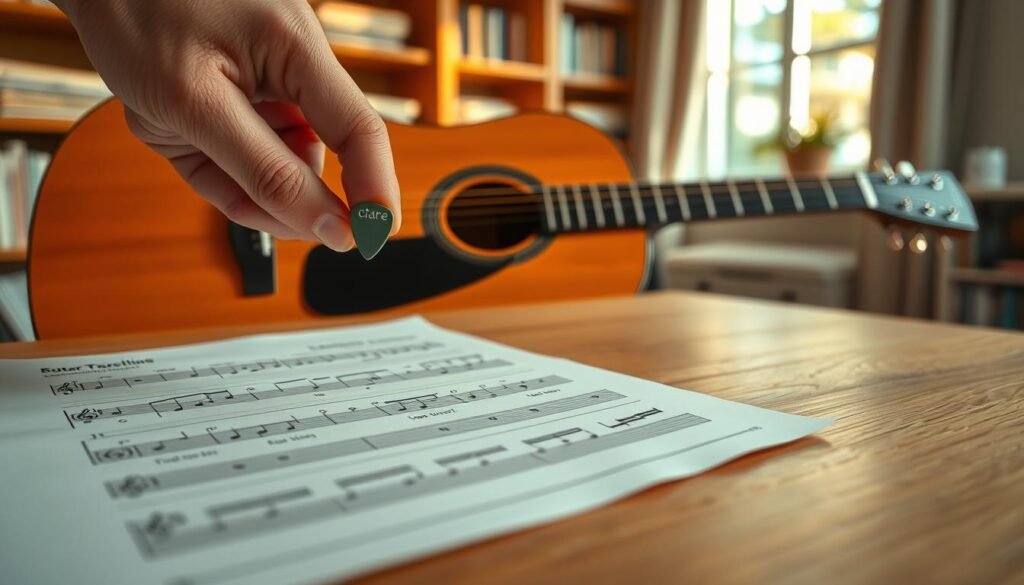
TAB shows time as you move left to right. Each character position is a note or rest. Remember the string order: high E at the top, then B, G, D, A, and low E at the bottom.
This habit helps with sight-reading and supports a solid beginner guitar tabs tutorial routine.
What the numbers mean: frets and open strings
Numbers on the lines point to frets. A 0 means play the open string. A 1 means first fret, and so on.
If you see 12 on a line, play the twelfth fret on that string. TAB shows the arranger’s chosen positions; the same pitch can appear in different places on the neck.
| Item Name | Description | Calories | Price |
|---|---|---|---|
| High E string | Top line on TAB, often used for melodies and single-note riffs | 0 | $0.00 |
| B string | Second line from top, common for vocal-like lines | 0 | $0.00 |
| G string | Middle line, versatile for chords and fills | 0 | $0.00 |
| D string | Fourth line, anchors many chord shapes | 0 | $0.00 |
| A string | Fifth line, used for bass notes in many arrangements | 0 | $0.00 |
| Low E string | Bottom line, provides the lowest pitches and power chords | 0 | $0.00 |
| Open string (0) | Play string without fretting, common in beginner patterns | 0 | $0.00 |
| Single-fret number | Play that fret on the indicated string as the next note | 0 | $0.00 |
| Multiple-digit number | Fret beyond 9; read both digits as a single fret | 0 | $0.00 |
| Position choice | TAB shows the arranger’s preferred fretboard position for a pitch | 0 | $0.00 |
How vertically aligned numbers indicate chords or simultaneous notes
When numbers stack vertically across lines, play those notes together. This alignment signals a chord or multiple strings plucked at once. You can strum or pick them depending on the arrangement.
Some TABs omit rhythm. In those cases, listen to the recording or find a version with rhythmic underlay. Pair TAB with chord charts to see finger assignments and simplify practice. Following this beginner guitar tabs tutorial approach builds confidence fast.
For reading guitar tabs for beginners, practice matching numbers to frets slowly, then speed up. Regular short sessions help your eyes and fingers coordinate. Keep routines simple, focus on string order, and repeat common open-string patterns until they feel automatic.
Understanding the guitar tab staff and fretboard layout
Learning to read a six-line tab staff is key to mastering guitar tablature. Each line represents a string, with the top line being high E and the bottom being low E. Numbers on these lines tell you which fret to press, turning a written roadmap into a physical movement on the neck.
Six-line staff mapping to guitar strings
The six-line staff is labeled TAB in most charts. From top to bottom, the lines represent high E, B, G, D, A, and low E. This layout matches the fretboard, making learning faster when you use sight and touch together.
Fret numbering, common fret marker positions, and octaves
Frets are numbered from the nut outward. Most guitars have between 19 and 24 frets. Marker dots at frets 3, 5, 7, 9, and a double marker at 12 guide your hand. The 12th fret marks one octave higher than an open string, so note names repeat up the neck.
| Item Name | Description | Calories | Price |
|---|---|---|---|
| High E string (1st) | Highest pitch string; top line on tab; open note E4 | 0 | $0.00 |
| B string (2nd) | Second-highest string; useful for melodies and chords | 0 | $0.00 |
| G string (3rd) | Central role for many voicings and melodic lines | 0 | $0.00 |
| D string (4th) | Lower mid-range string; common for riffs and bass notes | 0 | $0.00 |
| A string (5th) | Supports root notes and power-chord shapes | 0 | $0.00 |
| Low E string (6th) | Lowest pitch string; backbone for rhythm and bass lines | 0 | $0.00 |
| Fret markers | Dots at 3, 5, 7, 9 and double at 12 help navigation | 0 | $0.00 |
| Octave span | Twelve frets equal one octave; notes repeat up the neck | 0 | $0.00 |
| Typical fret count | Most guitars: 19–24 frets; affects range and choices | 0 | $0.00 |
| Common fingering choice | Pick positions that reduce shifts and preserve tone | 0 | $0.00 |
Translating tab positions to physical fretboard locations
One number in tab can correspond to several fretboard positions. Choose the one that minimizes hand movement and matches the tone you want. Open strings sound different from fretted notes; that difference matters when arranging or phrasing.
Use chord charts, suggested fingerings, or a quick practice run to test position choices. This practice ties guitar tab notation tips to real fingering decisions and improves your skill at understanding guitar tablature. Over time, you gain confidence in translating printed numbers into smooth hand shifts while mastering guitar tablature.
Reading rhythm and timing in tabs: simple ways to interpret note length
Many guitar tablatures list the notes in order but leave rhythm unclear. This can slow down learning for beginners. A quick scan can tell you if the TAB shows rhythm or if you need to rely on the original recording.
When TAB does and doesn’t show rhythm
Some publishers add rhythmic underlay using standard note values beneath the TAB line. Tools like Guitar Pro and MuseScore exports often include stems, beams, and rests. Other TABs omit those details and present only fret numbers.
Using sheet-music-style rhythmic structures under TAB
If a TAB contains rhythmic notation, treat it like standard notation. Match quarter notes, eighth notes, and rests to the fret numbers. This method speeds up accurate timing when using guitar tab reading techniques.
When rhythm marks are present, count beats aloud. Use simple counts such as “1 & 2 & 3 & 4 &” for eighth-note subdivisions. This helps you internalize the pulse before playing.
Practical tips for keeping time when rhythm markings are absent
First, listen to the original recording and tap along to learn phrasing. This step is essential for beginners who need an audio anchor.
Second, use a metronome or a slowdown app to practice tricky passages at a reduced tempo. Slow playback reveals where notes fall and aids muscle memory, which is key to easy guitar tab reading.
Third, clap or vocalize rhythms before fretting the notes. Mark phrase lengths directly on the TAB with a pencil. Those marks help you spot repeats and rests at a glance.
| Item Name | Description | Calories | Price |
|---|---|---|---|
| Metronome App | Tap tempo and adjustable subdivisions for practicing timing | 0 | $0–$4.99 |
| Slowdown Tool | Change speed without altering pitch; ideal for transcribing | 0 | $0–$30 |
| Guitar Pro Export | Tab files with rhythmic underlay and playback features | 0 | $5–$79 |
| MuseScore | Free notation editor that shows rhythm under TAB | 0 | Free |
| Backing Track | Looped accompaniment to keep groove while practicing | 0 | $0–$15 |
| Pencil & Printout | Annotate phrase marks and rests directly on the tab | 0 | $0.10–$1 |
| Practice Routine | Short, timed sessions focusing on subdivisions and feel | 0 | Free |
| Click Track | Precise beat reference for recording or timed practice | 0 | $0–$10 |
| Ear-Training Exercise | Identify rhythmic patterns from recordings to match TAB | 0 | Free–$20 |
Use these methods together. Combining listening, metronome work, and marked TAB pages builds reliable timing. This process turns uncertain fret numbers into musical phrases you can play with confidence using guitar tab reading techniques.
Common tablature symbols every beginner should know
Tabs use simple symbols to show how to play without long explanations. Learning a few marks helps you read tabs fast and play songs in many styles. Here are the main signs you’ll see and how to play them.
Hammer-ons and pull-offs connect notes smoothly. A hammer-on is marked with an H or a slur between frets. It raises the pitch by bringing a finger down hard enough to sound the note without re-picking. A pull-off uses P or a slur to drop to a lower pitch by pulling the string away while keeping contact.
Slides, ties, and slurs show motion or sustain. Slides are a diagonal line or sl., connecting two fret numbers. You slide the finger while keeping pressure. A tie keeps the same pitch ringing and is shown as a curved slur linking identical fret numbers. Slurs more broadly indicate legato phrasing between notes.
Bends change pitch by pushing the string across the fretboard. Notation uses B or arrows with labels like Full or 1/2 to show how far to bend. Pre-bends (PB) are bent before you pluck the string. Bend releases show an arrow down and return the string toward the original pitch.
Vibrato and grace notes add expression. Vibrato is a wavy line above the note; the length tells how long it should be applied. Grace notes are tiny noteheads or minute marks such as small H, P, sl., or B to signal a very quick ornament before the main note.
Harmonics produce bell-like tones. Natural harmonics are often marked harm, while artificial harmonics use A.H. Tap harmonics appear as T.H. These marks tell you where to touch lightly or to use right-hand technique for the chime effect.
Other common signs to know include palm muting labeled P.M. with a dashed line, tapping shown as T, and fingerstyle letters p, i, m, a to indicate right-hand fingers. Muted or dead notes use X to show a percussive hit, not a pitched tone.
| Item Name | Description | Calories | Price |
|---|---|---|---|
| Hammer-on (H) | Connects to a higher fret without re-picking; slur shows legato | 0 | $0.00 |
| Pull-off (P) | Releases to a lower fret by pulling the string; shown with P or slur | 0 | $0.00 |
| Slide (sl.) | Diagonal line connects frets; slide while keeping pressure | 0 | $0.00 |
| Bend (B) | Arrow or B with Full/1/2; pre-bend shown PB, release shown with down arrow | 0 | $0.00 |
| Vibrato | Wavy line above note; length shows duration of the effect | 0 | $0.00 |
| Grace Note | Small notehead or tiny ornament marking; quick approach to main note | 0 | $0.00 |
| Natural Harmonic | Marked harm; touch string lightly at node to produce chiming tone | 0 | $0.00 |
| Artificial Harmonic (A.H.) | Produced by fretting and lightly touching at a harmonic point | 0 | $0.00 |
| Palm Mute (P.M.) | Right-hand dampening shown with dashed line for muted sustain | 0 | $0.00 |
| Muted Note (X) | Percussive, dead note indicated with X; no clear pitch | 0 | $0.00 |
These symbols are key to understanding guitar tablature. Practicing them in simple riffs and exercises helps you apply guitar tab notation tips quickly. As you get better, mastering guitar tablature will become second nature when learning songs.
Guitar tab notation tips for expressive techniques
Expressive guitar parts need clear notation. This guide offers practical tips for guitar tab notation. These tips help shape tone and groove when reading or writing tabs.
Palm muting is marked as P.M. with a dashed line for duration. Move your palm closer to the bridge for more sustain. Shift it farther toward the neck for a tight, chugging sound.
When you see P.M. start and stop marks, match your right-hand placement. This ensures consistent tone.
Muted and percussive notes use an X instead of a fret number. These X notes create a pitchless, rhythmic snap. They are common in rock, punk, and funk.
Combine X notes with palm muting for a tight, percussive pocket. This pocket locks with drums or bass.
Tapping is labeled with T and reads like a hammer-on by the picking hand. Two-handed tapping uses both hands to hammer notes independently. This method lets you play wide intervals and rapid runs that feel impossible with one hand.
Practice tapping slowly with a clean, amplified tone. This ensures each tapped note rings clearly.
On stage or in the studio, stack techniques for dynamics. Mark P.M., X notes, and T in the tab. This combined notation helps you reproduce the intended groove and energy.
| Item Name | Description | Calories | Price |
|---|---|---|---|
| Palm Muting (P.M.) | Dashed line shows duration; palm position alters sustain | 0 | $0.00 |
| Muted Note (X) | Pitchless, percussive stroke for rhythm accents | 0 | $0.00 |
| Tapping (T) | Picking-hand hammer-on; two-handed allows wide intervals | 0 | $0.00 |
| Combined Notation | Layer P.M., X, and T to shape dynamics and groove | 0 | $0.00 |
| Practice Tip | Use slow tempo, clean tone, and metronome for clarity | 0 | $0.00 |
| Stage Adjustment | Match amp and pick attack to maintain clarity live | 0 | $0.00 |
| Recording Note | Record palm muting and tapped parts separately when possible | 0 | $0.00 |
| Notation Clarity | Label start/stop points for P.M. and tapping to guide players | 0 | $0.00 |
| Genre Use | Rock, punk, and funk favor X notes; metal uses heavy P.M. | 0 | $0.00 |
| Ear Training | Listen to recordings while reading tabs to match feel | 0 | $0.00 |
Keep practicing these guitar tab reading techniques to make tabs come alive. For beginners, start slow and mark each technique on the page. Simple, repeated practice helps the hands and ears learn how notation translates into sound.
How chords, riffs, and arpeggios appear in tabs
Tabs show visual patterns for playing guitar. They tell you whether to strum chords, play riffs, or roll notes as arpeggios. Looking at a staff helps you understand how to read tabs for guitar and find popular song tabs easily.
Full chords are shown as stacked numbers across the six lines. Each number indicates the fret to press on its string. Playing these numbers together creates a full chord sound, making it easier to learn common open chords.
Power chords and partial chords have two or three numbers on adjacent strings. These shapes are smaller and easier to move up and down the neck. They are popular in rock and punk riffs, making it simple to copy the tone and attack from popular song tabs.
Riffs often mix single-note lines with partial chords. When numbers line up vertically, play them together. When they are staggered, play them one after another. This rule makes reading riffs straightforward and teaches you how to read tabs for guitar in a musical way.
Arpeggios are notated in two common ways. One method shows the same chord as stacked numbers but with a vertical wavy line, signaling a roll. The other writes the notes in sequence with timing marks beneath the staff. Practicing these patterns improves your ability to perform spread chords cleanly.
Suggested fingerings and simple chord charts help manage stretches during arpeggiation. Try slurring from the bass note up through the chord or using a thumb for low strings to keep the roll smooth. These small adjustments support easy guitar tab reading when tackling spread chords.
| Item Name | Description | Calories | Price |
|---|---|---|---|
| Full Open Chord | Vertically stacked numbers across multiple strings; common for folk and pop. | N/A | $0.00 |
| Power Chord | Two or three notes on adjacent strings; easy to move and staple in rock riffs. | N/A | $0.00 |
| Single-Note Riff | Sequential notes on one string or small shifts between strings; forms melodies. | N/A | $0.00 |
| Arpeggiated Chord (Wavy) | Stacked chord with a vertical wavy line; play notes quickly in sequence. | N/A | $0.00 |
| Arpeggiated Chord (Timed) | Notes written one after another with timing marks; precise roll pattern. | N/A | $0.00 |
| Muted/Percussive Hit | Marked with X; used within riffs to add rhythm and groove. | N/A | $0.00 |
| Hammer-on / Pull-off | Legato symbols H and P; show quick transitions inside riffs or chords. | N/A | $0.00 |
| Bend | Notated with B or arrow and amount; expressive element in riffs and solos. | N/A | $0.00 |
| Slide | Diagonal line between frets; used to connect notes in riffs or chords. | N/A | $0.00 |
| Palm Mute | Marked P.M.; gives a choked, rhythmic tone useful in power-chord riffs. | N/A | $0.00 |
- Start slow: Play stacked chord shapes first, then add arpeggiation.
- Match shapes: Use chord diagrams to place fingers before reading the rhythm.
- Isolate riffs: Loop short sections to master timing and tone.
Practical guitar tab reading techniques for beginners
Start with small choices that save motion and sound good. A single pitch can sit in several fret positions. Pick open strings when they ring clearly. Choose fretted positions that keep your hand near the next note. These techniques cut learning time and reduce strain.
Map the note on the staff to all possible fretboard locations. Mark the easiest option on your TAB copy. Use open strings for sustain, low frets for comfort, and higher frets when tone matters. Rely on common fret markers at frets 3, 5, 7, 9, and 12 to orient your hand quickly.
| Item Name | Description | Calories | Price |
|---|---|---|---|
| Open-string choice | Use open strings when no stretch is required and tone benefits | 0 | $0.00 |
| Low-fret position | Keep hand near nut for economy and simple chords | 0 | $0.00 |
| Shifted fingering | Move up the neck to match melody or avoid awkward stretches | 0 | $0.00 |
| Fret marker use | Visual landmarks at 3, 5, 7, 9, 12 improve orientation | 0 | $0.00 |
Combining TAB with chord charts and fingering suggestions
Pair TAB and chord charts to learn both sound and shape. TAB shows which string and fret to play. Chord charts show finger numbers and hand shape. Use finger-number suggestions in charts to avoid awkward stretches. This approach makes a beginner guitar tabs tutorial more effective for real songs.
Using fret markers and practicing common patterns
Practice pentatonic boxes, simple riff shapes, and open-string melodies in short loops. Mark hard bars on your TAB and isolate them. Slow the section with a metronome, then raise the speed gradually. Regular, focused repetition builds muscle memory with less frustration.
- Label tricky measures on your TAB for focused practice.
- Use chord charts when fingering choices matter for voicing.
- Start slow; increase tempo in 5–10 percent steps.
This mix of strategy and routine reflects practical guitar tab reading techniques and keeps progress steady. For a complete beginner guitar tabs tutorial, combine sight reading with fingering charts and deliberate pattern practice to move from basic riffs to confident playing.
Learn with easy guitar tab reading exercises and popular songs
Start with simple melodies and short riffs to get familiar with the fretboard. These exercises focus on clear patterns, steady timing, and easy movements. Practice slowly, use a metronome, and repeat short sections until you can play them by heart.
Starter exercises:
Begin with open-string melodies to learn where notes are on each string. Try simple sequences that move up and down one string. After mastering the pattern, add basic hammer-ons, pull-offs, and slides. These moves will make reading guitar tabs easier.
| Item Name | Description | Calories | Price |
|---|---|---|---|
| Open-String Melody 1 | Single-note pattern on low E and A; focuses on finger placement | 0 | $0.00 |
| Basic Riff 1 | Three-note riff combining single notes and a power chord | 0 | $0.00 |
| Hammer-On Drill | Short phrase using hammer-ons and pull-offs on open strings | 0 | $0.00 |
| Slide Flow | Two-string slide patterns to practice smooth transitions | 0 | $0.00 |
| Power Chord Loop | Looped progression using partial chords and palm muting | 0 | $0.00 |
| Beginner Riff Pack | Collection of famous simple riffs suitable for slow practice | 0 | $0.00 |
| Timing Backing | Short backing track to work on rhythm with a metronome | 0 | $0.00 |
| Chord Strum Basics | Simple strumming patterns with open and partial chords | 0 | $0.00 |
| Embellishment Set | Short licks adding hammer-ons, slides, and simple bends | 0 | $0.00 |
| Progression Checklist | Step-by-step goals from open strings to intermediate techniques | 0 | $0.00 |
Examples to try:
Choose famous beginner-friendly riffs and learn them from guitar tabs. Slow the track and loop short measures. Riffs will combine timing and technique in small bites. Use backing tracks to lock in rhythm and feel.
Progression plan:
- Start with open-string melodies and single-note riffs to map the fretboard.
- Move to simple chord strumming and partial chords to add harmony.
- Add basic embellishments like hammer-ons, pull-offs, and slides to increase expression.
- Work toward intermediate techniques such as bends, vibrato, and light tapping.
Set measurable tempo goals. Aim to play a phrase cleanly at 60 BPM, then raise speed by 5–10 BPM when consistent. Track progress using recordings. Steady, focused practice makes reading guitar tabs for beginners and mastering guitar tabs for popular songs feel attainable.
Keep exercises short and frequent. Repeat small sections until accuracy beats speed. This steady approach makes easy guitar tab reading a reliable path from first notes to confident songs.
Tools and resources to master guitar tablature quickly
Good tools speed learning. Use reliable sources for clean tabs, focused practice apps, and occasional lessons to stay on track. The right mix helps with mastering guitar tablature while keeping practice efficient and enjoyable.
Below is a quick reference of common items players use during practice. The table lists useful services and tools alongside a short description, estimated calories to mirror snack choices for long practice sessions, and a sample price point. This format helps you scan options and pick what fits your routine.
| Item Name | Description | Calories | Price |
|---|---|---|---|
| Ultimate Guitar | Large online TAB libraries, user ratings, and chord diagrams for popular songs. | 120 | Free tier; Premium subscription available |
| Songsterr | Tabbed tracks with synced playback and clear notation for instrument parts. | 95 | Subscription based |
| Sheet Music Direct | Official sheet music and accurate arrangements for many artists and genres. | 150 | Per-download pricing |
| Anytune | Tempo control and looped rehearsal tools that preserve pitch for slow practice. | 60 | Free version; in-app purchases |
| Amazing Slow Downer | Precision slow-down and pitch adjustment to dissect tricky passages. | 80 | One-time purchase |
| Transcribe! | Advanced audio tools for isolating parts, changing speed, and visual waveform display. | 70 | Paid license |
| GuitarTuna | Tuner and metronome app that helps you tune quickly and keep steady time. | 40 | Free with optional upgrades |
| Backing Track Apps | Play-along tracks in various styles to practice timing and phrasing with a band feel. | 110 | Varies by app |
| DAW (Reaper, GarageBand) | Record practice, loop sections, adjust tempo, and layer parts for full-band context. | 200 | Free to affordable options |
| Local and Online Instructors | Personal guidance to translate TAB into efficient fingering and technique work. | 180 | Hourly rates vary |
Recommended online TAB libraries and sheet music sources
Start with reputable collections. Ultimate Guitar, Songsterr, and Sheet Music Direct offer accurate tabs, chord charts, and sometimes synced audio. Subscription tiers often add curated beginner content. Use these online TAB libraries to compare versions and find clean transcriptions that match your skill level.
Apps, slow-down tools, and backing tracks for practice
Choose apps that let you slow recordings without changing pitch. Anytune, Amazing Slow Downer, and Transcribe! let you loop sections and isolate tricky licks. Backing-track apps and DAWs help lock timing. Combine a tuner like GuitarTuna with a metronome to create stable practice sessions. These apps for guitar practice let you break songs into manageable segments.
When to take lessons: using instructors to accelerate progress
Lessons speed progress when you hit plateaus or need technique correction. A teacher can show efficient fingering, demonstrate bends and vibrato, and build a practice plan that complements your use of online resources. Private lessons, group programs such as School of Rock, and targeted online courses all work. Blend lessons with self-study to keep momentum toward mastering guitar tablature.
- Use online TAB libraries to verify alternate versions.
- Pair slow-down apps with backing tracks for rhythm work.
- Take lessons when technique or speed stops improving.
- Pick one trusted tab source and one practice app to start.
- Set short loops in the app and repeat daily for focus.
- Schedule occasional lessons to check form and progress.
Below are concise FAQs to guide next steps for practice and resources.
| FAQ | Answer |
|---|---|
| Which site is best for accurate tabs? | Songsterr and Sheet Music Direct lean toward accuracy; Ultimate Guitar offers breadth and community ratings. |
| What app helps slow down songs while keeping pitch? | Anytune and Amazing Slow Downer preserve pitch and let you loop hard passages. |
| Should I use backing tracks? | Yes. Backing tracks improve timing and musical context during practice. |
| When is a teacher useful? | When progress stalls or when you need personalized technique correction. |
| Can DAWs help beginners? | Simple DAWs like GarageBand help record practice and build confidence with layering. |
| How often should I practice with these tools? | Short daily sessions of 20–40 minutes using loops and metronome beats beat occasional long sessions. |
| Do tuner apps matter? | Yes. Accurate tuning prevents learning bad habits and sharpens your ear. |
Conclusion
Learning to read guitar tabs is a quick way to start playing songs. TAB shows you where to place your fingers on the fretboard. This makes it easier for beginners than traditional music notation.
Listen to songs while practicing to improve your timing. Use tools like metronomes or apps to slow down the music. This helps you feel the rhythm and connect notes into melodies.
Start with simple exercises and move on to chords and riffs. Practice regularly to get better fast. Lessons or online courses can give you extra help and speed up your progress.