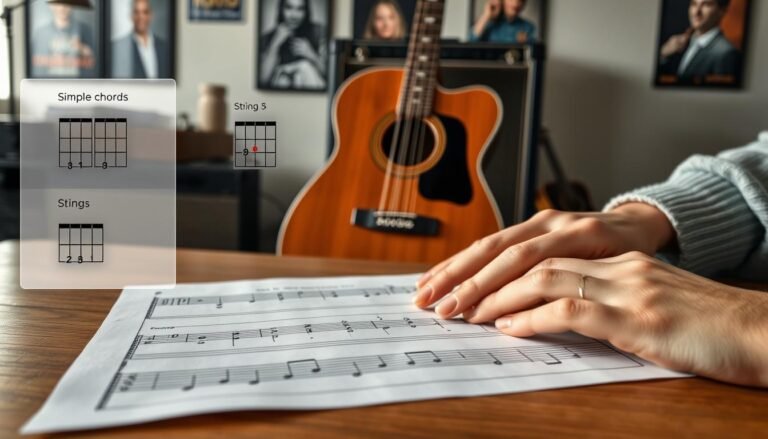
Learn How to Read Guitar Notes Effortlessly
Learning to read guitar notes is a key step for beginners. This guide will cover both guitar tablature and sheet music. This way, you can choose the method that suits you best.
Guitar tablature, or TAB, uses six lines to represent the strings. Numbers on these lines show where to place your fingers. It’s read from left to right, and numbers stacked mean chords.
Techniques like hammer-ons and pull-offs are marked with special symbols. Schools like School of Rock start with TAB in lessons. You can find TAB versions of songs easily at Sheet Music Direct.
Standard notation, on the other hand, uses a staff and treble clef. It shows pitch, rhythm, and more. Learning staff notes and simple mnemonics can speed up sight reading.
The fretboard connects both systems. Note names follow a pattern that repeats at the 12th fret. Knowing this pattern helps you find notes fast.
This article will teach you music notation basics, fretboard mapping, and rhythm. You’ll also learn about technique symbols, practice drills, and resources. This will help you read guitar notes with confidence.
Why learning to read guitar notes matters for beginner guitarists

Learning to read guitar notes is more than just remembering songs. Guitar tabs help you play songs fast by showing where to press the strings. Sheet music, on the other hand, gives you the rhythm, key, and more.
Knowing both systems lets you see music from different angles. This is great for playing with others, like piano or voice.
Reading music makes rehearsals smoother. Everyone can follow the same score. This is key in groups where everyone needs to be on the same page.
Linking staff notes to the fretboard makes playing easier. If you can spot a note on the staff, you can play it on the guitar. This skill makes you better in groups and saves time in rehearsals.
| Item Name | Description | Calories | Price |
|---|---|---|---|
| Guitar TAB Starter | Compact booklet showing fret positions for common songs and simple riffs | 0 | $7.99 |
| Beginner Sheet Music Pack | Standard notation for easy songs with clear rhythmic marking | 0 | $14.99 |
| Fretboard Reference Chart | Map of note names across strings and frets, ideal for sight reading | 0 | $5.99 |
| Ensemble Guitar Guide | Tips for reading scores in bands, pits, and chamber groups | 0 | $12.50 |
| Metronome & Sight-Read Kit | Exercises pairing rhythm practice with short notation excerpts | 0 | $9.50 |
| Transcription Workbook | Step-by-step tasks to convert guitar tabs into sheet music | 0 | $11.00 |
| Play-Along Backing Tracks | Recorded tracks in common keys for rehearsal and ear training | 0 | $8.75 |
| Key Signature Flash Cards | Portable cards for quick practice of sharps and flats | 0 | $4.25 |
| Sight-Reading App Subscription | Interactive drills for notation and TAB integration | 0 | $3.99/month |
| Rehearsal Planner Pad | Template to track parts, tempos, and key changes for group work | 0 | $6.00 |
Practical takeaway: guitar tabs are great for learning songs fast. But, sheet music gives you the full picture of rhythm and harmony. For playing with others, focus on reading and understanding music notation and key signatures.
how to read guitar notes
Learning guitar notes can start with two main paths: guitar tab and standard notation. Each has its own benefits. Choose the one that fits your goals first, then mix both to learn faster.

guitar tab uses six lines for strings and numbers for frets. It shows chords vertically and timing horizontally. TAB is great for learning riffs and chords quickly. It also marks techniques like slides and bends.
standard notation is on the treble clef and shows pitch, rhythm, and more. It uses staff lines and spaces for notes. This format is key for playing with others and arranging music.
| Item Name | Description | Calories | Price |
|---|---|---|---|
| Guitar TAB | Six-line diagram showing string and fret placement; clear technique markers for guitar-specific articulations | 0 | $0 (common online) |
| Standard Notation | Treble clef staff showing pitch, rhythm, dynamics, and harmonic context; vital for ensemble sight reading | 0 | Varies by score |
| Combined Practice | Read rhythm and harmony in notation, check TAB for fingering and playability; transcribe between formats | 0 | Practice time |
| Technique Markers | Symbols for slides, bends, vibrato and muting that appear in TAB and notation differently | 0 | Included in lessons |
| Sight Reading | Skill developed with standard notation for faster ensemble integration and accurate rhythmic execution | 0 | Lesson cost |
| Quick Song Learning | TAB enables rapid pickup of riffs and chord shapes without deep theory | 0 | Often free |
| Transcription | Converts ear, TAB and notation into a unified understanding of melody and harmony | 0 | Practice time |
| Ensemble Use | Standard notation aligns parts across instruments and communicates dynamics | 0 | Score purchase |
| Fretboard Knowledge | Combining formats strengthens fretboard mapping and choice of fingerings | 0 | Practice time |
| Learning Speed | Using both systems shortens the path from sight reading to confident playing | 0 | Effort |
Overview of the two main systems
Guitar tab shows you where to place your fingers on the fretboard. It’s great for learning riffs and chords quickly. But, it doesn’t show note duration like notation does.
Standard notation gives you the whole musical picture: pitch, rhythm, and more. It’s essential for playing with others and improving your sight reading skills.
When to use TAB vs. sheet music depending on goals
Use TAB for quick access to riffs, chord shapes, or rock parts. It focuses on position and technique.
Choose standard notation for playing in an orchestra or improving sight reading. It helps with timing and reading across clefs.
How combining both systems speeds up learning and musical understanding
Read a phrase in notation to learn its rhythm and harmony. Then, use TAB to find the best fingering. This trains your ear and note locations.
Transcribing between formats strengthens music theory and fretboard command. It moves you from mimicking songs to understanding music.
Understanding the guitar fretboard and note names
Learning fretboard notes begins with the music alphabet. The seven letters A through G are the base of every scale and chord. On guitar, enharmonic names like A# and Bb are common. They show the different ways to name the same note.
Start by tracing the chromatic scale on one string. Move up in half steps: A → A# → B → C → C# → D → D# → E → F → F# → G → G# → A. The 12th fret repeats the open-string pitch, making the octave pattern easy to spot.
Use the low E string as a guide. Memorize its sequence of notes. Then, apply octave shapes to find the same note names elsewhere. This makes navigating the guitar fretboard faster and more reliable.
| Item Name | Description | Calories | Price |
|---|---|---|---|
| Low E String Map | Notes from open E up to the 12th fret following the chromatic scale | 0 | $0.00 |
| Octave Shape | Two-note pattern to locate the same pitch on another string | 0 | $0.00 |
| 5th-Fret Overlap | Standard string-to-string relationship: most strings repeat at the 5th fret | 0 | $0.00 |
| 4th-Fret Exception | G-to-B string interval where the overlap happens at the 4th fret | 0 | $0.00 |
| 12th-Fret Marker | Dual markers help you spot the octave and repeat point on the neck | 0 | $0.00 |
| Enharmonic Example | A# and Bb shown on adjacent frets to explain naming differences | 0 | $0.00 |
| Practice Drill | Find every A on the neck using octave shapes and overlap rules | 0 | $0.00 |
| String Note Guide | Open string names and common fret references for quick lookup | 0 | $0.00 |
| Fretboard Visualization | Simple patterns to connect the chromatic scale with fret positions | 0 | $0.00 |
| Name Recall | Short exercises to speed up naming fretboard notes under time | 0 | $0.00 |
Remember the overlap rules for quick navigation. Most strings line up at the 5th fret. For example, low E fifth fret gives A; A fifth gives D; D fifth gives G. The G-to-B interval breaks this pattern and aligns at the 4th fret instead. Use this fact to locate notes and build octave shapes fast.
Working from the chromatic scale and the music alphabet in short daily drills will lock in fretboard knowledge. Practicing with clear goals helps you name notes without thinking. This improves sight reading, improvisation, and communication with other musicians.
Reading guitar tablature: the beginner-friendly roadmap
Guitar tablature is a quick way to learn songs. It has six lines for strings and numbers for frets. It’s great for beginners because it shows the fretboard directly.
How to read the six TAB lines and fret numbers
The top line is the high E string, and the bottom is low E. Numbers on the lines tell you which fret to press. 0 means play the open string.
Read from left to right. Numbers together form a chord. Frets repeat at the 12th fret, so 15 plays the same note an octave above fret 3.
| Item Name | Description | Calories | Price |
|---|---|---|---|
| Standard TAB staff | Six lines labeled TAB showing string and fret positions | 0 | $0.00 |
| Fret numbers | Indicate pitch; 0 = open, higher numbers = higher frets | 0 | $0.00 |
| Vertical alignment | Shows chords when numbers line up across strings | 0 | $0.00 |
| Horizontal spacing | Represents timing and melody flow from left to right | 0 | $0.00 |
| Labeling | Staff may be marked “TAB” to avoid confusion with standard notation | 0 | $0.00 |
| Common fret range | Most TABs use 0–24 to cover typical neck range | 0 | $0.00 |
| Octave repeats | Notes past 12 repeat one octave higher | 0 | $0.00 |
| Chord vs. melody | Vertical groups = chord, spaced numbers = melody or riff | 0 | $0.00 |
| Reading order | Always left to right like standard Western notation | 0 | $0.00 |
Interpreting vertical alignment for chords and horizontal flow for melody
When numbers stack vertically, play them together as a chord. If numbers are staggered, play them in sequence to form a melody or riff. Use spacing as a guide to rhythm when no standard notation is present.
Common TAB symbols and basic technique markers
TAB symbols tell you how to shape notes. H means hammer-on with an arc connecting notes. P marks a pull-off. A forward slash or backslash shows a slide up or down. Bends use arrows or text like 1/2 or full. A squiggle shows vibrato. T means tap; X marks a muted note. P.M. signals palm muting. Downstroke and V denote picking direction.
These TAB symbols pair with guitar technique markers to guide execution. Bends push the string up on most strings; low E bends push down. Hammer-ons and pull-offs need fingertip strength. Tapping sounds clearer with more gain, a technique Eddie Van Halen helped popularize.
Reading standard sheet music and notation basics
Reading sheet music helps guitarists understand pitch, rhythm, and expression. Start with basic staff reading and practice with your ears. The goal is to make reading music as easy as playing chords and scales.
Treble clef and staff layout
The guitar uses treble clef. The staff has five lines and four spaces, each representing a note. Spaces are named F A C E from bottom to top. Lines follow the mnemonic Every Good Boy Does Fine for E, G, B, D, F.
This knowledge helps you quickly read guitar notes on the page.
Reading notes outside the staff
Ledger lines extend the staff for notes above or below the normal range. They add extra pitches without changing the clef. Practice reading these lines to avoid mistakes when melodies go high or low.
Key signatures and pitch naming
A key signature appears after the clef and lists sharps or flats for the whole piece. No sharps or flats means it’s C major or A minor. One sharp makes it G major, three sharps make it A major.
The key signature changes how you name notes and affects the tonal center you hear.
| Item Name | Description | Calories | Price |
|---|---|---|---|
| Staff Basics | Five lines and four spaces; treble clef indicates guitar range | 0 | $0.00 |
| Spaces Mnemonic | FACE helps you recall space notes quickly | 0 | $0.00 |
| Lines Mnemonic | EGBDF guides line names for fast reading | 0 | $0.00 |
| Ledger Lines | Extend staff range for high and low pitches | 0 | $0.00 |
| Key Signature | Sharps or flats next to clef set the key | 0 | $0.00 |
| Common Keys | C major (0), G major (1 sharp), A major (3 sharps) | 0 | $0.00 |
| Rhythmic Info | Notation shows durations, rests, and time signature | 0 | $0.00 |
| Combined Reading | Pitch plus rhythm yields effective sight-reading | 0 | $0.00 |
| Practical Tip | Match note names on staff to fretboard patterns | 0 | $0.00 |
| Goal | Use sheet music to play accurately in ensembles | 0 | $0.00 |
Notation includes rhythm, dynamics, and articulation, along with pitch. Start with short sight-reading sessions. Practice pitch naming, ledger lines, and key signature awareness. This will make reading guitar notes second nature.
Mastering rhythm: counting, subdivisions, and rests
Rhythm is key to musical timing. Before playing a note, you must feel the beat and know how it divides. Use clear rhythm counting to map beats, learn common time signatures, and read note values with confidence.
Time signatures show how many beats are in a measure and which note gets one beat. For example, 4/4 means four quarter-note beats per bar. Bar lines mark the start and end of each measure. A measure must add up to the full beat total shown by the time signature.
Note durations tell us how long each sound lasts. Whole notes last four beats, half notes two, and quarter notes one. Eighth notes last half a beat, and sixteenth notes a quarter. Dotted notes add half the original value, so a dotted half equals three beats. Flags show single short notes; beams group eighths and sixteenths.
| Item Name | Description | Calories | Price |
|---|---|---|---|
| Quarter Pulse | Basic quarter-note counting at set tempo for steady beat control | 120 | $4.99 |
| Eighth Pairing | Two eighth notes grouped to teach “1 & 2 &” subdivision | 95 | $3.49 |
| Sixteenth Drive | Four-part subdivision using “1 e & a” for fast rhythmic control | 140 | $5.99 |
| Dotted Flow | Exercises mixing dotted notes with regular values to build feel | 110 | $4.49 |
| Rest Awareness | Clapping patterns that include rests to internalize silence and placement | 85 | $2.99 |
| Meter Shift | Practice changing time signatures to improve adaptability | 130 | $6.49 |
| Accent Training | Focus on accented beats to enhance groove and phrasing | 100 | $3.99 |
| Single-String Transfer | Apply clapped rhythms to single-string picking patterns | 125 | $5.49 |
| Tempo Ladder | Gradual tempo increases using metronome exercises for precision | 150 | $7.99 |
| Sight-Reading Starter | Short rhythmic examples to build quick sight reading accuracy | 90 | $3.25 |
Start with clapping-only drills to focus on timing. Clap steady quarter notes, then move to eighths using “and” between beats. For sixteenth patterns use “1-e-and-a” to split each beat into four equal parts.
Introduce metronome exercises at slow tempos. Set a comfortable BPM, practice subdivisions, then raise the speed in small steps. Slow metronome work builds clean transitions and steady time.
Transfer clapped patterns to the guitar one string at a time. Play single notes while keeping the same rhythm counting. This method links physical motion to internal pulse and improves sight reading of rhythmic notation.
- Count aloud while tapping or clapping.
- Use “and” and “e-and-a” for subdivisions.
- Practice rests as intentionally as notes.
- Use an online or hardware metronome for consistent tempo.
Regular practice that combines rhythm counting, time signatures, precise note durations, metronome exercises, and brief sight reading drills will grow reliable timing. Keep sessions short and focused for faster results.
Essential guitar techniques shown in notation and TAB
This section explains how common guitar techniques are shown in standard notation and TAB. It uses clear symbols and quick tips for practice. The aim is to help you quickly spot hammer-ons, pull-offs, bends, vibrato, tapping, palm muting, and strumming notation.
Slides and bends
Slides in TAB are shown as lines between fret numbers. An upward slope means slide up, and a downward slope means slide down. In standard notation, a diagonal line or gliss marks the same movement.
Bends are marked with curved arrows and interval amounts, like ½ or full. Pre-bends show an arrow before the beat; release arrows return to the original pitch. For smooth bends, use two or three-finger support to keep control and pitch accuracy.
Hammer-ons and pull-offs
Hammer-ons are marked with H in TAB and often shown with slurs in notation. Pull-offs use P and similar arcs. These techniques help in playing scales and licks smoothly.
Execution tip: strike the first note cleanly, then hammer with a strong fingertip impact or pull off with controlled motion to keep tone even.
Vibrato, tapping, and muting
Vibrato is shown as a zig-zag line above the staff. The length of the line indicates how long to sustain the effect. Tapping is marked with a T above the note in TAB and can combine with hammer-ons from both hands for two-handed licks.
Muted notes show an X on the TAB string. Palm muting is labeled P.M. above the passage. Vary palm pressure toward the bridge to shape tone while keeping rhythm tight.
Strumming notation and patterns
Downstrokes are shown with a thick horizontal stroke and legs pointing down; upstrokes use a V. Strumming notation lines up with subdivisions so you can see down on beats and up on the “ands.”
Practice common patterns slowly, count eighths and sixteenths, and match hand motion to the symbols for consistent groove.
| Item Name | Description | Calories | Price |
|---|---|---|---|
| Slide | Line between frets in TAB; glissando marking in notation | 0 | $0.00 |
| Bend | Curved arrow with interval amount; supports expressive pitch shifts | 0 | $0.00 |
| Hammer-on | Marked H with slur; creates legato ascending notes | 0 | $0.00 |
| Pull-off | Marked P with slur; produces smooth descending notes | 0 | $0.00 |
| Vibrato | Zig-zag above staff; length shows duration | 0 | $0.00 |
| Tapping | Marked T above note in TAB; uses picking-hand finger | 0 | $0.00 |
| Palm Muting | Marked P.M. above passage; X shows muted string in TAB | 0 | $0.00 |
| Strumming | Downstroke and upstroke symbols aligned with rhythmic subdivisions | 0 | $0.00 |
Use slow practice to connect notation to feel. Read the symbols, try the execution tips, and apply the patterns to songs you know. This approach makes hammer-ons, pull-offs, bends, vibrato, tapping, palm muting, and strumming notation part of your regular vocabulary.
Memorization and practice strategies for the fretboard
Learning the fretboard gets easier with clear patterns and daily practice. Start with a simple plan that links visual shapes to music. Use octave shapes and drills to build quick recall. Then, add scale practice and chord mapping to connect notes to music.
Using octave shapes and simple patterns
Octave shapes are a quick way to find the same note higher or lower. A common pattern matches the outer notes of power-chord shapes. Use these shapes off the low E and A strings to find middle-neck tones fast.
Visual patterns make learning easier. Spotting an octave shape helps you remember fretboard locations without naming every fret first.
Drills for learning notes on strings and across frets
Start with the chromatic sequence on a single string. Play every fret while naming the notes out loud. Repeat until you can move up and down the neck without hesitation.
Apply the 5th-fret/4th-fret overlap rule to map notes between strings. Practice random-fret naming for speed. These drills build raw recall and prepare you to read and play in real time.
Integrating scale and chord knowledge
Combine scale practice with chord mapping to anchor note names in musical context. Play a major or minor pentatonic pattern and call out each scale degree as you move through it.
Then map those same notes onto basic chord shapes. This creates links between single-note awareness and harmonic function, making it easier to improvise and compose.
| Item Name | Description | Calories | Price |
|---|---|---|---|
| Single-String Chromatic Drill | Play every fret on one string while naming notes aloud to build linear recall. | 0 | $0.00 |
| Octave Shape Locator | Use octave shapes from low E and A strings to find the same note an octave away. | 0 | $0.00 |
| 5th/4th Overlap Mapping | Map common overlap points between strings to speed cross-string identification. | 0 | $0.00 |
| Random-Fret Naming | Have a partner call frets or use an app, then name the note immediately for recall speed. | 0 | $0.00 |
| Major Scale Degree Drill | Play a major scale pattern and state each degree to link pitch to function. | 0 | $0.00 |
| Minor Pentatonic Linking | Practice pentatonic boxes while naming notes to bridge lead playing with theory. | 0 | $0.00 |
| Chord Mapping Session | Identify chord tones on the neck and trace them across positions for harmonic clarity. | 0 | $0.00 |
| Call-and-Response Drill | Instructor plays a note; you locate and name it, then reverse roles for active listening. | 0 | $0.00 |
| Scale Practice with Naming | Integrate scale practice with verbal naming to reinforce interval and fret relationships. | 0 | $0.00 |
| Integrated Run-through | Combine octave shapes, fretboard drills, scale practice, and chord mapping in one session. | 0 | $0.00 |
- Keep sessions short: five to fifteen minutes daily beats long, infrequent practices.
- Rotate focus: one day on octave shapes, next on fretboard drills, then scale practice.
- Track progress: time yourself naming 12 frets on the low E string and aim to improve.
Consistent use of these steps helps you memorize fretboard areas and hear their musical roles. Over time, octave shapes and targeted fretboard drills make note finding automatic. Scale practice and chord mapping tie those notes to real music.
Note reading exercises to build sight-reading skills
Start with focused practice that separates rhythm, pitch, and notation. Short daily sessions keep progress steady. Use a metronome and simple targets so small gains add up.
Begin with clapping-only rhythm drills to lock in subdivisions and rests. Practice quarter-note claps, then move to eighth-note patterns. Try dotted rhythms next, then introduce 16th-note patterns. Repeat each pattern at a slow tempo until you feel steady.
| Item Name | Description | Calories | Price |
|---|---|---|---|
| Quarter-Note Warmup | Clap steady quarter notes with metronome at 60–80 BPM | 0 | $0 |
| Eighth-Note Pattern | Alternate single and paired claps to practice subdivisions | 0 | $0 |
| Dotted Rhythm Drill | Mix dotted quarter + eighth counts to build syncopation | 0 | $0 |
| 16th-Note Control | Short bursts at slow tempo to improve precision | 0 | $0 |
Single-string sight reading
Move from clapping to playing single-note patterns on one string. Start on the open low E and read simple notation that maps directly to frets. Use very slow tempos and focus on correct timing and fingering.
After you master one string, expand to adjacent strings using overlap points like the 5th-fret rule. This staged approach makes single-string sight reading predictable and less intimidating.
Transcription practice
Transcription practice connects ear, tab, and notation. Pick a riff you know well, then write it out in TAB. Convert the TAB to standard notation or start from the staff and add TAB under it. Doing both directions improves aural recognition and reading speed.
Keep these sessions short: 10–20 minutes a day. Alternate clapping-only rhythm, single-string sight reading, and transcription practice. Increase tempo in small steps once accuracy holds steady.
- Use a slow metronome setting for sight-reading drills.
- Record transcriptions to check pitch and timing later.
- Focus on consistency over speed during early reps.
Follow this routine for several weeks. Regular, focused note reading exercises will make sight-reading drills practical and reliable. Transcription practice ties what you hear to what you read.
Combining TAB and sheet music to accelerate learning
Mixing TAB and standard notation speeds up your progress. Use notation for rhythm, key, and form. TAB shows exact finger placement and string choices.
To transcribe TAB to notation, first find the fret and string for pitch. Add rhythm from TAB timing marks or listen for note lengths. Complete the staff with clef, key signature, and time signature.
To convert notation to TAB, map staff pitches to fretboard positions. Choose fingerings that match the style.
| Item Name | Description | Calories | Price |
|---|---|---|---|
| Notation First | Learn rhythm and harmonic context before fingering choices | 120 | $0.00 |
| TAB First | See fret positions and technique markers for quick replication | 90 | $0.00 |
| Chord Charts | Show shapes and finger numbers for strumming and comping | 60 | $0.00 |
| Combined | Use notation for ensemble cues, TAB for guitar detail | 150 | $0.00 |
| Lesson Workflow | Start with staff, add TAB for fingering, finish with play-along | 200 | $0.00 |
| Rehearsal Prep | Provide notation to band, hand out TAB for guitarists | 80 | $0.00 |
| Transcription Drill | Write both formats to train ear and notation skills | 110 | $0.00 |
| Voicing Focus | Use chord charts to check shapes, use TAB to capture voicings | 70 | $0.00 |
| Performance Pack | Full set: guitar sheet music, TAB, and chord charts for shows | 300 | $0.00 |
| Practice Loop | Cycle notation, TAB, then play with metronome | 95 | $0.00 |
Chord charts are great for quick visual learning. They’re good for strumming and basic harmony. But they don’t show single-note riffs or exact voicings.
Teachers mix lesson formats to speed up learning. They use notation for timing and form. TAB shows fretboard tricks and technique.
In rehearsals, staff notation helps everyone follow changes. TAB lets each player learn parts quickly.
When choosing materials, compare TAB and chord charts. Use chord charts for jams, TAB for signature riffs. Guitar sheet music is best for rhythm and orchestration.
- Tip: When transcribing TAB to notation, listen to phrasing for rhythm marks.
- Tip: When converting notation to TAB, pick fret positions for ergonomics.
- Tip: Use chord charts as a shortcut, not a replacement, for authenticity.
Using both formats improves sight-reading, ear training, and stage readiness. This method keeps learning focused and goal-oriented. It helps you go from rough chords to polished guitar sheet music smoothly.
Tools and resources to support reading guitar sheet music
Getting better starts with the right tools. Use apps, TAB libraries, and lessons to improve sight-reading and fretboard skills.
Here’s a quick guide to help you pick the best tools for your practice.
| Item Name | Description | Calories | Price |
|---|---|---|---|
| Sheet Music Direct | Official arrangements and downloadable guitar parts with staff view | 0 | $1–$10 per song |
| Ultimate Guitar (TAB libraries) | Extensive user-submitted tabs plus interactive player and chord charts | 0 | Free; premium $4–$7/mo |
| Metronome App (Smartphone) | Tempo control, subdivision options, and practice timers | 0 | Free to $5 |
| Fretboard Trainer App | Visual note drills and fretboard playback tied to notation | 0 | $0–$6 |
| Notation App (Staff + TAB) | Shows staff and TAB together, slows playback and loops passages | 0 | $10–$30 |
| Pickup Music Sight-reading for Beginners | Structured sight-reading course tailored to guitarists | 0 | $20–$80 |
| Local music school (School of Rock) | Group ensembles, led rehearsals, and song-based learning | 0 | $50–$200/mo |
| Backing track services | Play-along tracks with adjustable tempo and looping | 0 | Free to $10/mo |
| Private instructor | One-on-one lessons focused on reading, technique, and repertoire | 0 | $30–$100/hr |
Recommended apps and TAB libraries
Start with Ultimate Guitar and Sheet Music Direct for reliable tabs. Use apps that show both staff and TAB to understand note mapping.
Metronomes, backing tracks, and sight-reading course options
Practice with metronome apps to keep tempo steady. Backing tracks add musical context. For structured learning, try Pickup Music’s sight reading course.
How private lessons and ensemble programs fast-track progress
Private lessons offer personalized feedback and pacing. Teachers focus on reading and rhythm. Ensemble programs at schools and theaters demand quick adaptation, speeding up learning.
- Use mobile TAB viewers with fretboard playback to check fingerings.
- Combine metronome apps with slow-down tools for tricky passages.
- Pair a sight reading course with weekly private sessions for steady gains.
Mix these tools for a balanced practice plan. The right mix of apps, TAB libraries, a sight reading course, and private lessons will keep you improving steadily.
Conclusion
Learning to read guitar notes involves three main skills. First, you need to map notes to the fretboard. Second, mastering rhythm and duration is key. Lastly, applying guitar-specific techniques is essential.
Using TAB can give you quick results. But, standard notation and music symbols offer a full musical picture. This makes it easier to work with other musicians. Regular practice helps tie all these skills together.
Begin with simple TAB to keep your practice going. Add drills like FACE and EGBDF to learn notes. Also, practice the chromatic sequence and the 5th/4th-fret overlap.
Use a metronome to improve your rhythm. Practice octave shapes and scales to remember the fretboard faster. Transcribing familiar riffs helps link your ear, TAB, and notation.
Online TAB libraries, notation apps, and metronomes can help you progress. Backing tracks, sight reading courses, and lessons or ensembles also speed up your learning. These tools make practice more efficient and fun.
By combining short daily routines with focused exercises, you’ll grow faster. Reading guitar notes is a skill that takes time but is very rewarding. It opens up new creative possibilities and improves your group playing.