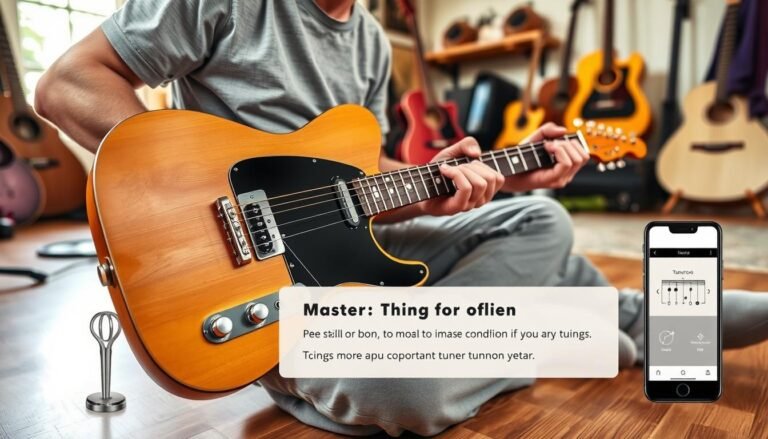
Learn How to Play Electric Guitar: Tips & Tricks
Starting to play electric guitar is easy. Just follow a five-step plan. First, choose how you want to learn. Then, pick the right equipment for beginners.
Next, learn the basics of music. After that, learn your first song. And don’t forget to practice regularly.
Mirco Sontag’s method is all about making progress and setting achievable goals. This way, you can build your skills without getting frustrated.
The electric guitar is great for many music styles like rock, pop, metal, and blues. It offers a wide range of sounds thanks to pickups and amps.
For beginners, guitars from brands like Yamaha, Epiphone, Squier, and Harley Benton are good choices. They cost between €200 and €300. You’ll also need a starter amp, light-gauge strings, and some basic accessories.
Start with short practice sessions of 15–30 minutes. Make sure your instrument is in tune and use a metronome to improve your timing. Playing simple songs like “Smoke on the Water” and “Seven Nation Army” can help you learn fast.
To play electric guitar well, choose a guitar that’s easy to play, not just expensive. Use a comfortable pick and light strings. And always follow a structured lesson plan or work with a teacher to avoid bad habits.
Recording your practice, switching between easy and hard songs, and playing while standing up can help you improve quickly.
how to play electric guitar
The electric guitar offers a wide range of sounds and styles. It doesn’t have the bulk of an acoustic guitar. You can shape your tone with pickups, amplifiers, and pedals for different genres.
Famous guitars like the Fender Stratocaster and Gibson Les Paul show how design affects sound and playability. This makes the electric guitar a great choice for those who want versatility and quick tone changes.

Playing electric guitar has many practical benefits for beginners. Thinner necks and lighter strings make playing easier and faster. You can practice late without disturbing others with headphone-ready amps.
Knowing what to expect helps beginners stay motivated. With regular practice, many can learn basic chords and simple riffs in months. It’s normal for progress to slow down after an initial burst of improvement.
Focus on core techniques that apply to many songs. Learn hammer-ons, pull-offs, slides, and basic bending. Spend time with a metronome, practice simple riffs, and get comfortable with amp controls and a tuner. Mastering these basics will help you grow musically and keep practice rewarding.
| Item Name | Description | Calories | Price |
|---|---|---|---|
| Fender Stratocaster | Versatile single-coil tones; great for blues and pop | 0 | $799 |
| Gibson Les Paul | Warm, sustained humbucker sound for rock and lead | 0 | $2499 |
| Gibson SG | Bright, aggressive tone suited to hard rock | 0 | $1799 |
| Fender Telecaster | Clear, cutting tone; favored for country and rock | 0 | $699 |
Choose a learning path with short, focused sessions. Celebrate small victories like clean chord changes or a learned riff. This approach builds confidence and leads to consistent progress.
Finding the right learning method for your goals

How you learn affects how fast you get better and how much you enjoy it. Your budget, schedule, and goals help decide the best way to learn. Here are the main options and how to pick the right one for you.
What to expect from each path.
| Item Name | Description | Calories | Price |
|---|---|---|---|
| Structured online courses | Video modules, play-alongs, progress tracking; works for self-paced learners. | 0 | $10–$30/month |
| Private guitar lessons | One-on-one feedback, hands-on correction, tailored goals and repertoire. | 0 | $30–$80/session |
| Apps and interactive tools | Looping, tempo control, instant playback for practice and repetition. | 0 | $5–$20/month |
| Self-directed study | Books, YouTube, and trial-and-error learning; requires discipline to avoid bad habits. | 0 | Varies |
| Blended approach | Mix of online electric guitar lessons and occasional in-person coaching for best results. | 0 | Variable |
Online electric guitar lessons and apps
Online lessons are great for those with busy lives. Sites like Fender Play and TrueFire offer lessons and tracks. They help you stay on track without leaving home.
These tools help build your skills and song library. Use apps to slow down songs and loop parts. Getting feedback from a teacher helps fix mistakes found in lessons.
Private lessons and in-person teachers
Private lessons offer detailed feedback on your playing. A good teacher tailors lessons to your style, whether it’s blues, metal, or pop. Lessons keep you motivated and help you learn faster with targeted help.
Try different teachers to find the right fit. Look for those with successful students and clear plans. Expect to pay more for personalized guidance and scheduled lessons.
Self-taught strategies and pitfalls
Learning guitar on your own can work if you’re structured. Start with good books, courses, and focused videos. Set goals and record yourself to track your progress.
Watch out for bad habits like wrong wrist angle or uneven timing. Regular feedback from a teacher or friend helps avoid these. Many find a mix of online lessons and private lessons is the best way to learn.
- Tip: Practice a little every day for steady improvement.
- Tip: Use tools to slow down songs to learn tricky parts.
- Tip: Keep a log of your practice to see how you’re doing.
Choosing an electric guitar and starter equipment
Choosing the right gear makes learning faster and more fun. There are a few key choices to make. Try out instruments in a shop to see if they feel right before you buy.
Guitar types and tonal differences
There are main types of guitars that affect sound and feel. A Fender Stratocaster offers bright, versatile sounds. A Gibson Les Paul gives warm, sustained tones. An Epiphone SG has an aggressive edge.
A Fender Telecaster is great for clear, twangy sounds. Try these styles to find the one that fits your sound preferences.
| Item Name | Description | Calories | Price |
|---|---|---|---|
| Fender Stratocaster (style) | Versatile single-coil tones for blues, pop, and rock | 0 | $250–$1,200+ |
| Gibson Les Paul (style) | Full-bodied humbucker sound with strong sustain | 0 | $600–$3,000+ |
| Epiphone SG (style) | Aggressive midrange, light body, good for rock | 0 | $300–$700 |
| Fender Telecaster (style) | Clear, cutting tones ideal for country and clean work | 0 | $250–$1,500+ |
| Yamaha/ Squier beginner models | Reliable playability and low price for starters | 0 | $150–$350 |
| Practice amp (e.g., Fender Mustang) | Modeling amp with useful presets and headphone out | 0 | $150–$300 |
| Boss Katana / Yamaha THR | Compact, stage-capable options with rich tone | 0 | $200–$400 |
| Starter bundle (Harley Benton set) | Includes guitar, amp, cable, strap, and picks | 0 | $200–$350 |
| Accessories pack | Tuner, spare strings (.009–.042), picks, case | 0 | $20–$60 |
Essential beginner gear
Start with a guitar you can play, a small practice amp, a tuner, a good cable, and spare strings. Use light gauge strings for easier playing. Try different picks to find the right feel for your playing style.
Headphones are great for practicing without disturbing others. A good strap, a reliable tuner, and a quality cable make daily practice better. Look for starter bundles from brands like Yamaha or Squier for all you need.
What to spend on now and when to upgrade
For beginners, spending around €200–€300 (about $220–$330) is wise. This buys a playable guitar from Yamaha, Epiphone, Squier, or Harley Benton. Avoid very cheap guitars that are hard to play.
Upgrade when you need better gear. Get a better amp for gigs, a higher-end guitar for better tone, and pedals as you get more skilled. Keep your first setup simple to focus on technique without getting lost in tone.
Quick buying tip: Focus on comfort and playability over brand name. This lets you enjoy learning and making progress.
Understanding music basics and fretboard fundamentals
Start with simple habits that make practice productive. Learn the electric guitar basics by tuning before each session, keeping good posture, and using focused short drills. These routines build muscle memory and make learning smoother over weeks.
Standard tuning and tuning tools
Standard tuning on a six-string electric guitar is E-A-D-G-B-E. Use a clip-on tuner from Korg or a tuning app like Fender Tune to get accurate pitches quickly. Tune before every practice and check tuning after bending strings or heavy strumming.
Reading tablature and basic notation
Tablature shows strings and fret numbers, letting you pick up songs fast. Start with tabs and chord charts from a simple Mel Bay chord book to learn shapes and song structure. Learn basic sheet music later to round out skills without slowing song learning now.
Memorizing the fretboard and note locations
Memorize open string notes first, then use octave shapes and scale patterns to place notes quickly. Practice short drills: name notes on frets 1–12, play scales while saying notes, and record sessions to spot weak spots.
| Item Name | Description | Calories | Price |
|---|---|---|---|
| Korg Clip-On Tuner | Accurate chromatic tuner that clips to headstock for quiet environments | 0 | $29.99 |
| Fender Tune App | Free mobile app with chromatic and preset tunings plus metronome | 0 | Free |
| Mel Bay Chord Book | Compact chord charts and basic theory for beginners | 0 | $12.50 |
| Practice Metronome | Simple digital metronome for timing drills and scales | 0 | $15.00 |
| Guitar Recorder App | Record practice to review timing and note accuracy | 0 | Free |
| Scale Chart Poster | Visual fretboard map with common scales and octave shapes | 0 | $9.99 |
| Practice Journal | Simple log to track drills, tempo, and progress | 0 | $6.00 |
| Guitar Strap | Adjustable strap to keep guitar stable standing or seated | 0 | $14.99 |
| Electric Guitar Basics Guide | Concise handbook covering tuning, posture, and beginner techniques | 0 | $8.95 |
| Beginner Strings Set | Light gauge strings that are easier on the fingers for new players | 0 | $7.50 |
Use repetition and short recordings to track improvement. As you grow comfortable with standard tuning and tuning tools, expand reading skills from tablature to basic notation. These steps help you memorize fretboard patterns and play with confidence.
Essential chords, power chords, and rhythm techniques
Begin with basic open chords like E major, A major, and D major. These chords are key in many songs and help you place your fingers correctly. Keep your fingers curved to avoid muffled sounds and use lighter strings to ease finger strain.
Start with slow chord changes. Practice moving between E, A, and D with simple strumming. Choose a pick grip that feels natural and steady. Playing while standing will help you get used to live performances and improve your endurance.
Open shapes are great for beginners. Pair them with simple strumming and focus on timing. Add one new chord each week to keep your progress steady.
Power chords are essential for rock and punk. They are two- or three-note shapes that move across the neck. Learn a root-fifth shape on the low E and A strings, then slide it to different frets to form new chords.
Work on palm muting for tighter rhythm. Mix downstrokes with occasional upstrokes to add punch. Practice short, precise power chord bursts before increasing speed.
Rhythm techniques include syncopation, palm muting, and alternating strums. Try reggae-style offbeat patterns and straight rock pulse. Mix easy rhythms with harder ones to boost your confidence and variety.
Metronome practice is key for timing. Start slow, set a tempo you’re comfortable with, and play in time with the click. Gradually increase the BPM in small steps as you get more comfortable.
Use this practice table to track your progress and choices. Update it as you try new picks, string gauges, and tempos.
| Item Name | Description | Calories | Price |
|---|---|---|---|
| Beginner Session | 10 minutes warm-up with E, A, D open chords and simple strum | 0 | $0 |
| Power Chord Drill | 15 minutes sliding root-fifth shapes across frets with palm muting | 0 | $0 |
| Rhythm Practice | 10 minutes syncopation and reggae offbeat patterns | 0 | $0 |
| Metronome Work | 15 minutes metronome practice, slow to medium tempo increases | 0 | $0 |
| Technique Focus | 10 minutes finger arching, pick grip, and standing practice | 0 | $0 |
| Song Application | 20 minutes applying beginner chords and power chords to a simple song | 0 | $0 |
| Cool Down | 5 minutes light chord changes and stretching | 0 | $0 |
| Pick Trial | Compare thin, medium, and heavy picks for strumming clarity | 0 | $5 |
| String Choice | Test light-gauge strings to reduce finger fatigue during chord work | 0 | $8 |
| Performance Run | Play through a set while standing to simulate a gig | 0 | $0 |
Practice with purpose. Break your sessions into short, focused blocks. Cover open chords, power chords, and rhythm techniques. Regular metronome practice will improve your timing and make playing with others easier.
Basic electric guitar techniques and effects-safe practice
Begin with small drills to build control. Focus on finger placement, timing, and tone. This helps you catch problems early and play with confidence as you get better.
Left-hand technique is key for clear notes. Keep fingers arched and press close to the fret. Avoid resting knuckles on the strings. Practice hammer-ons and pull-offs slowly to avoid fret buzz.
Right-hand basics shape rhythm and articulation. Hold the pick lightly and pick near the bridge for attack or over the neck for warmth. Alternate picking with short, even strokes improves speed and accuracy.
| Item Name | Description | Calories | Price |
|---|---|---|---|
| Alternate Picking Drill | 8-note chromatic run across four frets at one string | 0 | $0 |
| Legato Exercise | Hammer-ons and pull-offs across a three-fret pattern | 0 | $0 |
| Muted Rhythm | Palm-muted eighth-note groove to lock timing | 0 | $0 |
| Single-Note Accuracy | Slow tempo target-note work to fix intonation | 0 | $0 |
| String Skipping | Wide interval picking to train precision | 0 | $0 |
| Metronome Sessions | Progressive tempo increases for consistency | 0 | $0 |
| Open-Chord Transitions | Slow chord change drills for smooth motion | 0 | $0 |
| Palm Muting Control | Adjust bridge pressure to vary deadness | 0 | $0 |
| Scale Sequences | Three-note-per-string patterns for fluid runs | 0 | $0 |
| Simple Bends | Half and whole-step bends with pitch checking | 0 | $0 |
Practice without effects to spot timing and intonation issues. Clean amp settings and no pedals make mistakes clear. Fix these problems before adding distortion, reverb, or delay.
Once basics are solid, add one effect at a time. Start with light overdrive to learn how it affects fret noise. Try a modest reverb to check note decay. Keep chains simple to trace problems to specific settings.
Choose strings that support your goals. Light-gauge sets like .009–.042 ease bending and fretting for beginners. They reduce hand fatigue and help build proper left-hand technique without high tension.
Guitar string setup is key for comfort and tone. Aim for a comfortable action that lets notes ring cleanly. If action feels high or intonation is off, consider a professional setup from a local tech at Fender or Gibson service centers.
Carry spare strings and learn to tune before every session. Tune carefully, check saddle position, and stretch new strings gently. Small setup tweaks greatly improve practice clarity and steady progress.
Learn your first songs and riffs to build confidence
Start with short pieces that fit your hands and ear. Learning simple riffs and chord progressions boosts confidence fast. Choose songs with clear parts and steady tempo to track your progress.
Beginner riffs that focus on one or two strings help you master timing and fretting. Try the opening line of “Smoke on the Water” by Deep Purple to practice two-note shapes. “Seven Nation Army” by The White Stripes works well for single-string melody practice. Play slowly, then add small speed gains with a metronome.
Learn first songs electric guitar by dividing each song into bite-size phrases. Start on single strings, then add simultaneous string fretting when you feel steady. For chord-based learning, use simple progressions such as Am, C, D, and G to play dozens of beginner songs with minimal strain.
Use printed or online tablature to map the notes. A focused set of three to five songs builds muscle memory faster than switching constantly. Record short takes to compare timing and tone with the original recordings.
| Item Name | Description | Calories | Price |
|---|---|---|---|
| Smoke on the Water | Classic two-note riff for rhythm and timing | 0 | $0 (publicly known) |
| Seven Nation Army | Simple single-string melody, great for accuracy | 0 | $0 (publicly known) |
| Knockin’ on Heaven’s Door | Chord changes ideal for strumming and singing | 0 | $0 (publicly known) |
| Come As You Are | Melodic repeats that train tone and timing | 0 | $0 (publicly known) |
| Practice Set | Short loops, metronome, and 10-minute warmups | 0 | $0 (self-made) |
| Tab Book | Reliable tablature for chosen songs | 0 | $10–$25 |
| Backing Track | Play-along mix to lock timing and feel | 0 | $0–$5 |
| Slow-Down App | Tool to reduce tempo without changing pitch | 0 | $0–$40 |
| Recording Device | Phone or interface for quick self-review | 0 | $0–$150 |
| Metronome | Steady timing for tempo control | 0 | $0–$30 |
Beginner riffs and melody starters
Isolate short motifs of a riff and loop them until finger memory forms. Use simple bends and slides sparingly to stay focused on rhythm and note clarity.
Chord-based songs to practice changes
Play slow chord shifts between Am, C, D, and G until switching feels natural. Strum steady patterns and count beats aloud. Add a capo to match your vocal range if you plan to sing along.
Using tabs, backing tracks, and slow-down tools
Combine accurate tabs with backing tracks to rehearse timing and dynamics. Use YouTube speed controls, Transcribe!, or Anytune to slow phrases without changing pitch. Record short clips and compare them to originals to set clear micro-goals.
Practice plans, progress tracking, and common mistakes to avoid
Short, focused sessions are key to getting better. Try to practice for 15–30 minutes each day. Mix warm-ups, technique drills, and timing practice in your sessions.
Use a metronome to keep the rhythm. Set clear goals and take short breaks to avoid getting tense.
Here’s a quick guide to plan your practice sessions. It helps you compare different tools and snacks for long practice days.
| Item Name | Description | Calories | Price |
|---|---|---|---|
| Clip-on Tuner (Korg) | Fast, accurate tuning for noisy rooms; easy to clip on headstock | 0 | $14.99 |
| Metronome App (Soundbrenner) | Vibrating metronome and visual tempo; good for timing work | 0 | $0–$4.99 |
| DAW for Recording (GarageBand) | Simple multitrack recording for review and layering ideas | 0 | Free on macOS/iOS |
| Practice Snacks (Banana) | Quick energy to avoid dips during extended practice | 105 | $0.25 |
| Guitar Stand (Hercules) | Safe, quick access to your instrument to encourage frequent practice | 0 | $29.99 |
| Notebook or App (Trello) | Track goals, set milestones, and log practice notes | 0 | $0–$12.50 |
| Pickup Cleaner (MusicNomad) | Maintain hardware for consistent tone and playability | 0 | $9.99 |
| Backing Tracks Pack | Varied grooves to test timing and apply skills musically | 0 | $5–$15 |
| Practice Amp (Fender Frontman) | Small amp for practicing tone and dynamics without effects | 0 | $79.99 |
| Ear Protection (Etymotic) | Protect hearing during long sessions and band practice | 0 | $19.99 |
| Stretch Band | Hand and wrist warm-ups to reduce strain and improve reach | 0 | $7.50 |
Effective practice routine templates
One simple plan divides 20 minutes into warm-up (4 minutes), technique (6 minutes), repertoire (6 minutes), and timing or improv (4 minutes). For longer sessions, repeat the cycle and add focused weak-point work. Keep goals specific, such as “clean hammer-ons at 80 bpm” or “smooth the chorus strumming pattern.”
Recording and self-review
Recording guitar practice reveals issues that slip by while playing. Use a phone or a basic DAW like GarageBand to capture short takes. Listen with fresh ears and mark time stamps where timing, tone, or intonation falters.
Regularly saving samples creates a clear timeline for progress tracking guitar. Compare clips monthly to see measurable gains and adjust priorities. Use simple tags for each file: date, tempo, and focus area.
Common beginner mistakes and how to fix them
Applying small corrections early avoids long-term habits that limit progress. Avoid gripping the neck too hard; practice relaxed posture and finger stretching to free up motion.
Trying songs beyond current skill leads to frustration. Simplify parts, slow them down, and loop short sections. For bad timing, practice with a metronome and backing tracks to lock in rhythm.
Skipping tuning and relying on effects mask problems. Tune every session with a clip-on or app. Practice raw without pedals to hear and fix technique issues.
Poor posture and strap height create strain and poor fretting. Adjust strap so the guitar sits at a comfortable angle. Ask a teacher or friend to check posture during practice.
Track repetitions and challenges in a notebook or app to avoid skipping fundamentals. Balance songs with scales, chord transitions, and timing drills to build a rounded routine that reduces common guitar mistakes.
Conclusion
Learning electric guitar is easy if you follow a simple five-step plan. First, choose how you want to learn. Then, get the right gear. Next, learn how to tune and understand the basics.
Start with simple songs and make practicing a regular habit. Mixing private lessons, online tutorials, and self-practice helps you progress faster. This way, you stay on track and balanced.
Practice every day using a metronome, light strings, and simple picking. Focus on chords, memorizing the fretboard, and timing in short sessions. Record yourself to track your progress and mix easy songs with harder riffs.
As you get better, upgrade your gear. A better amp or pedals can improve your sound, and a higher-quality guitar feels better. Use teachers, apps, and tutorials to keep learning interesting and fun.
With patience and consistent practice, you’ll improve your skills, learn more songs, and feel confident to play and improvise. Keep going, and you’ll see great results!