How to Read Guitar Chords: A Beginner’s Guide
Chords are key to harmony and rhythm in music. Before diving into chords, make sure your guitar is in tune. This ensures the sounds you practice match the notes.
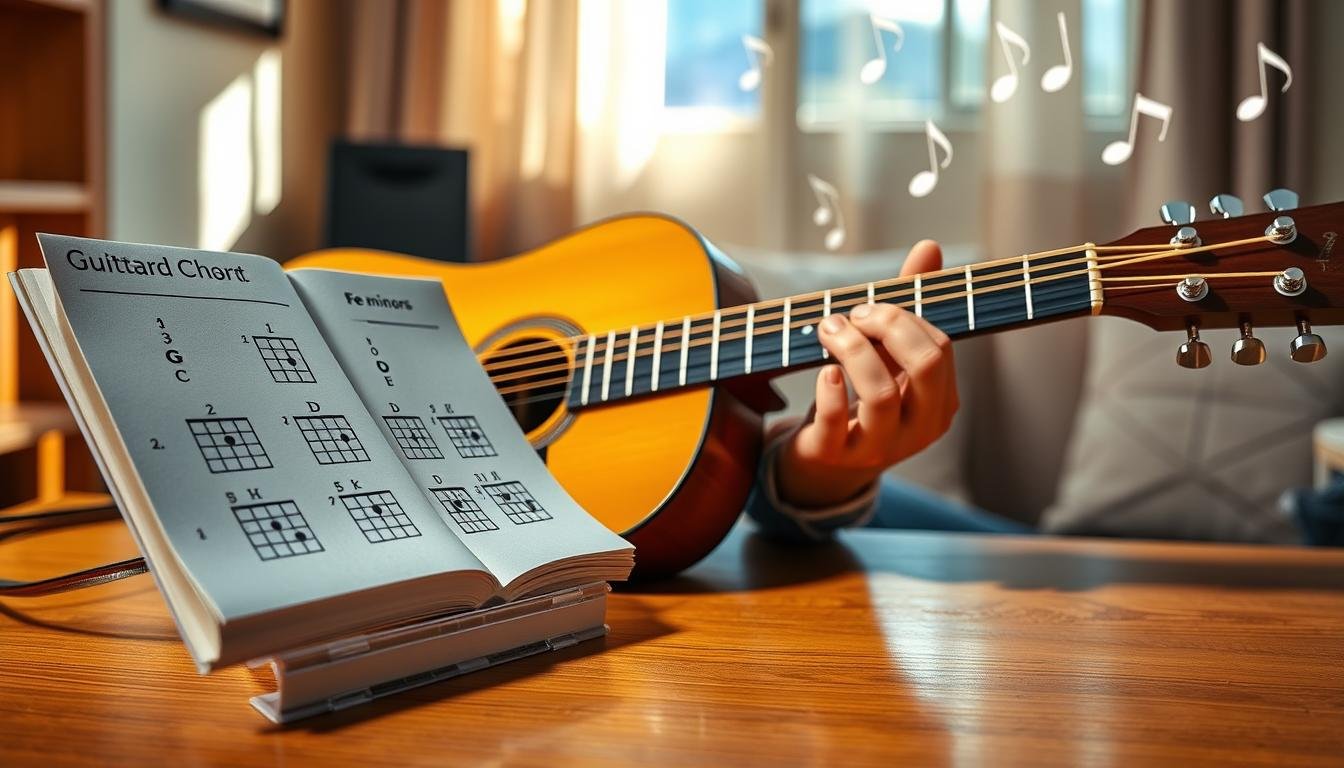
Learning guitar chords begins with chord diagrams. These charts show where to place your fingers and which strings to play. They help you turn visual information into sound.
Start with twelve basic chords: open major, minor, and seventh shapes. These chords are easy to play and open up a world of music. Use online charts and printable PDFs to help you learn faster.
Practice makes perfect. Start with open chords, then move to power chords, and finish with barre chords. This will help you master the fretboard.
Understanding the Basics of Chords and Harmony
Chords are the heart of most songs. They happen when two or more notes play together, creating harmony. This harmony gives songs depth and supports the melody, making learning guitar chord reading essential.
What is a chord and why chords matter
A chord is when you play multiple notes at once. Rhythm instruments like drums and bass provide the beat. But chords add the harmony that makes a song feel complete.
Knowing how to read guitar chords lets you follow a song’s harmony. This way, you can play along with confidence.
Common chord types for beginners
Beginners start with three main chord types. Power chords use the root and fifth, sometimes an octave apart. They are simple and great for rock and punk.
Open chords use open strings and full voicings from the CAGED system. These are perfect for folk, pop, and many beginner songs. Barre chords use one finger to bar a fret, making them versatile.
| Item Name | Description | Calories | Price |
|---|---|---|---|
| Power Chord | Two- or three-note shape; root and fifth; easy to move | 0 | $0.00 |
| Open Chord | Uses open strings; full voicings from the CAGED system | 0 | $0.00 |
| Barre Chord | Finger bars a fret to make movable shapes across the neck | 0 | $0.00 |
| Major Triad | Root, major third, perfect fifth; bright sound | 0 | $0.00 |
| Minor Triad | Root, minor third, perfect fifth; darker tone | 0 | $0.00 |
| Sus2 / Sus4 | Suspended chords replace the third with second or fourth | 0 | $0.00 |
| Seventh Chord | Adds a seventh for blues, jazz, and soul colors | 0 | $0.00 |
| Octave Shape | Two notes an octave apart; useful for riffs and fills | 0 | $0.00 |
| Movable Shape | Any chord shape shifted up or down the neck to change key | 0 | $0.00 |
| Open Sus | Hybrid shapes that mix open strings and suspended notes | 0 | $0.00 |
Why beginners start with specific chords
Open and power chords are easier to play because they sit low on the neck. They often use fewer fingers, making them simpler to press and switch between. Learning these shapes helps beginners progress faster and opens up a wide range of songs.
Developing good habits is key. Always tune your guitar before playing with a clip-on tuner or app. Try the School of Rock method by practicing chord shapes and then applying them to simple songs like “Hey There Delilah” or “Bad Moon Rising.” This approach improves your guitar chord reading and understanding of chord diagrams.
how to read guitar chords
Learning to read guitar chords is key to playing with purpose. This guide breaks down chord diagrams into easy parts. You’ll learn to spot notes, fingerings, and hand placement.

What chord diagrams represent
Chord diagrams show a part of the guitar neck as if you’re holding it. Vertical lines represent strings, from low E to high E on the left. Horizontal boxes below the top bar mark frets. The thick top bar is the nut when the chord is at the first fret.
A diagram might include a fret number like 6fr to show a higher starting position. Use diagrams to learn chord shapes, fingerings, and hand placement. They show the chord’s layout without listing every note like tabs do.
Reading finger numbers and symbols
Dots mark where to press. Numbers next to dots tell which finger to use: 1=index, 2=middle, 3=ring, 4=pinky. A T sometimes denotes the thumb when it wraps around the neck. A straight line across strings near the top shows a full barre with one finger.
Guitar chord notation often includes small letters or symbols for variations, such as m for minor or 7 for seventh chords. Learning these symbols helps you recognize chord variations quickly.
Interpreting open strings, muted strings, and fret positions
Open strings are marked with circles above the strings. An X above a string means do not play that string or mute it. The first boxed row equals the first fret. When diagrams start higher up, they may show a fret number at the side to indicate the chord’s position on the neck.
Diagrams focus on shape and fingering. Reading guitar tabs, on the other hand, lists fret numbers on six lines for exact notes and rhythms. Use chord diagrams to study chord form and guitar tab to learn note-by-note parts.
| Item Name | Description | Calories | Price |
|---|---|---|---|
| Open E Major | Standard open chord using low E, A, D strings with full resonance | 0 | $0.00 |
| A Major | Three-finger cluster on the second fret, common for beginners | 0 | $0.00 |
| Barre F | Full barre at first fret, builds hand strength and movable shapes | 0 | $0.00 |
| Open G | Mixes open strings with fretted notes for bright tone | 0 | $0.00 |
| Power Chord (Root 5) | Two-note shape used in rock, movable up the neck | 0 | $0.00 |
| Dm | Minor open chord with clear melody tone on high strings | 0 | $0.00 |
| C Major | Classic open chord with three fretted notes and two open strings | 0 | $0.00 |
| Em | Easy two-finger chord, great for quick changes | 0 | $0.00 |
| Bm (mini) | Partial barre on second fret for those easing into full barre | 0 | $0.00 |
| D Major | High-register open chord used in many folk and pop songs | 0 | $0.00 |
How to read chord diagrams for common beginner chords
Learning to read chord diagrams helps you pick up easy guitar chords quickly. Think of the diagram as a mini fretboard. The vertical lines represent strings, and the horizontal lines are frets. Dots show where to place your fingers.
Step-by-step for E major
For E major, look for dots on the A string at fret 2, the D string at fret 2, and the G string at fret 1. You’ll see finger numbers near each dot: middle on A2, ring on D2, index on G1. Circles above E, B, and high E indicate open strings. Follow the diagram from left to right and top to bottom to place your fingers correctly.
Step-by-step for A major
An A major chart often has three dots on the second fret over the D, G, and B strings. You can play these with your index, middle, and ring fingers together or use one finger to bar them. The diagram also shows if strings are open or muted.
Reading barre and movable shapes
A straight line across a fret is a barre, like in F major at the first fret. This barre across the low E string is the nut for movable E shapes. Moving the shape up the neck changes the chord root, creating new major or minor chords.
Identifying chord names from diagrams
Letters above a diagram tell you the chord: E, A, D, C, G, and more. Symbols after the letter show the chord’s quality, like m for minor or 7 for dominant seventh. If no letter is there, find the lowest note played or the bass string to guess the root note and name the chord.
| Item Name | Description | Calories | Price |
|---|---|---|---|
| E major example | Dots at A2 (middle), D2 (ring), G1 (index); open E, B, high E | 0 | $0 |
| A major example | Three dots on 2nd fret (D,G,B); can stack fingers or bar with one | 0 | $0 |
| Barre shape (F) | Full barre across 1st fret with E-shaped form behind it; movable up neck | 0 | $0 |
| Movable E/A shapes | Slide E or A shape to change root for major/minor chords | 0 | $0 |
| Chord naming tips | Letter indicates root; suffixes show quality; use bass note if unlabeled | 0 | $0 |
Practice reading diagrams every day to connect visuals with finger memory. Knowing how to read chord diagrams makes switching between easy guitar chords smoother and speeds up learning songs.
Reading guitar tabs versus chord diagrams
Guitar players often use two visual languages: chord diagrams and TAB. Each shows fretboard information but for different reasons. Knowing how to read guitar chords from diagrams and how to read guitar tabs helps you learn songs faster.
Key differences between TAB and chord diagrams
TAB lists strings and numbers for frets in a linear, time-aware format. It tells you which fret to play on each string and can show timing, bends, and slides. Chord diagrams give a snapshot of a hand shape. They mark finger positions, open strings, and muted strings without timing detail. This makes chord diagrams ideal for quick guitar chord notation that shows shapes at a glance.
| Item Name | Description | Calories | Price |
|---|---|---|---|
| Chord Diagram | Static fretboard snapshot showing finger placement and muted/open strings | 0 | $0.00 |
| TAB Line | Six-string lines with fret numbers for exact note placement and timing cues | 0 | $0.00 |
| Voicing Example | Shows which notes in a chord are played on each string for a recorded take | 0 | $0.00 |
| Arpeggio Notation | TAB indicates finger-by-finger sequence across strings for riffs and solos | 0 | $0.00 |
| Muted String Mark | Diagrams use an X; TAB uses X or – on string line | 0 | $0.00 |
| Open String Mark | Diagrams show O above string; TAB uses 0 in the line | 0 | $0.00 |
| Barre Indication | Diagram shows a thick bar across frets; TAB shows repeated fret numbers on multiple strings | 0 | $0.00 |
| Timing Info | Rare in chord diagrams; TAB can include rhythm markers or standard notation | 0 | $0.00 |
| Learning Use | Diagrams for shapes and quick comping; TAB for riffs, solos, and precise voicings | 0 | $0.00 |
| Notation Complexity | Simple for beginners when reading guitar chords; TAB can be detailed and technical | 0 | $0.00 |
When to use diagrams and when to use TAB
Use chord diagrams when you need fast visual cues for shapes, fingerings, and which strings ring. Diagrams speed up chord changes and help with guitar chord reading in rhythm parts. Use TAB when the part includes specific riffs, arpeggios, or solos that require exact fret choices and timing. Many arrangements mix both: a diagram for the harmony and TAB for the intro riff.
How to translate a chord diagram into a TAB and vice versa
To convert a diagram into TAB, list strings from low E to high E and insert fret numbers where diagram dots sit. Mark open strings with 0 and muted strings with x. Add timing marks or spacing to show strumming patterns if needed. To convert TAB into a diagram, find frets played at the same time and map them onto a fretboard grid. Group simultaneous notes into a playable shape and add O or X markers for open or muted strings. Keep in mind that some songs use alternate voicings; TAB will reveal which voicing a recording favors.
- Start with diagrams to learn shapes, then consult TAB for recorded voicings.
- Use TAB to check the exact bass note or an unusual fingering you cannot infer from a diagram.
- Practice translating both ways to build fluency in guitar chord notation and reading guitar tabs.
Finger placement, technique, and practice tips
Good technique makes learning faster and keeps you playing longer. This section covers posture, fingertip placement, quick troubleshooting, and focused drills. These tips help you learn guitar chords and improve guitar chord reading with confidence.
Proper finger placement and posture
Keep fingertips close to the fret wire without touching it. Use the very tips of your fingers and form a curved “C” arch. This lets adjacent strings ring clean. Rest the thumb behind the neck for support; on movable shapes, the thumb can fret the low E for a fuller bass.
Sit or stand with a relaxed, straight back. Position the guitar at a height that lets your fretting hand move freely. Good posture lowers tension and speeds up chord changes.
Common beginner troubleshooting tips
If a chord sounds muffled, pick each string one at a time to find muted notes. Lift and re-place the finger that mutes the string, aiming to land with the fingertip. Hover fingers just above the fretboard as a practice habit so you can drop them accurately into shape.
Use light pressure at first, then increase until the note rings clearly. Change strings or freshen strings when they sound dull. Capos can simplify keys while you focus on shapes and guitar chord reading.
Practice exercises for faster chord changes
Start with fretting and un-fretting drills: form a chord, lift slightly, then press back down. Use a slow metronome and change chords on the beat. Two-chord loops like G–C build fluidity. After comfortable loops, add a third chord to create common progressions used in many beginner songs.
Work on targeted five-minute drills switching between open, power, and barre shapes. Practice transitions slowly, then raise tempo in small increments. Finger-conditioning tools and fingertip care help long-term comfort and speed.
| Item Name | Description | Calories | Price |
|---|---|---|---|
| Practice Metronome Session | 10-minute timed routine of slow chord changes, increasing tempo by 5 BPM every two minutes | 0 | $0 (app) |
| Fingertip Conditioning | Daily fingertip presses and rolling exercises to build callus and endurance | 0 | $5 finger trainer |
| Two-Chord Loop Drill | Repeat G–C or D–A for 5 minutes with metronome, focus on clean string ringing | 0 | Free |
| Barre Shape Transition | Move an E-shaped barre up the neck as a timed exercise to master movable shapes | 0 | Free |
| Capo Practice | Use a capo to change keys while keeping familiar beginner guitar chords | 0 | $10–$20 |
| String Maintenance | Clean and change strings regularly to keep tone bright and reduce effort | 0 | $6–$20 |
| Hover-and-Place Drill | Hold fingers above fretboard, then place and strum each string to check clarity | 0 | Free |
| Power Chord Shifts | Move power chord shapes up and down the neck for speed and accuracy | 0 | Free |
| Song-Based Practice | Apply three-chord songs to link chord reading to real music | 0 | Free |
| Thumb-Back Support | Exercises to position the thumb correctly for improved reach and leverage | 0 | Free |
Mix these habits into short daily sessions to steadily improve how you read guitar chords and play beginner guitar chords. Small, focused practice beats long unfocused sessions when you want reliable progress in learn guitar chords and overall guitar chord reading.
Essential beginner chord list and chord families
Begin with a few shapes that unlock most songs. This list focuses on practical sounds for lessons and jam sessions. It shows how open shapes, movable forms, and simple voicings connect when you learn how to read guitar chords.
The core open chords to learn first give you major, minor, and seventh tones with minimal finger stretches. These include G, C, D, A, E major; Em, Am, Dm minor; and common seventh shapes like A7 and G7. Together they cover hundreds of songs and match many lists of 12 essential chords.
Power chords are stripped-down shapes notated as “5,” such as A5. They use the root and fifth, with an optional octave. Power chords are neither major nor minor because they lack the third. Rock and punk songs from Green Day to Joan Jett rely on power chords for a punchy sound. Use them for riffs, palm-muted progressions, and simple substitutions when a full open chord is hard to play.
The CAGED approach maps five open shapes—C, A, G, E, D—along the neck to form movable chord families. Each shape becomes a template you shift to make major and minor chords in new positions. Learning CAGED helps you see how a single chord family concept links open chord tones to barre shapes and adds options for voicings.
Combine open chords, power chords, and CAGED forms in practical song examples. Play “Sweet Home Alabama” with open and suspended voicings, or use power chords for Green Day riffs and Island in the Sun-style alternations. This approach trains your ear and your fingers while reinforcing how to read guitar chords across different formats.
| Item Name | Description | Calories | Price |
|---|---|---|---|
| G major | Open three-finger shape, bright and full; vital for many folk and pop songs | 45 | $0.00 |
| C major | Open ring-finger shape, foundational for progressions in key of C | 40 | $0.00 |
| D major | High-voiced open chord, useful for lead-friendly accompaniments | 38 | $0.00 |
| A major | Compact triad, common in rock and country rhythms | 42 | $0.00 |
| E major | Full-bodied open chord, works well with open-string bass notes | 50 | $0.00 |
| Em | Two-finger minor; easy to switch to from E major for darker tones | 28 | $0.00 |
| Am | Warm minor shape used in ballads and folk progressions | 30 | $0.00 |
| Dm | Higher-register minor with a plaintive sound; common in minor keys | 35 | $0.00 |
| A5 (power) | Root and fifth shape; great for palm-muted rock riffs | 15 | $0.00 |
| E5 (power) | Low, punchy power chord used in punk and hard rock | 18 | $0.00 |
| CAGED shapes | Movable templates that connect open shapes across the fretboard | 60 | $0.00 |
| Simple 7ths | A7, G7 and others for bluesy color and dominant function | 33 | $0.00 |
- Practice path: Start with three open chords per week and add one power chord variation.
- Integration: Use CAGED to move an open chord up the neck and compare voicings.
- Song work: Swap a full open chord for a power chord to hear how tone changes.
Applying chords to songs: easy songs and progressions for beginners
Learning guitar chords is fun when you play songs. Start with simple tunes that use a few open shapes. This lets you focus on timing, strumming, and smooth changes while enjoying recognizable melodies.
- “Sweet Home Alabama” — C, G, D. Great for practicing steady downstrokes.
- “Bad Moon Rising” — G, D, A. Works well with brisk tempo and basic rhythm.
- “Love Me Do” — G, C, D. Simple three-chord pattern for first singalongs.
- “Hey There Delilah” — uses basic fingerpicking with open chords for tone practice.
- “Hallelujah” — gentle arpeggios that reinforce how to read guitar chords while you play.
- “Smoke on the Water” — iconic riff and power-chord practice for beginners.
- “Boulevard of Broken Dreams” — uses common rock progressions and barre shifts.
- “Good Riddance (Time of Your Life)” — open chords with simple strum dynamics.
- “Island in the Sun” — bright open chords and light rhythmic feel.
Common chord progressions to practice
| Progression | Example in G | Why it helps | Song examples |
|---|---|---|---|
| I–V–vi–IV | G–D–Em–C | Builds muscle memory for many pop songs | Countless easy guitar songs |
| I–IV–V | G–C–D | Teaches strong root changes and strum timing | Classic rock and folk tunes |
| vi–IV–I–V | Em–C–G–D | Good for practice with relative minors and dynamics | Ballads and modern pop |
| Two/three chord loops | G–C–D / Em–C–G–D | Focuses on quick changes and rhythm stability | Campfire and beginner repertoire |
Switching between open, power, and barre shapes in songs
Some songs use open chords in verses and power or barre shapes in choruses. Practice two-chord drills that move between open and power forms. Use a metronome to increase tempo in small steps. This isolates transitions and builds confidence.
Try using a capo to keep open shapes while matching a singer’s range. Start by reading chord diagrams for the shapes, then add simple strumming and backing tracks to lock in timing. That approach ties how to read guitar chords to real playing and expands the list of easy guitar chords you can use.
Working these patterns daily makes common chord progressions for beginners feel natural. Once muscle memory forms, you can tackle more complex arrangements and a wider catalog of easy guitar songs.
Tools and resources to speed up learning guitar chord reading
Good tools make learning guitar chords faster. Start with essentials like a tuner and metronome. These keep your instrument in tune and your timing steady. Use resources that combine chord diagrams with practice to build skill.
Tuners, metronomes, and backing tracks
A clip-on chromatic tuner or app keeps pitch accurate. A metronome trains steady timing for smooth chord changes. Backing tracks add musical context, making practice feel like playing with others.
Printable chord charts, interactive chord libraries, and mobile apps
Printable chord charts and PDFs of beginner chords give quick reference. Interactive libraries from Ultimate Guitar and JustinGuitar let you hear voicings and transpose shapes.
Apps show chord diagrams for guitar with audio examples. These apps speed up learning chords by ear and sight. They also help with reading guitar tabs for single-note detail.
Lessons, courses, and structured programs
Private lessons and online courses offer feedback and clear progress. Programs from School of Rock and Liberty Park Music move players from basic chords to ensemble performance. They include practice plans with TAB, diagrams, and strumming patterns.
Video lessons show posture and finger placement. Structured plans guide learning chords step by step. They improve reading guitar tabs alongside chord reading.
| Item Name | Description | Calories | Price |
|---|---|---|---|
| Clip-on Chromatic Tuner | Fast, accurate tuning for acoustic and electric guitars | 0 | $14.99 |
| Digital Metronome App | Variable tempo, subdivisions, and practice modes | 0 | $0–$4.99 |
| Printable Chord Chart Pack | PDF set of 12 beginner chords with fretboard diagrams | 0 | $7.00 |
| Interactive Chord Library (app) | Audio samples, voicings, and transpose feature | 0 | $3.99/month |
| Beginner Course Bundle | Structured lessons covering tuning, TAB, and strumming | 0 | $49.99 |
| Capo and String Winder Kit | Handy accessories to speed setup and song changes | 0 | $12.50 |
| Practice Amp (small) | Low-watt amp for electric practice and tone shaping | 0 | $79.99 |
| Finger Exerciser | Builds strength and independence for barre chords | 0 | $9.95 |
| Backing Track Pack | Tracks in common keys for rhythm and groove practice | 0 | $8.00 |
| Video Lesson Subscription | Step-by-step visual guidance for posture and technique | 0 | $14.99/month |
Pair these tools with short, focused practice sessions. Use chord diagrams and reading guitar tabs together. This balanced approach helps you learn chords faster and play with confidence.
Conclusion
Learning to read guitar chords is a key skill for music lovers. Start with simple chords like open and power shapes. Use chord diagrams to learn where to place your fingers.
When you need rhythm, refer to TAB. Make practice a regular part of your routine. Focus on changing between two chords smoothly.
Practice strumming in time with a metronome. Playing songs you know helps solidify your skills. Use chord charts and apps to learn faster. Lessons or classes can also help.
With regular practice and the right tools, you’ll soon play by ear. You’ll even perform with others. Keep at it to enjoy the music you love.