Understanding How Many Keys on a Piano Have
The piano is a keyboard instrument. When you press a key, a felt-covered hammer hits a string. This makes sound. A standard full-size piano has 88 keys.
This includes 52 white keys and 36 black keys. This setup is key for playing most music. It shapes what you can play.
This article talks about how many keys a piano has. It explains why different instruments have different counts. You’ll learn about grand and upright pianos, digital options, and special models like Bösendorfer.
It also covers how key count affects playing. You’ll see how it impacts practice and buying a piano. It’s all about understanding piano key count and its effects.
What is a piano and how the keyboard produces sound
The piano is a keyboard instrument played by pressing keys in a straight line. Each key press moves a mechanism. This mechanism strikes strings, causing them to vibrate and produce sound.
The keys are arranged with the musical alphabet A–G on both white and black keys. This layout helps beginners learn intervals and chords. It also guides finger placement and sight-reading.
How keys trigger hammers and strings
When you press a key, a lever called the action moves a hammer. The hammer strikes strings tuned to a specific pitch. Then, it falls back, allowing the strings to vibrate freely.
Dampers stop the vibration when you release the key, unless you hold the sustain pedal. This process turns a simple press into controlled dynamics and expression.
| Item Name | Description | Calories | Price |
|---|---|---|---|
| Grand piano | Full-size acoustic with horizontal action; rich resonance and dynamic range | 0 | $50,000 |
| Upright piano | Vertical strings and compact footprint; common in homes and schools | 0 | $6,000 |
| Digital stage piano | Weighted keys with sampled acoustic sounds; portable for gigs | 0 | $1,200 |
| Keyboard controller | Electronic unit for MIDI control; comes in 25–88 key sizes | 0 | $300 |
| Baby grand | Smaller grand with warm tone; fits mid-size rooms | 0 | $12,000 |
| Spinet | Compact upright for tight spaces; limited bass response | 0 | $1,800 |
| Bösendorfer extended | Acoustic model with extra low keys for extended range | 0 | $120,000 |
| Hybrid piano | Combines acoustic action with digital sound engines | 0 | $8,500 |
| Portable practice keyboard | Lightweight option for students; fewer keys for travel | 0 | $150 |
| Concert grand | Largest grand used in halls; exceptional projection | 0 | $200,000 |
Relevance of key count to musical expression and genres
The number of keys you choose affects the music you can play. Some music needs extra notes. Pop, jazz, and teaching music usually fit within a standard range.
Knowing how many keys a piano has helps choose the right one. Remember, touch, action, and sound quality are key to expressive playing.
how many keys on a piano
The modern full-size piano has 88 keys. This layout includes 52 white keys and 36 black keys. It covers a wide musical range. Knowing the number of keys helps choose the right piano for playing and teaching.
A standard piano, whether grand or upright, has 88 keys. The range goes from A0 to C8. This range spans about 27.5 Hz to 4186 Hz, covering 7¼ octaves.
Breakdown of 52 white keys and 36 black keys
The 52 white keys show the natural notes A through G. The 36 black keys are for sharps and flats. They appear in groups of two and three, helping players find notes quickly.
How the key count maps to musical range and dynamics
More keys mean a wider pitch range and better bass or treble. Composers like Rachmaninoff and Beethoven wrote for 88 keys. Without certain keys, you might need to transpose or omit notes.
| Item Name | Description | Calories | Price |
|---|---|---|---|
| Full-size Piano | 88 keys, 52 white and 36 black; standard concert range A0–C8 | 0 | $6,000–$150,000 |
| Upright Piano | Typically 88 keys; compact vertical action for home use | 0 | $2,000–$20,000 |
| Baby Grand | Full 88-key grand in a smaller cabinet for living rooms | 0 | $7,000–$50,000 |
| Bösendorfer Extended | Variants with extra keys (e.g., 97 keys) for expanded bass | 0 | $60,000–$200,000 |
| Stage Digital Keyboard | Commonly 61 keys; portable and MIDI-ready for live use | 0 | $300–$2,000 |
| Portable Practice Keyboard | Compact 49 keys for beginners and travel practice | 0 | $100–$400 |
| Weighted Digital Piano | 88 weighted keys emulate acoustic action and touch | 0 | $500–$5,000 |
| Hybrid Piano | Acoustic feel with digital sound and 88-key action | 0 | $4,000–$30,000 |
| Compact Home Keyboard | 75 keys, a balance between range and portability | 0 | $200–$1,200 |
| Classroom Keyboard | 61 keys, built to last for group lessons and schools | 0 | $150–$800 |
Historical evolution of piano key number and range
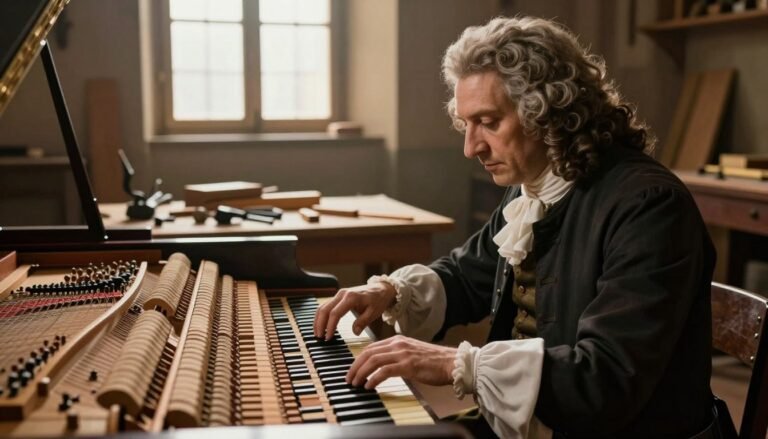
Early keyboard instruments paved the way for today’s pianos. Harpsichords and clavichords had varying ranges. But Bartolomeo Cristofori’s pianoforte introduced a new level of expressiveness. It had about 54 keys, giving players a dynamic control they didn’t have before.
In the 18th and 19th centuries, piano makers gradually increased the number of keys. Makers like Broadwood and Steinway expanded the range to meet composers’ needs. This growth in piano keys reflected changes in music and technical goals.
By the late 1800s, the piano’s standard layout was established. By the 1890s, the 88-key layout became common, covering about 7¼ octaves. Musicians learned that a full-size concert piano has 88 keys.
Composers and performers drove this expansion. Figures like Franz Liszt needed bigger dynamic contrasts and deeper bass. They wanted brighter treble colors too. This pushed builders to extend the range, allowing pianists to create new textures and effects.
Instrument makers then introduced structural innovations. They built stronger frames, used longer strings, and improved the action design. These changes made it practical and reliable to have extended ranges. The journey from Cristofori’s 54-key beginnings to the standard 88-key piano shows how repertoire and performance practice evolved.
| Item Name | Description | Calories | Price |
|---|---|---|---|
| Bartolomeo Cristofori pianoforte | Early pianoforte with about 54 keys; allowed dynamic touch | 0 | $0 (historical) |
| Broadwood expanded keyboard | Incremental range additions in late 18th–early 19th century | 0 | $0 (historical) |
| Steinway late-19th-century grands | Robust frames and actions supporting near-modern range | 0 | Varies by model |
| Standard 88-key concert piano | Established by 1890s; about 7¼ octaves for wide repertoire | 0 | Varies by brand and condition |
| Bösendorfer Imperial (extended) | Example of later range extensions for extra bass notes | 0 | Premium pricing |
| Romantic repertoire demand | Composers called for deeper bass and brighter treble registers | 0 | N/A |
| Technological advances | Improved strings, cast iron frames, and refined action aided expansion | 0 | N/A |
| Concert expectations | Public performance needs solidified the 88-key norm | 0 | N/A |
| Modern orchestral demands | 20th-century composers exploited full piano ranges | 0 | N/A |
| Surviving historical instruments | Museum pieces show Cristofori 54-key layouts and tuning | 0 | N/A |
Common piano key count variations across instrument types
Different instruments have varied piano key counts. This is to fit space, budget, and musical needs. Most full-size grand and upright pianos have 88 keys. This gives a wide range of sounds for both classical and modern music.
Full-size grands and uprights:
Concert grands from brands like Steinway, Yamaha, and Bösendorfer have 88 keys. Player pianos and modern uprights also have 88 keys. This ensures they work well with standard music scores and teaching materials.
Smaller acoustic pianos:
Compact baby grands and some older spinet uprights might have fewer keys. Some historical and space-saving models have nonstandard key counts. But, many baby grands today have 88 keys. If you’re short on space, make sure to check the key count before buying.
Digital pianos and synthesizers:
Portable controllers and stage keyboards often have fewer keys to save weight and add features. You’ll find 25, 49, 61, 75, and 88 keys in presets. A 49- or 61-key model is good for simple practice. But, a full 88-key digital piano is better for acoustic sound and a wide range of music.
| Item Name | Description | Calories | Price |
|---|---|---|---|
| Concert Grand (88) | Full-range acoustic piano for performance and teaching | 0 | $80,000+ |
| Baby Grand (88 or reduced) | Smaller footprint, often full range but check models | 0 | $6,000–$30,000 |
| Upright/Spinet (compact) | Space-friendly, some historical models with fewer keys | 0 | $1,000–$8,000 |
| Portable Keyboard (49) | Lightweight controller for travel and synth parts | 0 | $100–$300 |
| Stage Keyboard (61) | Common for live work and MIDI control | 0 | $200–$1,000 |
| 88-Key Digital | Weighted action, matches acoustic piano key total | 0 | $500–$5,000 |
When picking an instrument, think about your music and practice needs. Fewer keys might be okay for synth work and casual playing. But, serious students and performers usually need the full 88 keys for realistic playing.
Specialty and extended-range pianos
Some makers add more keys to pianos, giving players new sounds. These pianos have notes below A0 or above C8. This change affects the piano’s sound and feel.
Many concert artists prefer these pianos for recordings and modern music. The Bösendorfer 97-key model, for example, has nine bass keys. These keys are not often used in music, but they add depth to the sound.
Adding more high notes can go beyond what we can hear. Composers must use these notes wisely. If not, the sound can become thin or clash with other notes.
Extra bass strings make the piano sound fuller and sustain longer. This is more important to musicians and engineers than just having more keys.
| Item Name | Description | Calories | Price |
|---|---|---|---|
| Bösendorfer 97-key | Concert grand with nine extra bass notes and extended resonance | 0 | $250,000 |
| Yamaha CFX (88-key) | Standard concert grand used in many halls and recordings | 0 | $150,000 |
| Steinway Model D (88-key) | Classic concert grand prized for balanced tone and projection | 0 | $170,000 |
| Fazioli F308 (88-key) | Large concert grand with powerful bass and clear treble | 0 | $200,000 |
| Custom extended bass grand | Modified instruments adding low C or lower for specific repertoire | 0 | $220,000 |
| Digital 88-key workstation | Weighted keys with sampled sounds, portable alternative | 0 | $1,200 |
| Stage 76-key digital | Compromise between range and portability for gigging players | 0 | $900 |
| Upright 88-key acoustic | Space-saving acoustic option with full piano key total | 0 | $8,000 |
| Hybrid piano (88-key) | Combines acoustic action with digital sound engines | 0 | $12,000 |
| Mini 61-key digital | Compact keyboard for learners and limited spaces | 0 | $300 |
Specialty pianos are not for everyone. Most players stick with the standard 88 keys. Consider extended-range pianos only if you need them for specific music or sound.
Understanding piano octaves and keyboard layout
The keyboard is like a map you can learn fast. Knowing piano octaves and the layout helps you find notes and read music better. It shows how patterns on the piano keyboard lead you to middle C, F, and other key points across seven-plus octaves on an 88-key instrument.
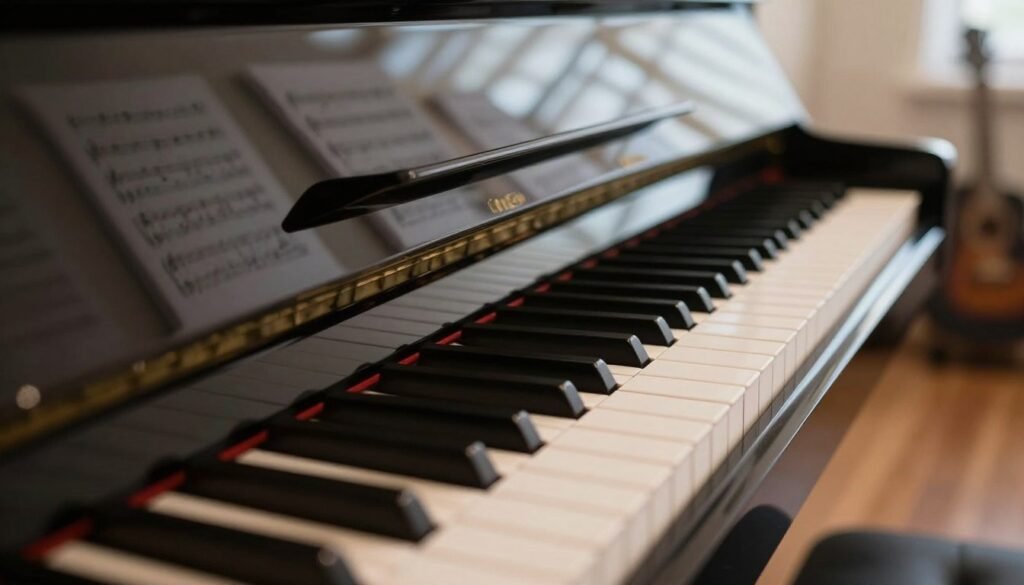
An octave is the space between two notes with the same name, like A to A. On a standard 88-key piano, you get seven full octaves plus extra notes. This wide range lets you play deep bass and bright melodies.
Using black-key groups to find landmarks
Black keys come in groups of two and three. The white key to the left of two black keys is C. The white key to the left of three black keys is F. These patterns help you find notes quickly across the piano.
| Item Name | Description | Calories | Price |
|---|---|---|---|
| Middle C | Reference note near center of keyboard useful for hand placement | 0 | $0.00 |
| Octave span | Interval from one C to the next higher C; seven-plus octaves on 88 keys | 0 | $0.00 |
| Black-key groups | Two and three key clusters that mark C and F positions | 0 | $0.00 |
| Lowest A | Deep bass anchor at the far left of the 88-key piano | 0 | $0.00 |
| Highest C | Top range note near the right end of the keyboard | 0 | $0.00 |
| Sight-reading aid | Using octave and key-layout patterns to speed note recognition | 0 | $0.00 |
| Hand placement | Positioning hands relative to octave landmarks for accurate playing | 0 | $0.00 |
| Transposition reference | Counting semitones across octaves to shift music into new keys | 0 | $0.00 |
| Learning tip | Start by locating C and F with black-key groups, then expand outward | 0 | $0.00 |
| Range reminder | How many keys on a piano determines how many octaves you can access | 0 | $0.00 |
How layout aids sight-reading and orientation
Recognizing the piano keyboard pattern makes reading music easier. Spotting a group of two black keys helps you find C and the octave above and below. This cuts down on mistakes and speeds up learning.
For beginners, practice finding C and F on the keyboard. Also, learn to count octaves to understand the piano’s range. Over time, the layout becomes familiar, and reading music gets better.
Practical implications of piano key number for players
When choosing an instrument, think about how many keys you need. The piano’s key count affects what you can play, how you practice, and if you can take it to gigs or lessons.
Repertoire demands
Most music, from classical to pop, assumes 88 keys. Solo pieces, chamber music, and recitals usually fit within this range. But, some modern and Romantic music might need extra notes, making extended-range pianos a good choice for experts.
Choosing an instrument
Students and teachers often prefer 88-key pianos to match school music and techniques. Musicians on the move might choose 61–76 key controllers for easier carrying. Those with little space might opt for upright pianos or digital ones that fit everyday needs.
Technique, registration, and transposition
The number of keys changes how you play and arrange music. Missing notes can mean rearranging or changing octaves. This affects fingerings, pedaling, and practice.
| Item Name | Description | Calories | Price |
|---|---|---|---|
| Compact 61-key Controller | Portable MIDI keyboard for studio work and live synth parts | 0 | $149 |
| 76-key Stage Keyboard | Extended range for leads and left-hand bass without full 88-key footprint | 0 | $299 |
| Standard 88-key Digital Piano | Weighted keys with full-range piano key count for lessons and performance | 0 | $799 |
| Upright Acoustic Piano | Traditional action and resonance in a space-friendly cabinet | 0 | $2,500 |
| Baby Grand Piano | Smaller grand with full number of piano keys and rich tonal color | 0 | $6,500 |
| Full-size Grand Piano | Concert-level power, full piano key count, responsive action | 0 | $45,000 |
| Bösendorfer 97-key Model | Extended bass for repertoire requiring extra low notes | 0 | $120,000 |
| Hybrid Piano | Acoustic action with digital features and standard key count | 0 | $9,500 |
| 88-key Stage Piano (Portable) | Lightweight full-range keyboard for touring pianists | 0 | $1,299 |
| 61-key MIDI Controller | Affordable entry tool for producers and composers | 0 | $99 |
Choosing based on key count balances music needs with practicality. Consider if the key count limits your music choices or if you’ll need to transpose. Making this choice early saves time and keeps your musical goals achievable.
Here are some practical tips to start with:
- For classical study, prioritize an 88-key weighted instrument.
- If you travel a lot, favor 61–76 keys for a lighter setup.
- When missing keys limit a piece, practice transposition and octave displacement techniques.
Deciding on the right piano key number is a smart investment. It supports your music, improves your skills, and fits your lifestyle.
Types of piano keys and key action that affect playability
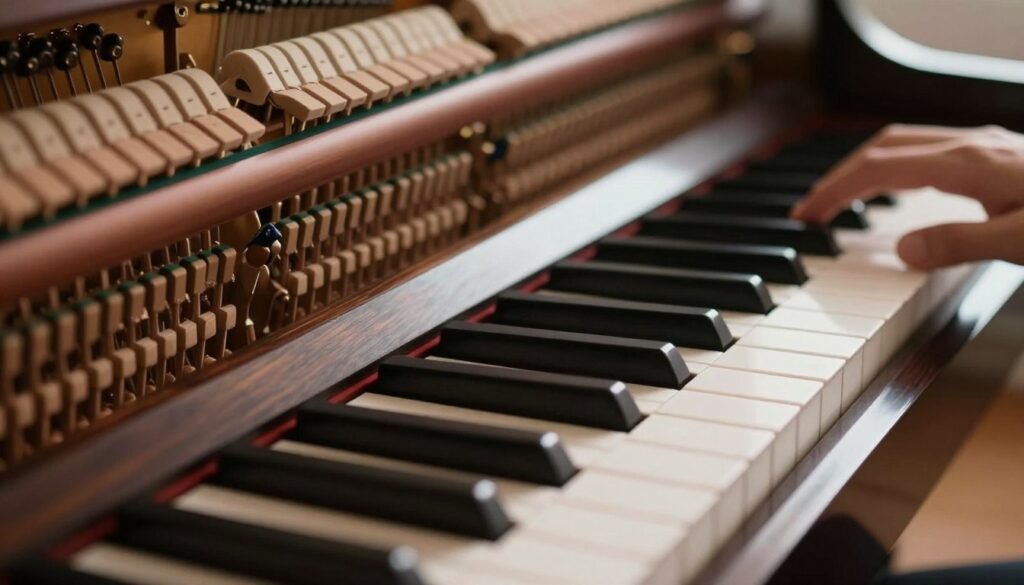
How keys feel affects your playing more than just how many there are. Light, springy keys are great for synth sounds and quick playing. But, heavier keys help with dynamic control and phrasing, perfect for moving between stages or practice rooms.
Non-weighted keys have a uniform, easy touch. They’re common on portable keyboards for casual use and quick practice. But, they don’t mimic an acoustic piano, which can limit technique transfer for students.
Semi-weighted actions mix springs with small weights. Entry-level digital pianos often use this setup. It offers some resistance while keeping cost and weight down. Players get better control than non-weighted keys but without the full feel of an 88-key graded hammer instrument.
Weighted keys provide consistent resistance across the keyboard. They simulate acoustic resistance and support expressive dynamics. Choosing an 88-key instrument with weighted action helps you build reliable touch across the full piano keyboard keys.
Graded hammer action varies resistance from bass to treble. The low end feels heavier, the high end lighter, matching acoustic grands. This layout helps you develop finger strength and nuanced control that translates between digital and acoustic instruments.
| Item Name | Description | Calories | Price |
|---|---|---|---|
| Non-weighted keyboard | Light, uniform touch best for synths and basic practice | 0 | $99 |
| Semi-weighted digital | Partial resistance, common on budget home keyboards | 0 | $249 |
| Weighted digital | Full resistance across keys for realistic technique | 0 | $699 |
| Graded hammer 88-key | Heavier bass, lighter treble; mirrors acoustic piano feel | 0 | $1,499 |
| 88-key stage piano | Portable, weighted action for live performance | 0 | $1,199 |
| 61-key practice keyboard | Good for travel and basic lessons; fewer keys than full piano | 0 | $179 |
| 49-key compact synth | Small footprint, non-weighted, aimed at electronic players | 0 | $129 |
| Bösendorfer-style extended | Extra bass keys with heavy action for low-register work | 0 | $2,999 |
| Hybrid piano | Acoustic hammers with digital control and weighted keys | 0 | $4,499 |
| Student upright | Acoustic touch with consistent action across 88 keys | 0 | $2,200 |
Touch sensitivity depends on the chosen action more than the piano key count. If you plan to move between acoustic lessons and home practice, choose an instrument that matches acoustic key feel. This approach helps you develop technique that reads well on any piano keyboard keys.
When evaluating gear, test dynamics, repeatability, and resistance. Ask whether weighted or graded hammer action fits your goals. Many players find realistic key weighting matters more than how many keys on a piano are present for day-to-day improvement and performance readiness.
How tuning, pitch standard, and frequency relate to key range
Tuning connects each piano key to a specific pitch. Most modern instruments use A4 = 440 Hz as the standard. This sets the math to turn keyboard distance into measurable piano key frequency values.
Typical tuning reference
With A4 = 440 Hz, each semitone steps by a twelfth-root-of-two ratio. This makes it easy to figure out how many keys up or down from A4 change the pitch. The chosen temperament and tuning accuracy will slightly shift exact frequencies.
Frequency span of an 88-key instrument
| Item Name | Description | Calories | Price |
|---|---|---|---|
| A0 (lowest) | Lowest standard piano note on 88-key models | 0 | $0 |
| C1 | Low bass note used for orchestral depth | 0 | $0 |
| A4 (reference) | Standard tuning pitch at 440 Hz | 0 | $0 |
| C8 (highest) | Highest standard note on an 88-key piano | 0 | $0 |
| 88-key span | Approximate frequency range from A0 to C8 | 0 | $0 |
| Extended 97-key | Bösendorfer-style extension into extra low notes | 0 | $0 |
| Human hearing | Typical audible band from 20 Hz to 20,000 Hz | 0 | $0 |
| Practical pitch zone | Most musical pitch detail lies below ~4000 Hz | 0 | $0 |
| Resonance effect | Extra keys add sympathetic resonance more than discrete pitch | 0 | $0 |
| Notation reach | How many keys on a piano determines written range | 0 | $0 |
In simple terms, the standard 88-key piano goes from A0 ≈ 27.5 Hz to C8 ≈ 4186 Hz. These are the practical limits for audible pitches under A4 = 440 Hz.
Human hearing and extreme keys
Human hearing ranges from 20 Hz to 20,000 Hz. But musical pitch clarity is best below 4,000 Hz. Very low bass notes tend to sound like rumble. Very high extra treble notes can sound thin or piercing.
Designers add extra keys for tonal color and extended sympathetic resonance, not for new pitch content. The 88-key standard covers most useful frequencies for performance and composition.
Choosing the right piano keyboard keys for your needs
When deciding between a full 88-key piano and a smaller controller, think about space, budget, and the music you play. A full piano offers the widest range for classical music and improving technique. On the other hand, smaller keyboards save space and money and are great for many modern styles.
An acoustic grand piano needs a lot of space and costs more. Digital 88-key models by Yamaha or Roland offer a similar feel at a lower price. If you have a small living area, 61- or 76-key boards are a good choice. They fit small rooms and are more affordable.
| Item Name | Description | Calories | Price |
|---|---|---|---|
| 88-key Acoustic Grand | Full-range piano with real strings and hammers | 0 | $10,000+ |
| 88-key Digital Piano | Weighted keys, realistic touch, portable options | 0 | $600–$3,000 |
| 76-key Stage Keyboard | Good compromise for range and portability | 0 | $300–$1,200 |
| 61-key MIDI Controller | Compact, ideal for synth work and sequencing | 0 | $100–$600 |
| 49-key Portable Controller | Highly portable for travel and live sampling | 0 | $80–$400 |
When fewer keys are appropriate
If you work with synth patches, MIDI sequencing, or live electronic performance, a compact controller might be best. Portable 49–61 key units are light and easy to set up. Think about whether you need the full piano range for your performances.
Considerations for teachers, beginners, and professionals
Teachers often recommend 88-key instruments for students to build proper finger strength and touch. Beginners benefit from realistic key weighting as they develop technique. Professionals choose based on their needs: stage pianists might prefer a weighted 88-key stage piano, while touring keyboardists might use compact controllers for sampling and synthesis.
When comparing options, consider your repertoire, space, and budget. This helps determine if the piano key count and action type fit your goals. Knowing what you need makes buying a piano more confident and practical.
Conclusion
The standard piano has 88 keys. These keys are divided into 52 white and 36 black, covering 7¼ octaves. This range goes from A0 to C8. When A4 is set to 440 Hz, the keys’ frequency range is about 27.5–4186 Hz.
Early pianos had fewer keys. Cristofori’s first keyboard had around 54 keys. By the late 19th century, the modern 88-key standard emerged.
Some pianos have fewer keys for practical reasons. Compact uprights and older pianos are examples. Specialty models, like some Bösendorfer concert grands, have extra bass notes for better sound.
Digital keyboards and synthesizers offer 25 to 88 keys. This range helps balance portability and playability.
For most players, an 88-key piano with realistic action is best. Smaller keyboards are good for travel, electronic music, or saving money. Consider space, budget, and your music needs when choosing.
Try an 88-key digital or acoustic piano if unsure. This way, you can play a wide range of music. It keeps your options open and meets your musical needs.