
Learn How to Read Piano Sheet Music Easily
Music notation is like a written language for sound. It started with medieval monks and grew into today’s staff notation. This system lets composers like Ludwig van Beethoven write down exact sounds and rhythms.
Starting with piano sheet music might look hard, but it’s quicker than you think. You don’t need to read perfectly right away. Simple tricks, cheat sheets, and learning staff positions help a lot.
This guide will show you how to go from beginner to reading music with confidence. You’ll learn about the grand staff, note names, rhythms, and more. It covers key signatures, time signatures, playing with both hands, and sight-reading.
Practice a little every day, quickly look over the music before playing, and mark hard parts. This approach is better than looking for a quick fix. By following these steps, you’ll enjoy playing more music and improve your skills.
Why Learning to Read Piano Sheet Music Matters for Beginners
Reading music is like a language that captures tone, rhythm, and expression. For beginners, it brings clarity. Scores keep what composers intended, allowing you to learn pieces exactly as written.
Reading also makes sight-reading faster and reduces guesswork. Instead of relying on memory or trial-and-error, you follow a clear map. Once you know the basics, you can access a vast library of scores online and in print.
Music theory and simple memorization tools help beginners make steady progress. Cheat sheets, octave-mapping, and note charts make learning easier. These tools help you translate staff symbols to the keyboard confidently, making beginner piano sheet music less overwhelming.
Music as a written language and its benefits
Notation shows pitch, rhythm, and articulation in one place. This makes rehearsals more efficient. Students who learn to read can study dynamics and phrasing that are not obvious by ear. Written music also supports accurate practice for duet partners and ensembles.
Long-term advantages over playing by ear or chord-only methods
Playing by ear builds intuition, while chord charts let you accompany songs fast. Reading full notation offers added flexibility. You can interpret complex arrangements, transcribe parts, or rearrange pieces for different skill levels. These skills are important when moving from simple tunes to classical or jazz repertoire.
Why it’s worth the time for beginner piano sheet music learners
Systematic study yields quick wins. Short daily practice on piano sheet music basics improves reading speed and accuracy. Many pianists who started later wish they had begun sooner because early literacy opens more learning paths.
| Item Name | Description | Calories | Price |
|---|---|---|---|
| Note Flashcards | Cards for lines and spaces to build recognition | 0 | $7.99 |
| Octave Map Poster | Keyboard diagram showing staff-to-key placement | 0 | $12.50 |
| Beginner Method Book | Stepwise lessons that combine reading and technique | 0 | $9.95 |
| Metronome App | Subdivision practice to lock rhythm | 0 | Free / $2.99 |
| Lead Sheet Pack | Simple melodies with chords to bridge ear and notation | 0 | $5.00 |
| Sight-Reading Drills | Short exercises to increase tempo and accuracy | 0 | $4.50 |
| Annotation Stencils | Symbols for marking fingering and repeats | 0 | $6.25 |
| Practice Journal | Track goals, tempo, and progress for each piece | 0 | $8.00 |
| Online Course Access | Guided lessons on reading and rhythm | 0 | $29.99 |
| Sheet Music Binder | Organize scores for quick pre-play scanning | 0 | $11.00 |
Pre-play scanning and smart annotation reduce mistakes. Look for recurring patterns and anchor notes so you don’t read every single pitch. This approach shortens practice time and boosts confidence when sight-reading is required.
In practice, learning to read beginner piano sheet music pays off quickly. You gain repertoire, improve memory, and find new creative options for arranging and interpreting songs. For most learners, the time invested yields lasting musical freedom.
Understanding the Grand Staff and Clefs for piano sheet music basics
The grand staff is like a map for reading piano sheet music. It has two staves joined by a brace, showing both high and low notes. Middle C is in the middle and helps you find notes on the keyboard.
Structure and position
Each staff has five lines and four spaces. Notes are placed on lines or in spaces to show pitch. Short lines called ledger lines extend the staff for notes above or below the lines.
Clef roles for hands
The treble clef is on the top staff for the right hand. The bass clef is on the bottom staff for the left hand. Knowing this helps you place your hands correctly and avoid mistakes.
Where middle C fits
Middle C is on an imaginary line between the staves. It’s a key spot for beginners to learn. Checking for middle C helps you map staff notes to keyboard keys.
Ledger lines and practical tips
Ledger lines are short strokes for notes beyond the five lines. Use a cheat sheet to map staff positions and ledger-line notes to keys. This makes reading easier and boosts your confidence.
| Item Name | Description | Calories | Price |
|---|---|---|---|
| Grand Staff Diagram | Visual of two staves joined by a brace showing middle C location | 0 | $0.00 |
| Treble Clef Guide | Right-hand notes and common octave references for beginners | 0 | $0.00 |
| Bass Clef Guide | Left-hand notes with ledger-line examples and octave mapping | 0 | $0.00 |
| Ledger Line Cheat Sheet | Quick reference mapping ledger-line notes to piano keys | 0 | $0.00 |
| Pre-play Scan Checklist | Steps to find clefs, key, and middle C before playing | 0 | $0.00 |
| Simple Staff-to-Keyboard Map | Compact chart showing staff positions and corresponding keys | 0 | $0.00 |
| Beginner Sight-Reading Pack | Short exercises that focus on treble clef bass clef transitions | 0 | $0.00 |
| Practice Flashcards | Cards for memorizing piano sheet music notes and middle C | 0 | $0.00 |
| Hands Coordination Guide | Tips for aligning right- and left-hand parts across the grand staff | 0 | $0.00 |
| Octave Reference Chart | Clear labeling of octaves to reduce reading errors on the keyboard | 0 | $0.00 |
Start a pre-play routine with a quick scan for clefs and middle C. This habit connects the staff to the keys. Practice a few notes daily, and the grand staff will become familiar.
how to read piano sheet music
Reading piano sheet music is easy when you break it down. This guide shows how to identify notes, create memorization aids, and connect them to the piano. These tips are great for any piano sheet music tutorial or beginner course.
Reading note pitch from lines and spaces
Note heads on the staff show the pitch. A higher note on the staff means a higher pitch. On the treble staff, space notes spell FACE.
Line notes read E-G-B-D-F. Many remember this with “Every Good Boy Does Fine.”
Middle C is on a ledger line between the grand staff. Notes below and above it are for left-hand and right-hand. Spot a note, name it by line or space, then check its octave.
Memorization aids for lines and spaces
Mnemonics help you learn fast. Use FACE for treble spaces and a memorable phrase for lines. Repeat it while playing each key. This uses visual, auditory, and kinesthetic memory.
Make a cheat sheet to map staff positions to keys. Practice by pointing to a staff note, saying its name, then playing it. Doing this often makes counting intervals unnecessary.
Practical tip: map staff notes to keyboard octaves
Make octave mapping a habit. Draw a quick reference showing middle C, C4, C5, and nearby Cs on the keyboard. Use this map before playing a new piece.
Look for patterns and anchor notes in the score. Identify repeated tones and accidentals, then mark them lightly. Anchors help you read groups of notes at once.
| Item Name | Description | Calories | Price |
|---|---|---|---|
| Treble Spaces | FACE mnemonic for quick recall of space notes on the treble staff | 0 | $0.00 |
| Treble Lines | E-G-B-D-F line sequence used with familiar phrase memory | 0 | $0.00 |
| Middle C Ledger | Single ledger line between staves; reference for octave mapping | 0 | $0.00 |
| Octave Cheat Sheet | Table linking staff positions to keyboard keys for fast lookup | 0 | $0.00 |
| Anchor Notes | Marked recurring notes to reduce sight-reading load | 0 | $0.00 |
| Kinesthetic Drills | Name and play notes aloud to embed visual and motor memory | 0 | $0.00 |
| Pattern Scanning | Pre-play scan to spot intervals, repeats, and accidentals | 0 | $0.00 |
| Simple Sight-Reading | Short exercises focusing on common staff positions | 0 | $0.00 |
| Beginner Lesson | Step-by-step practice for piano sheet music for beginners | 0 | $0.00 |
| Quick Reference | Portable mapping card to carry during practice sessions | 0 | $0.00 |
- Practice naming notes before you play to link sight and sound.
- Use the piano sheet music tutorial format: scan, mark, play slowly, then increase tempo.
- Work daily with short, focused sessions to build automatic recognition.
This method works for teachers, self-learners, and anyone using piano sheet music for beginners. Regular practice with these steps will help you play confidently.
Note values and timing: reading rhythm in piano sheet music notes
Understanding rhythm starts with simple shapes. Whole, half, and quarter notes show how long a sound lasts. Learning these first makes reading rhythm in piano sheet music clear and playable.
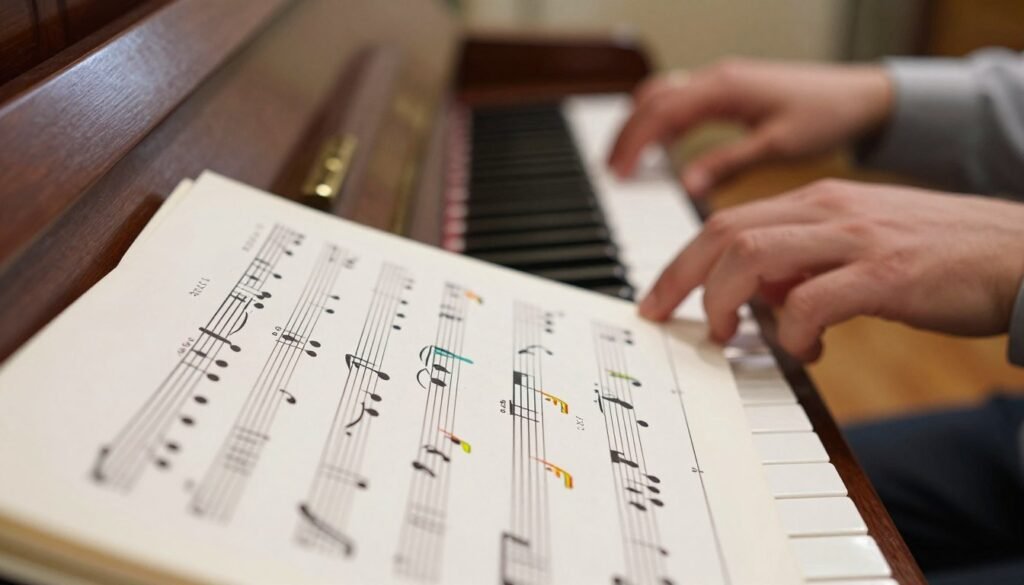
Start with basic durations and count aloud. A whole note lasts four beats, a half note two beats, a quarter note one beat. Stems and noteheads change the value. Seeing these shapes in piano sheet music notes helps you predict timing before you play.
Basic note shapes and durations
Focus on the three core values. Clap or tap each shape while counting steady beats. This trains your internal pulse and links visual symbols to physical timing.
| Item Name | Description | Calories | Price |
|---|---|---|---|
| Whole note | Hollow circle with no stem, equals four counts in common time | 0 | $0.00 |
| Half note | Hollow notehead with stem, equals two counts | 0 | $0.00 |
| Quarter note | Filled notehead with stem, equals one count | 0 | $0.00 |
| Eighth note | Filled notehead with stem and one flag or beam, equals half a beat | 0 | $0.00 |
| Sixteenth note | Filled notehead with two flags or double beam, equals quarter beat | 0 | $0.00 |
| Rest symbols | Silence values that match note durations for accurate timing | 0 | $0.00 |
| Dot augment | Adds half the value of the note to extend duration | 0 | $0.00 |
| Tie | Connects two notes of the same pitch to combine their durations | 0 | $0.00 |
| Tuplet | Divides a beat into irregular subdivisions like triplets | 0 | $0.00 |
| Measure bar | Separates the music into fixed-time segments for easier counting | 0 | $0.00 |
| Beat emphasis | Strong beats help you feel meter and maintain tempo | 0 | $0.00 |
Introduction to measures and left-to-right timing
Music moves left to right on the staff. Measures divide that flow into equal time spans. Time signatures set how many beats fit inside each measure.
Practice reading one measure at a time. Mark tricky spots before you play. This makes easy piano sheet music feel manageable and steady.
Simple practice exercises to internalize note lengths
Start with a single pitch. Tap the rhythm while counting aloud. Clap the pattern, then play it on the keyboard. Repeat until the timing is smooth.
Use short drills that build gradually. Scan for repeated rhythmic patterns first. Mark problem measures. These steps speed up sight-reading and help you read piano sheet music notes with confidence.
Key signatures, accidentals, and navigating sharps and flats
Before you start playing, take a moment to look at the key signature and any accidentals. This quick check helps you know which notes to play and when to use the black keys. It saves time and makes sight-reading easier.
What the key signature reveals
Key signatures tell you which notes are sharp or flat throughout a piece. This knowledge helps you predict scales and chord shapes. For beginners, a cheat sheet of major and minor signatures is very helpful. It connects theory to the keyboard.
How accidentals affect notes
Accidentals, like sharps, flats, and naturals, change the pitch for the rest of the measure. When you see one, apply it right away. Remember any repeated notes in that bar. This keeps your hands in sync with the music.
Pre-play scanning routine
- Check the key signature to set overall tonality.
- Scan each system quickly for recurring accidentals and circle or mark them.
- Note any modulations or key changes and highlight measure boundaries where accidentals reset.
- Identify tricky passages that use many black keys so you can plan hand shifts.
| Item Name | Description | Calories | Price |
|---|---|---|---|
| Key Signature Cheat Sheet | Compact list of major/minor signatures with corresponding sharps and flats for quick reference | 0 | $3.50 |
| Accidental Reminder Marks | Small pencil marks indicating frequently altered notes within measures | 0 | $1.00 |
| Pre-Scan Checklist | Step-by-step routine to follow before sight-reading any piece | 0 | $0.00 |
| Black-Key Fingering Guide | Fingering patterns for common black-key passages in popular keys | 0 | $2.25 |
| Common Modulation Map | Visual guide to typical key changes and how accidentals indicate the shift | 0 | $4.00 |
| Sight-Read Warmup Pack | Short exercises focusing on quick recognition of key signatures piano and accidentals piano | 0 | $5.00 |
| Beginner Piano Sheet Music Guide | Basic book covering clefs, rhythms, key signatures, and scanning methods | 0 | $12.99 |
| Annotated Practice Pages | Pages with pre-marked accidentals to train correct application under pressure | 0 | $3.75 |
| Quick-Find Key Wheel | Handy wheel showing relative majors and minors and their sharps/flats | 0 | $6.50 |
| Visual Ledger Line Aid | Strip to place on the staff for easier reading of notes outside the staff | 0 | $2.00 |
Use these steps and tools to make key signatures and accidentals routine. With practice, scanning the page becomes second nature. Your confidence with any piano sheet music guide will grow quickly.
Time signatures and counting: staying in rhythm with piano sheet music
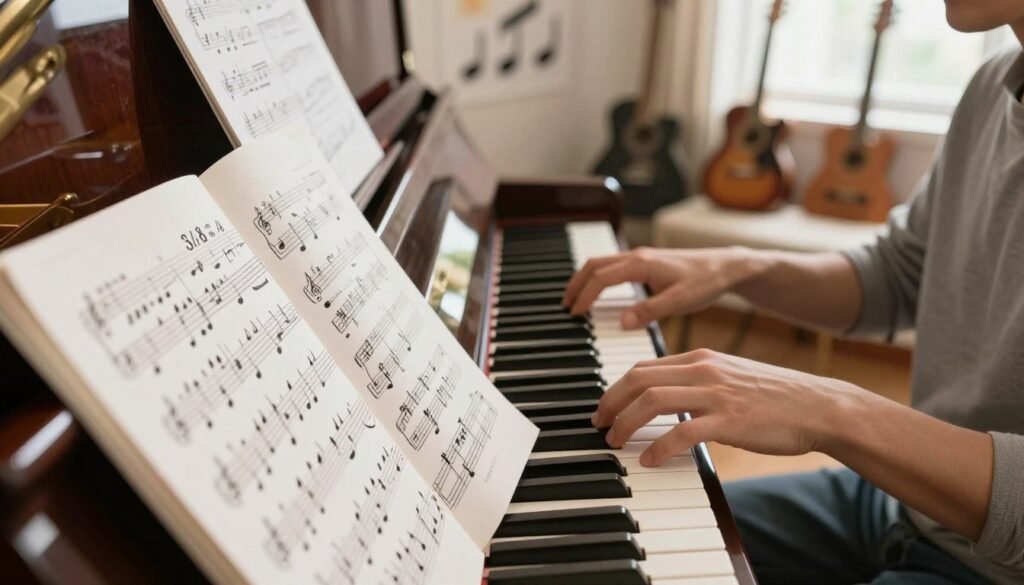
Knowing how beats are grouped is key to playing smoothly. Time signatures tell us how many beats are in a measure and which note gets one beat. Learning a few common meters makes reading and practicing easier.
| Item Name | Description | Calories | Price |
|---|---|---|---|
| 4/4 (Common time) | Four quarter-note beats per measure; used in most pop and classical pieces | 220 | $12.00 |
| 3/4 (Waltz) | Three quarter-note beats; feels like ONE-two-three with emphasis on one | 180 | $10.00 |
| 2/4 (March) | Two quarter-note beats; steady left-right pulse common in marches | 150 | $9.50 |
| 6/8 (Compound duple) | Six eighth-note beats grouped in two strong beats; useful for faster lilted patterns | 200 | $11.00 |
| 5/4 (Irregular) | Five beats per measure; use counting patterns to break into 3+2 or 2+3 | 195 | $13.00 |
| Cut time (2/2) | Two half-note beats; reads faster but feels broad and driving | 210 | $12.50 |
| 7/8 (Irregular) | Seven eighth-note beats; common groupings are 2+2+3 or 3+2+2 | 170 | $14.00 |
| 9/8 (Compound triple) | Nine eighth-note beats grouped in three strong pulses; used in some classical and folk tunes | 230 | $15.00 |
| 12/8 (Compound quadruple) | Twelve eighth-note beats organized in four strong beats; great for blues and slow rock feels | 240 | $16.00 |
| 3/8 (Simple fast) | Three eighth-note beats per measure; often used for short, quick phrases | 140 | $8.75 |
Practical counting methods
Start by saying beat numbers out loud while tapping a steady beat. For quarter-note meters, say “1-2-3-4.” Use “1-and-2-and” to place eighth notes and syncopation precisely.
Clapping exercises help you get the rhythm. Clap on strong beats, then add weak beats and “ands.” This trains your ears and hands together.
Applying rhythm to sight-reading
Before playing, look at the score for the time signature and recurring rhythms. Spot repeated motifs and mark tricky subdivisions. Tap the beat and say counts while tracing the bar lines left to right.
Use short, slow runs through a new piece, keeping counting rhythm piano audible. Speed up only after the pulse stays even. This builds confidence for reading sheet music for piano during live sight-reading.
Quick practice routine
- Look at the time signature and clap the measure once.
- Count aloud while tapping a metronome or your foot.
- Subdivide hard measures using “1-and” or “1-e-&-a.”
- Sight-read short phrases, maintaining the steady pulse.
Regular use of these steps makes time signatures piano feel natural. Consistent counting and subdivision will keep your rhythm secure when reading sheet music for piano under pressure.
Reading both hands: coordination strategies for piano sheet music for beginners
Reading both hands is like juggling two conversations. Think of the grand staff as two parts linked together. The top staff guides the right hand, and the bottom guides the left. Use middle C as a reference to align your hands and avoid confusion when the staves meet.
How to read and coordinate separate staves simultaneously
Before playing, scan each staff. Look for repeating notes and shared rhythms. Mark where the hands cross or share pitches. Start by practicing the left hand alone, then the right, and slowly join them. Slow, measured practice builds muscle memory and improves sight-reading skills.
Using anchor notes and pattern recognition
Anchor notes are repeated pitches that help you orient both hands. Identify these anchors and use them as checkpoints. Look for scale fragments, arpeggios, and common patterns. Once you see a pattern, guess the next notes instead of reading every single one.
Fingering strategies to simplify hand movement
Follow suggested fingering when given. If not, analyze the first two notes to choose a comfortable start. When the next note rises, avoid starting with the lowest finger. Write finger numbers on the score to remember your choices.
| Item Name | Description | Calories | Price |
|---|---|---|---|
| Hands-Separate Practice | Focus on each staff alone to master rhythm and pitch before combining. | 120 | $0 |
| Anchor Note Drills | Repeat short phrases centered on a stable pitch to build orientation. | 90 | $0 |
| Pattern Recognition Exercises | Spot scales and arpeggios to read groups of notes at once. | 80 | $0 |
| Slow Coordination Practice | Combine hands at a reduced tempo, then raise speed gradually. | 110 | $0 |
| Written Fingering | Annotate scores with finger numbers to remove on-the-spot decisions. | 30 | $0 |
| Middle C Mapping | Use middle C as a visual anchor between staves to align hand placement. | 50 | $0 |
| Octave Memorization | Learn octave shapes to reduce reading load and speed recognition. | 70 | $0 |
| Fingering Adjustment | Choose fingerings that favor smooth transitions and minimal hand shifts. | 40 | $0 |
| Score Marking | Mark hand divisions, repeats, and tricky bars for quick reference. | 25 | $0 |
| Hands-Together Tempo Drills | Use a metronome to coordinate both hands while keeping steady beat. | 150 | $0 |
Remember the basics of piano sheet music as you practice. Break pieces into short sections. Repeat patterns until they feel automatic. This method lowers mental load and speeds progress.
Practice coordination piano sheet music daily in brief, focused sessions. Over time, your eyes will scan both staves with ease. Your fingers will know common shapes, and sight-reading will become more reliable.
Sight-reading tips and how to make sight-reading easier
Improving sight-reading is easier with a simple routine before playing. Spend thirty seconds looking over the score for key and time signatures, tempo, repeats, and tricky accidentals. Look for patterns and how notes are distributed to keep your first play smooth and calm.
Pre-play scanning routine
First, find the key and time signatures. Then, look for tempo and repeat signs. Spot any tricky accidentals and long stretches of the same hand. This scan helps you feel more confident when you start playing.
Marking the music: annotation techniques that help
Mark scores like drafts. Circle sharps and flats, write fingerings above notes, and highlight repeating motifs. Use small, consistent symbols to avoid clutter. These marks make learning from a piano sheet music tutorial more practical and personal.
Practice drills and gradual difficulty progression
Short, daily practice beats long, infrequent sessions. Start with simple pieces and steady rhythms. Add new elements like syncopation or tighter hand crossings gradually.
| Item Name | Description | Calories | Price |
|---|---|---|---|
| Five-minute scan drill | Quickly analyze 3 short pieces for key, time, and tricky spots | 0 | $0 |
| Octave mapping cheat sheet | Reference showing staff positions and matching keyboard octaves | 0 | $0 |
| Hands-separate read | Practice left and right staves independently at target tempo | 0 | $0 |
| Progressive sight-reading set | Short excerpts that increase in difficulty by measure | 0 | $10 |
| Metronome pacing | Start slow, increase by 2–4 BPM after clean passes | 0 | $5 |
| Pattern highlight | Mark repeated rhythmic or melodic shapes for fast recognition | 0 | $0 |
| App-based drills | Interactive exercises from apps like flowkey to build speed | 0 | $20 |
| Minutes tracker | Log short sessions to ensure steady daily practice | 0 | $0 |
| Sight-read buddy | Exchange new pieces with another player for fresh challenges | 0 | $0 |
| Review pass | Play the piece again focusing on smoother transitions | 0 | $0 |
Use cheat sheets and octave maps to help when starting. Mix short drills with lessons or tutorials for steady progress. Apps like flowkey and books from Alfred Music offer structured drills for growth.
Remember, sight-reading needs constant practice. There’s no quick fix. Most progress comes from regular scans, annotations, and drills. Keep sessions short, focused on patterns and counting to make reading sheet music natural.
Working with chord charts and lead sheets versus full staff notation
Beginners often face a choice between reading full staff notation and using chord symbols or lead sheets. Chord charts piano and lead sheets piano are great for quick learning and band settings. Full notation gives exact melodies and voicings. Both paths have clear benefits for piano sheet music for beginners.
When chord notation is useful for beginners
Chord charts piano are perfect for pop, rock, and jazz. They focus on rhythm and harmony, not exact notes. They help you accompany singers, join a band, or sketch arrangements fast. Learning a few common shapes quickly gets you playing in real musical situations.
Why staff literacy is important
Reading full notation deepens musical understanding. It shows melodic lines, dynamics, and composer intent that chord symbols miss. Even if you rely on chord charts, knowing melodies expands your repertoire and improves sight-reading skills.
How to combine chord knowledge with reading notes
Start by placing chord names above the staff while reading simple tunes. Analyze how measures map to chords, then play the melody with the right hand and a simple chordal pattern with the left. This approach links visual staff literacy to practical accompaniment from chord charts piano and lead sheets piano.
| Item Name | Description | Calories | Price |
|---|---|---|---|
| Chord Starter Pack | Basic major and minor shapes for common keys, ideal for pop and rock | 0 | $9.99 |
| Melody Reader | Simple staff exercises that reinforce note recognition and rhythm | 0 | $7.50 |
| Lead Sheet Bundle | Short songs with melody line, chords, and lyrics for practical practice | 0 | $12.00 |
| Hybrid Practice Guide | Step-by-step plan to combine chord playing with staff reading | 0 | $5.00 |
| Ear Training Kit | Exercises to match chord symbols to harmonies heard in songs | 0 | $8.25 |
| Accompaniment Patterns | Left-hand patterns that fit common chord progressions | 0 | $6.50 |
| Sight-Read Booster | Timed drills to improve reading speed for melody lines | 0 | $4.75 |
| Jazz Chord Voicings | Basic seventh and extended voicings that work over charts | 0 | $11.00 |
| Pop Song Templates | Editable lead sheets to practice arranging and accompaniment | 0 | $9.00 |
| Practice Log | Simple tracking sheet to record goals and progress | 0 | $2.50 |
Keep practice short and focused. Learn a few chord shapes, read simple melodies on the staff, then combine both. This method builds confidence and broadens what a student can play from chord charts piano, lead sheets piano, and piano sheet music for beginners.
Practice plan and resources for easy piano sheet music learning
Begin with a simple routine that grows your knowledge bit by bit. Start with note names and simple melodies. Then, add rhythm, key signatures, and playing both hands together as you get better.
Practice in short daily sessions. Mix reading, clapping, and playing with each hand. This will help you make steady progress.
| Item Name | Description | Calories | Price |
|---|---|---|---|
| Daily 20-Minute Plan | Warm-up, note drills, rhythm clapping, one simple piece | 0 | Free |
| Weekly Focus Block | 30–45 minutes on a single skill: key signatures or sight-reading | 0 | Free |
| Flowkey Course | Guided lessons with sight-reading drills and feedback | 0 | Subscription |
| Digital Piano School Videos | Short tutorials for technique and notation tricks | 0 | Free/Paid |
| Pianote Lessons | Structured curriculum with community support and projects | 0 | Subscription |
| Cheat Sheets | Octave maps and note-location cards for fast recall | 0 | Free |
| Sight Reading Made Simple | Starter lesson pack for basic sight-reading routines | 0 | Free |
| Flash Drills | Short timed note-name and interval recognition practice | 0 | Free |
| Progress Tracker | Log pieces learned, speed, and accuracy improvements | 0 | Free |
| Metronome Practice | Steady tempo work for rhythm and sight-reading | 0 | Free |
Step-by-step practice schedule
- Week 1–2: Learn note names on the staff, map to keys, play five two-hand exercises slowly.
- Week 3–4: Add basic rhythms and simple measures; practice clapping and tapping with a metronome.
- Month 2: Introduce one or two key signatures and short pieces that use them.
- Month 3: Combine hands for short songs and aim to read and play five simple pieces.
Recommended beginner resources and apps
- flowkey offers guided lessons and sight-reading drills to reinforce notation learning.
- Digital Piano School provides short videos with practical tricks for faster reading.
- Pianote supplies structured lessons and a supportive community for steady improvement.
- Use printable cheat sheets and octave-mapping cards for quick staff-to-key recall.
Measuring progress and setting realistic goals
- Track pieces completed, sight-read speed, and accuracy with a simple log.
- Set short-term weekly targets and a three-month goal to play five simple pieces.
- Measure sight-reading by tempo: aim to sight-read basic-level pieces at a slow steady tempo, then increase speed.
- Adjust goals if accuracy drops; prioritize clean reading over rushing.
Use a piano sheet music guide and a tutorial to help you learn. Choose beginner piano sheet music that fits your level. Keep practicing core drills to improve your memory and confidence.
Conclusion
Learning to read piano sheet music is a skill that opens up new musical paths. It helps you understand the composer’s vision. While it’s not essential for every player, it greatly enhances your ability to read music.
Start with the basics of piano sheet music. Remember, steady progress is better than cramming at the last minute. This approach helps you grow faster.
Use simple tools to make learning easier. Map staff notes to keyboard octaves and use mnemonics for lines and spaces. A cheat sheet can also help. These tools make early practice more efficient.
Consistency is key for improving your sight-reading. Start with a pre-play scan, clear notes, and short practice sessions. There’s no quick fix, but combining these methods with apps or courses helps.
Begin with basic exercises today and set a daily goal. Regular practice and the right tools will make you more confident. Try an app or a beginner lesson to help you improve.