What Do the Pedals on a Piano Do: Understanding Piano Pedals Functions
Piano pedals are key tools for expression. They help shape the sound of your music. Most pianos have two or three pedals, each changing the sound in its own way.
The main sustain pedal lets strings ring out longer. It’s called the “soul of the piano” because it adds depth to your sound. Other pedals can change the sound’s color and volume.
Digital pianos use pedals in a similar way. They let you control the sound like an acoustic piano. Knowing how to use these pedals can make your playing sound richer and more detailed.
Start using the sustain pedal with your right foot when you can play smoothly with both hands. Add the left and middle pedals as you get better. This guide will help you master using pedals, making your music sound more vibrant and expressive.
what do the pedals on a piano do
Piano pedals change how the instrument sounds. They help shape sustain, blend tones, and soften timbre to match the music. Knowing how to use them lets you create long, singing lines or soft colors for quiet moments.
Why pedals matter for tone and expression
The damper pedal, or piano sustain pedal, lifts dampers from all strings. This makes every string vibrate together, adding warmth to chords. Use sustain to connect melodies, making phrases breathe and flow.
The soft pedal, or una corda, shifts the action to mute and thin the sound. It’s perfect for quiet, lyrical moments where a fragile tone is needed. The sostenuto pedal holds only selected notes, useful in organ transcriptions and modern textures that demand selective resonance.
| Item Name | Description | Calories | Price |
|---|---|---|---|
| Damper Pedal | Raises all dampers; creates sustained resonance and richer tone | 0 | $0.00 |
| Una Corda (Soft) | Shifts action to soften and thin timbre for intimate passages | 0 | $0.00 |
| Sostenuto | Holds selected notes while others remain unaffected | 0 | $0.00 |
| Half-Pedaling | Partial sustain control for cleaner legato and clarity | 0 | $0.00 |
| Selective Resonance | Combines dampers and sympathetic strings for color | 0 | $0.00 |
| Muted Effect | Soft pedal and light touch create an ethereal sound | 0 | $0.00 |
| Legato Pedaling | Timed pedal changes to connect notes cleanly | 0 | $0.00 |
| Sympathetic Color | Use sustain to layer harmonics and enrich tone | 0 | $0.00 |
| Expressive Shading | Combine pedals with dynamics for nuanced phrasing | 0 | $0.00 |
| Practice Tools | Simple exercises to train listening and timing | 0 | $0.00 |
When beginners should start pedaling
Beginners don’t need pedals at first. Start with the piano sustain pedal after mastering clean playing. Early pedaling can hide weak legato and poor finger coordination.
Use your right foot for sustain and the left for soft or sostenuto where available. Start with delayed pedaling: lift the pedal briefly after a chord change. This connects lines without blurring harmony. Train your ear to spot muddiness and release the pedal sooner when needed.
Practice simple exercises that pair short phrases with controlled pedal changes. Gradual listening practice builds reliable pedal technique and keeps tone clear while expanding expressive range.
Overview of common piano pedal types and layout
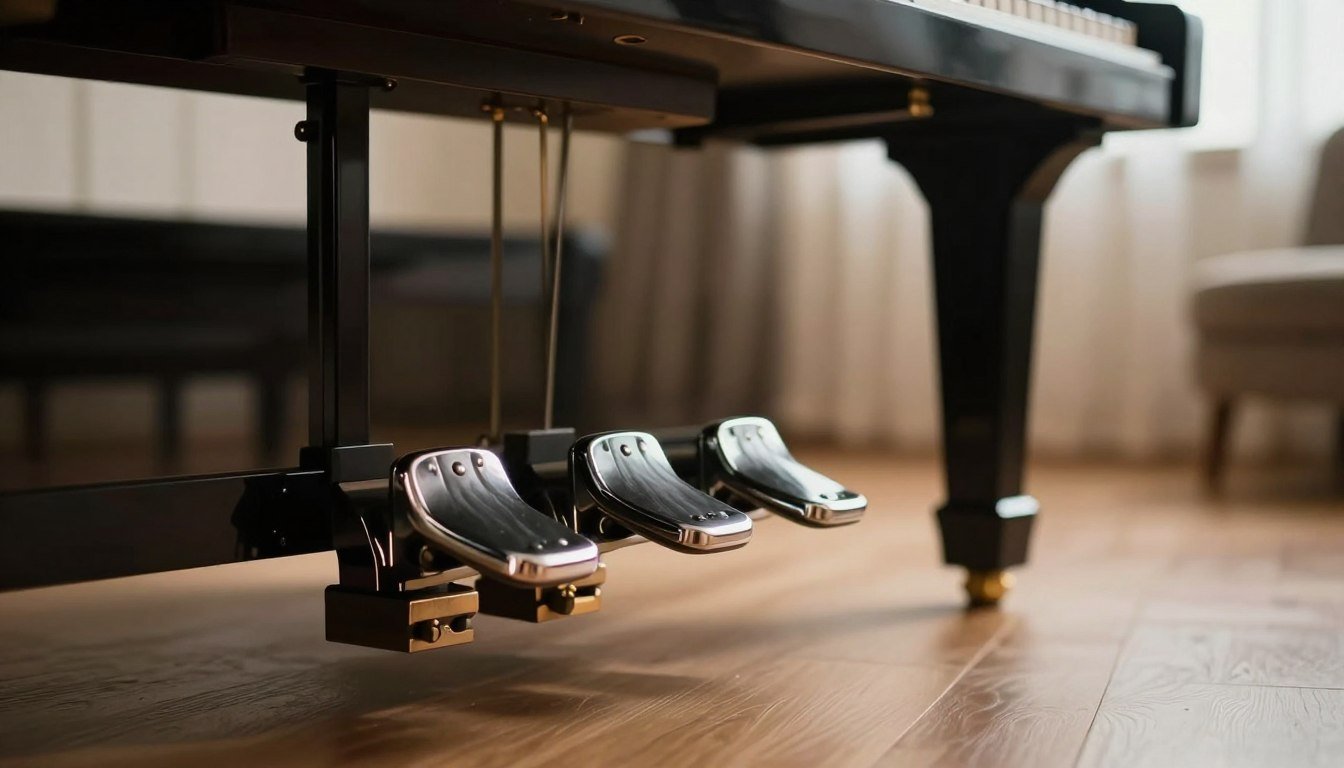
The three metal pedals at a piano’s base control tone, sustain, and timbre. Players should recognize common layouts and how each pedal changes sound. This helps when switching between acoustic grands, uprights, and digital instruments.
Typical pedal layout places the soft pedal on the left, a middle pedal with variable functions, and the sustain on the right. On a full concert grand, the pedals act as una corda, sostenuto, and damper sustain. Many upright piano pedals follow a similar order but offer different mechanics.
Three-pedal grand vs two-pedal and uprights
Grand piano pedals usually include three distinct actions: una corda for a muted tone, sostenuto to hold selected notes, and sustain for general resonance. These grand piano pedals work with parts like shifted hammer position and felt dampers to produce nuanced results.
Upright piano pedals often differ in mechanism and effect. The left pedal may not be a true una corda; it typically shifts hammer proximity or reduces volume. The middle pedal on many uprights is a practice or bass sustain that mutes sound for quiet practice. True sostenuto appears mainly on higher-end uprights from makers such as Steinway and Bechstein.
| Item Name | Description | Calories | Price |
|---|---|---|---|
| Una Corda (Left) | Softens tone by altering hammer strike point or moving hammers sideways | 0 | $0 (built-in) |
| Sostenuto (Middle) | Holds selected notes while allowing others to decay | 0 | $0 (built-in) |
| Sustain/Damper (Right) | Lifts all dampers for resonant sustain | 0 | $0 (built-in) |
| Upright Practice (Middle on many uprights) | Engages a felt rail to reduce volume for practice | 0 | $0 (built-in) |
| Half-blow (Left on some uprights) | Reduces hammer travel for softer attack | 0 | $0 (built-in) |
| Electronic Triple Pedal Setup | Three physical pedals with sensors that map to pedal functions | 0 | $49–$199 |
| Single Pedal (Digital) | Basic sustain switch for compact digital pianos | 0 | $15–$60 |
| Assignable Pedal Unit | Allows users to assign soft, sostenuto, or half-pedal via software | 0 | $80–$250 |
| Triple Optical Pedal | High-end pedal with continuous sensing for nuanced half-pedaling | 0 | $150–$400 |
| Practice Mute Accessory (Upright) | Aftermarket felt insert to lower volume for late practice | 0 | $25–$80 |
Digital piano pedal inputs and options
Digital piano pedal inputs range from a single jack to full three-pedal units. Many instruments include one 1/4″ input for a sustain pedal. Models such as Yamaha Clavinova and Arius often support three-pedal setups and offer advanced sensing.
Modern digital pianos can emulate half-pedaling, sostenuto, and una corda through sensors and firmware. If you play on a stage or at home, check compatibility: some keyboards require specific triple-pedal units to access full functionality.
Always verify a piano’s middle-pedal function before relying on it for performance. Treat the middle pedal on an upright as potentially different from the sostenuto found on a concert grand.
Sustain pedal (right pedal) — function and technique
The sustain pedal lifts dampers off the strings, making notes ring after you release the keys. This action blends tones and creates smooth connections that fingers alone can’t make. Use the right pedal with purpose to shape phrases and add resonance without hiding harmonic details.
Sit with your feet flat and hips relaxed. Place your big toe towards the right pedal, with the ball of your right foot on the pedal’s rounded edge. Keep your heel on the floor and move down from the ankle for a smooth motion. This stance gives you precision and reduces jarring sounds.
Common sustain techniques
Delayed or legato pedaling connects chords by pressing the pedal just after the attack, then lifting before the next harmony to avoid blurring. Half-pedaling lowers the pedal partially so dampers graze strings; it produces a color change without full sustain and suits fragile textures like the opening of Beethoven’s Moonlight Sonata. Preliminary pedaling—depressing slightly before striking—adds shimmer when used sparingly. Simultaneous or rhythmic pedaling can emphasize attacks when a musical effect calls for it; use this deliberately and with clear intent.
| Item Name | Description | Calories | Price |
|---|---|---|---|
| Kinetic Placement Drill | Exercise to anchor heel and pivot at the ankle for smooth pedal motion | 0 | $0 |
| Delayed Pedal Exercise | Play arpeggios while adding the pedal after each chord to practice legato timing | 0 | $0 |
| Half-Pedal Control | Slow scales while adjusting pedal depth to hear subtle color shifts | 0 | $0 |
| Clear-the-Harmony Drill | Change harmony frequently and lift fully between changes to train resets | 0 | $0 |
| Recording Comparison | Record short passages and compare with professional recordings for balance | 0 | $0 |
| Muddy Sound Test | Isolate chords with and without pedal to hear where blurring occurs | 0 | $0 |
| Accent Pedal | Coordinate pedal with accented beats for rhythmic emphasis | 0 | $0 |
| Neighbor-Note Clearing | Practice lifting pedal when neighbor tones might overlap and mask melody | 0 | $0 |
| Texture Balancing | Use half-pedal to keep texture transparent in dense harmonies | 0 | $0 |
| Dynamic-Pedal Pairing | Match pedal depth to dynamic changes for consistent tone control | 0 | $0 |
How to avoid muddy sound
Lift the pedal fully when harmony changes. This clears the resonance and prevents overlapping notes from smearing the texture. Short, timely lifts act like a reset. Listen critically and compare your playing to recordings by artists such as Arthur Rubinstein or Mitsuko Uchida to gauge clarity.
Practice the sustain pedal with focused, small goals: one technical move per session and one listening target per piece. Treat piano foot pedals as expressive tools, not safety nets. When used with refined sustain pedal technique, the right pedal enriches sound while keeping harmony transparent.
Soft pedal / una corda (left pedal) — function and variations
The soft pedal changes a piano’s sound and volume in different ways. On grands, it makes hammers hit fewer strings, changing the sound and making it softer. On uprights, it moves hammers closer to the strings, making the sound softer without moving the strings.
Bartolomeo Cristofori invented the soft pedal, also known as una corda. The name “una corda” means “one string” in Italian. Early pianos could play with one, two, or three strings, depending on the pedal used.
How the mechanism differs
On concert grands, the una corda pedal moves the action slightly to the right. This makes the sound warmer and more intimate. Uprights, on the other hand, use a different method. The soft pedal makes the hammers hit the strings softer, changing the sound and volume.
| Item Name | Description | Calories | Price |
|---|---|---|---|
| Yamaha U1 | Upright with responsive soft pedal action and consistent touch | 0 | $7,500 |
| Steinway Model D | Grand with precise una corda shift and rich tonal palette | 0 | $180,000 |
| Kawai GL-10 | Baby grand with clear soft pedal contrast for small halls | 0 | $25,000 |
| Boston GP-163 | Designed by Steinway engineers; strong una corda response | 0 | $35,000 |
| Kawai K-300 | Upright with effective half-blow mechanism for intimate play | 0 | $10,000 |
| Fazioli F278 | Concert grand with nuanced soft pedal shading and sustain | 0 | $250,000 |
| Roland DP603 | Digital piano with selectable soft pedal function and modeling | 0 | $1,300 |
| Petrof P 194 | European grand noted for a singing una corda character | 0 | $120,000 |
| Blüthner Model 1 | Grand with warm tonal shifts when using the soft pedal | 0 | $150,000 |
| Casio Privia PX-S | Compact digital with soft pedal emulation and MIDI support | 0 | $499 |
Musical uses
Use the soft pedal to create soft, ethereal sounds in quiet passages. It’s great for blending colors in chamber music and supporting singers. Composers like Beethoven used it to create contrast in their music.
When not to rely on it
Don’t use the soft pedal as a way to avoid playing softly. It changes the sound more than the volume on modern grands. Instead, practice playing softly by using finger weight and release. Use the soft pedal to add color, not to replace technique.
Practical tips
- Listen to timbral change, not just loudness, when using the soft pedal.
- Combine gentle touch with the una corda pedal for clean pianissimo lines.
- On uprights, expect reduced attack, not a lateral string shift.
- Avoid excessive use in quick passages where clarity depends on full string contact.
Sostenuto pedal (middle pedal) and middle-pedal alternatives
The sostenuto pedal lets you sustain certain notes while playing others. It’s great for adding depth to your music. This pedal type is a game-changer for texture and harmony.
- Press and hold the key or keys you want sustained.
- Depress the sostenuto pedal to lock the raised dampers.
- Release the held keys; those tones continue while later notes stop normally.
- Typical applications include sustaining a bass note or chord for organ transcriptions and certain Romantic or contemporary pieces.
Historic notes: the mechanism was visible mid-19th century and Steinway patented a version in 1874. It became common on grand pianos and higher-end uprights. Adoption varied across regions, with slower uptake in parts of Europe.
Middle-pedal variations on uprights:
- Practice mute: moves felt between hammers and strings for quieter practice.
- Half-blow or lock: holds a partial dampening effect for consistent tone color.
- Bass sustain: sustains only the lowest dampers to support bass lines without clouding upper voices.
- True sostenuto: less common on many uprights; check the instrument to confirm function.
Digital options: many digital pianos emulate sostenuto behavior in software. This offers a reliable alternative to mechanical retrofits and keeps the functionality among modern piano pedal types.
| Item Name | Description | Calories | Price |
|---|---|---|---|
| Sostenuto Pedal (Grand) | Selectively sustains notes held during pedal engagement; common on grands | 0 | $0 (built-in) |
| Practice Mute (Upright) | Inserts felt to reduce volume for quiet practice | 0 | $0 (built-in) |
| Bass Sustain (Upright) | Sustains low dampers only for clearer bass support | 0 | $0 (built-in) |
| Locking Half-Blow | Alters hammer reach to subtly change timbre and volume | 0 | $0 (built-in) |
| Digital Sostenuto Emulation | Software-based selective sustain on digital pianos | 0 | Varies by model |
| Aftermarket Retrofits | Mechanical additions to add sostenuto-like function to uprights | 0 | Varies by technician |
| Steinway Grand Mechanism | Historic patent model with durable sostenuto action | 0 | Included with Steinway grands |
| Hybrid Acoustic-Digital | Combines acoustic action with digital selective sustain features | 0 | Model dependent |
| Pedalless Upright | No middle pedal; relies on sustain and soft pedals only | 0 | Varies |
| Custom Workshop Mods | Tailored middle-pedal alternatives installed by technicians | 0 | Quote required |
- Try the sostenuto pedal by sustaining a low chord while playing a melody above.
- On uprights, test which middle-pedal alternative is present before using it in performance.
- On digital instruments, enable sostenuto emulation and confirm pedal response in settings.
Other historical and novelty pedals — context and legacy
Piano design once explored many mechanical experiments. Builders and composers added extra controls to add color and drama. These innovations left a lasting mark on instrument making and music.
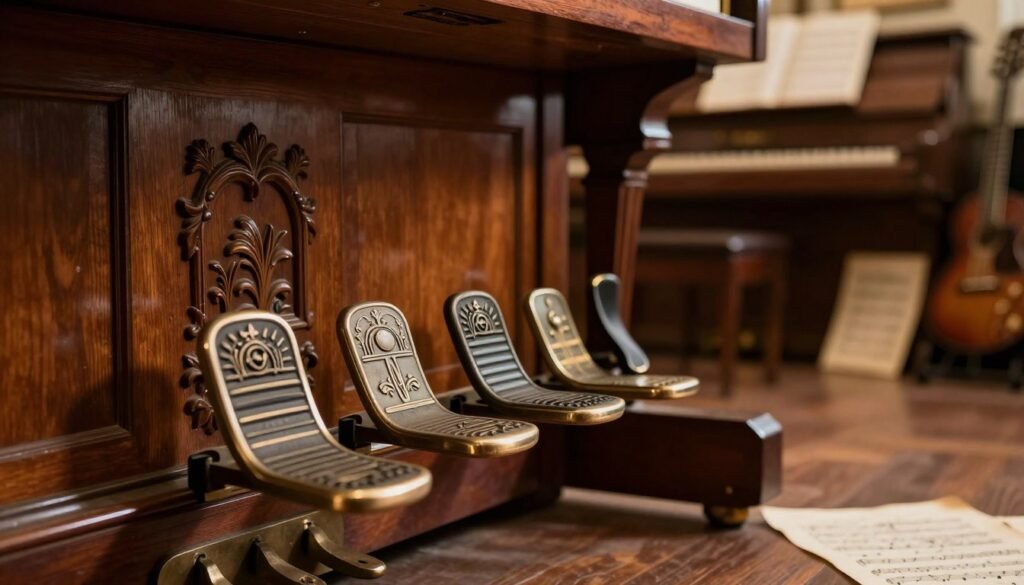
Early pianos used hand stops and knee levers to change sound without touch. Makers like Conrad Graf and Sébastien Érard introduced new layouts. Ludwig van Beethoven’s pianos sometimes had four or five pedals. Paul McNulty’s reproductions show how makers customized their instruments.
Novelties included Janissary effects with drums and bells. Composers like Wolfgang Amadeus Mozart used these sounds in pieces like Rondo alla Turca. Other pedals aimed for lute, buff, cembalo, moderator/celeste, or harmonic-swell effects. These added unique textures but were later seen as gimmicks.
| Item Name | Description | Calories | Price |
|---|---|---|---|
| Janissary Stop | Percussive bells and drum simulation for marchlike color | 0 | $1200 (restoration) |
| Lute/Moderator | Softens attack, simulates plucked timbre with felt or cloth | 0 | $450 (mod) |
| Buff Stop | Inserts leather or cloth to muffle strings for a muted tone | 0 | $380 (repair) |
| Aliquot/Blüthner | Sympathetic stringing that enriches overtones | 0 | $2,800 (historical upgrade) |
| Half-blow / Fourth Pedal | Reduces volume without shifting tone like una corda | 0 | $3,500 (factory on Fazioli F308) |
Blüthner’s aliquot stringing from 1873 added a sympathetic string group that changed resonance. This innovation remained influential for makers seeking richer harmonic color. Modern builders like Fazioli have brought back practical extra pedals. The Fazioli F308 has a fourth pedal that acts as a half‑blow, useful for less volume without the tonal shift of una corda.
Digital instruments map extra pedal inputs to nontraditional controls. You can assign modulation, pitch bend, or rotary speed to a pedal in a studio setup. Such flexibility makes novelty pedals practical again for sound designers who need real-time control over effects and dynamic nuance.
For performance, most players rely on standard grand piano pedals for expressive needs. Yet, specialty repertoire and recording sessions benefit from extra options. Knowing the role of historical piano pedals helps you make informed choices about instrument selection and technique.
Examples from piano history
- Graf and Érard offered distinct pedal mechanisms that influenced Romantic-era sound.
- Janissary stops supplied parade-like color in 18th-century salons and operas.
- Blüthner’s aliquot system enriched symphonic textures on solo pianos.
When modern extra pedals are useful
- Specialized repertoire that calls for distinct timbres beyond sustain, una corda, and sostenuto.
- Advanced dynamic control in concert halls where subtle volume change matters.
- Studio work where mapping extra pedals to synth parameters speeds creative workflow.
Understanding novelty pedals and historical piano pedals gives you a clearer view of how piano color evolved. This context informs choices about instruments, repertoire, and practice methods without demanding unnecessary changes to everyday technique.
How to learn pedal technique step-by-step
Start by listening carefully and setting small goals. First, practice sustain alone. Then, add the soft pedal. When you play more complex pieces, try using the sostenuto pedal.
| Item Name | Description | Calories | Price |
|---|---|---|---|
| Five-note scale drill | Play a simple five-note scale, press sustain after each chord, lift and reapply on harmony changes to cleanly separate sonorities. | 0 | $0 |
| Single-note melody with detached accompaniment | Sustain the melody while keeping the accompaniment staccato to learn selective pedal clearing. | 0 | $0 |
| Slow arpeggio half-pedal drill | On a grand, practice half-pedaling with slow arpeggios and listen for reduced blur between notes. | 0 | $0 |
| Hand-foot coordination offbeat release | Play a legato line while releasing the pedal on offbeats to avoid overlapping harmonies. | 0 | $0 |
| Una corda alternating passage | Alternate passages with and without soft pedal to compare color and to develop touch at pianissimo. | 0 | $0 |
| Sostenuto selective sustain | Hold a bass chord, engage sostenuto, then play independent upper-voice figurations to test selective support. | 0 | $0 |
| Recording comparison | Listen to recordings and match pedal timing, then try the same passage with your own pedaling choices. | 0 | $0 |
| App-guided timing | Use tools like flowkey or manufacturer lesson content for visual and aural models of release and half-pedal effects. | 0 | $0 |
| Teacher-led feedback | Work with a teacher to refine timing, tone control, and to tailor exercises to your repertoire. | 0 | $0 |
| Daily micro-practice | Short, focused sessions on a single pedal skill improve retention and listening accuracy. | 0 | $0 |
Beginner exercises for sustain control
Begin with simple drills on beginner piano pedals. Play a chord progression and press sustain after each note. Lift and reapply the pedal when the harmony changes. This helps you learn to hear when notes start to blend.
Try playing a single-note melody over detached chords. Keep the accompaniment crisp while the melody flows. These exercises improve timing and reduce your reliance on the pedal.
Intermediate exercises for half-pedaling and coordination
Half-pedaling is best practiced on a grand piano. Play slow arpeggios and lower the pedal partway. Listen for a decrease in blur and find the perfect spot to clear notes without losing resonance. Repeat this until you can find it easily.
Practice drills where hands play legato lines and the foot releases on offbeats. This helps avoid overlapping harmonies and improves foot independence. Mix these drills with scales and etudes to apply the skill to music.
Using the soft and sostenuto pedals in practice
Alternate passages with and without the soft pedal to hear the difference in color. Practice pianissimo scales with una corda engaged, focusing on touch. This strengthens finger control and musical judgment.
For sostenuto, hold a bass chord, engage sostenuto, and play independent upper-voice figurations. This shows selective sustain and how the middle pedal supports texture in Debussy and Ravel’s works.
Consult recordings and a qualified teacher to refine timing. Apps like flowkey and some manufacturer content offer good models for pedal timing and half-pedaling effects. Regular practice will make mastering pedal technique a reliable part of your playing.
Reading pedal notation and applying it musically
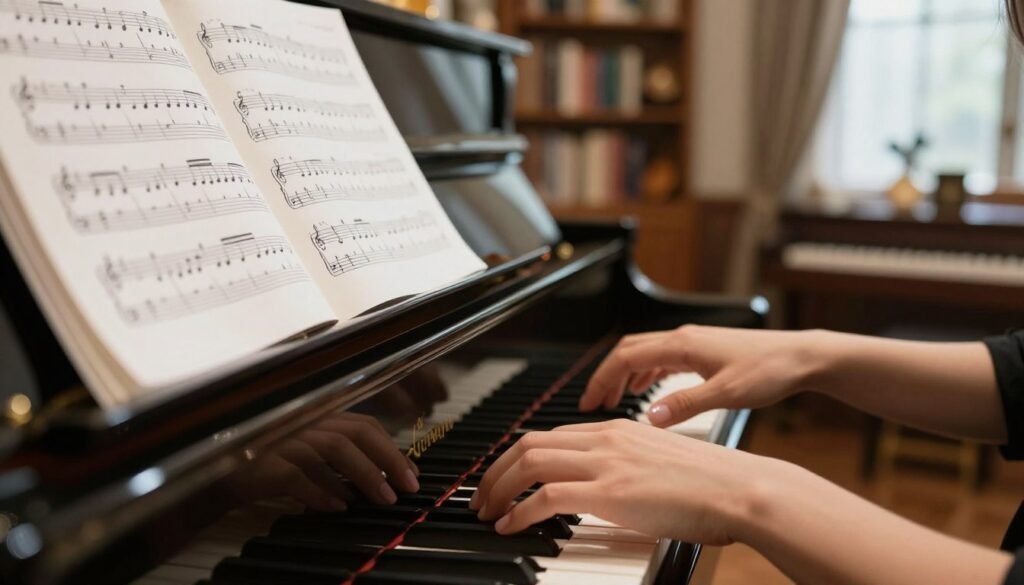
Pedal markings in a score guide your choices about sustain, color, and texture. When reading pedal notation, treat printed signs as informed suggestions. Test each marking on your instrument and in the room where you will perform.
Common symbols and their meanings
| Item Name | Description | Calories | Price |
|---|---|---|---|
| Sustain / Damper | Often marked “Ped.” for down with an asterisk or vertical bracket for release. Long lines may show extended holding. | 0 | $0 |
| Sostenuto | Marked “Sost. Ped.” and released with an asterisk or special release mark. Holds selected notes only. | 0 | $0 |
| Soft / Una Corda | Labeled “una corda” and released with “tre corde.” Changes timbre and reduces volume. | 0 | $0 |
| Brackets and Lines | Horizontal lines or angled brackets show when to depress and lift the pedal; spacing indicates timing. | 0 | $0 |
| Editorial Marks | Publishers sometimes add “Ped.” or release signs. Use them as a starting point after auditioning. | 0 | $0 |
Practical tips for applying markings
Start by following the pedal markings. Listen for clarity in bass and inner voices. If chords blur, shorten the pedal or use half-pedaling to clean the texture.
Adjust pedaling based on the piano’s sustain and the room’s acoustics. A conservatory grand like a Steinway reacts differently than an 1820 fortepiano. Use the score as a roadmap. Mark your own pedal choices after testing what works.
Historical notation pitfalls
Composers like Beethoven and Chopin wrote for instruments with quicker decay. Literal use of their pedal markings on a modern concert grand may cause muddiness. Treat older scores with caution and adapt by ear.
Some editions leave pedaling blank on purpose, trusting performers to decide. In those cases, base choices on phrasing and dynamic contrasts. Don’t add pedal just because the page is empty.
Final approach
Use reading pedal notation as a flexible guide. Balance the written pedal markings with your ear, the instrument’s response, and the acoustic environment. Make small, clear pencil marks in your score so you can reproduce successful choices.
Conclusion
Pedals are key for changing the sound, sustain, and color of the piano. Knowing how to use them is important. The right pedal, the right time: the right pedal makes sounds blend together smoothly. The left pedal changes the sound’s quality and volume.
The middle pedal or other options can mute certain notes. This keeps the sound clear and not mixed up. It’s all about using the pedals wisely.
Start by using the sustain pedal carefully and listen a lot. Play simple songs with different pedal uses to see how it affects the sound. As you get better, try soft and sostenuto techniques.
Make sure you know how your piano’s middle pedal works. Knowing about different pedals helps you choose the right music and practice methods.
Listen to recordings and get tips from a teacher to improve. With time and practice, using pedals becomes natural. It lets you express yourself more in music without hiding your skills.